
Recent Posts

News•Feb 27, 2026
Pentagon Pick to Lead Homeland Defense Policy Grilled over Election Security
The Senate Armed Services Committee interrogated Mark Ditlevson, the White House’s nominee for Assistant Secretary of Defense for Homeland Defense, about the prospect of deploying National Guard troops to polling places. Ditlevson sidestepped a yes‑or‑no answer, citing legal constraints and the need for a thorough threat analysis. Lawmakers expressed alarm that federal forces could intimidate voters or breach statutes that limit Guard involvement in elections. The hearing coincides with a White House push for an executive order to “nationalize” elections and recent controversial Guard deployments under former President Trump.
By Defense One
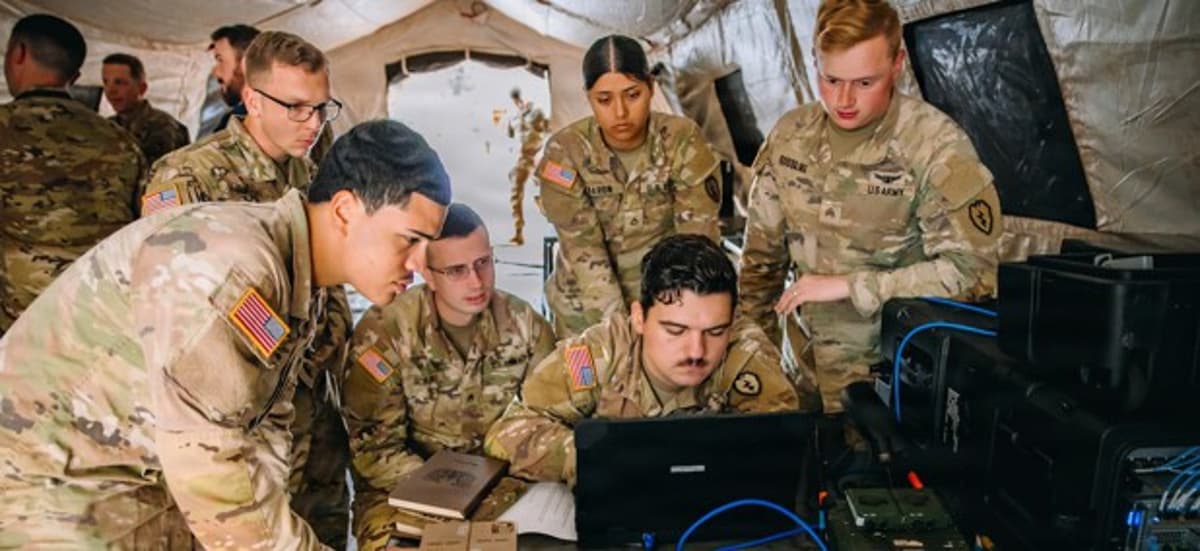
News•Feb 26, 2026
25th ID Helping the Army Smooth Out the Wrinkles in Its Next-Generation C2
The U.S. Army’s Next Generation Command and Control (NGC2) platform is being refined through the 25th Infantry Division’s Lightning Surge exercises, which expose data‑overload issues across siloed battlefield systems. A joint effort by Lockheed Martin and Palantir delivered an application that...
By Defense One

News•Feb 25, 2026
Several Trends Are Shifting Defense Tech Toward Europe
U.S. defense and tech giants are confronting a shifting landscape as Europe pursues digital sovereignty, strategic autonomy, and faster defense innovation spurred by the Ukraine war. New EU rules like the Digital Networks Act and Data Act compel American cloud...
By Defense One

News•Feb 25, 2026
Trump Repeats Claims to Have ‘Obliterated’ Iran’s Nuke Program, Ended ‘8 Wars’
President Donald Trump used his State of the Union address to repeat unverified claims that a June 2025 strike "obliterated" Iran’s nuclear program and that his interventions ended eight wars, including a cease‑fire between Thailand and Cambodia. He also asserted...
By Defense One

News•Feb 24, 2026
Air Force Test Pilots Used Tactical AI to Evade a Missile
Air Force test pilots used tactical AI on a Lockheed X‑62A Vista to autonomously evade a simulated surface‑to‑air missile, demonstrating rapid threat response without pilot input. The experiment, dubbed “Have Remy,” was disclosed by Skunk Works at the Air and...
By Defense One

News•Feb 24, 2026
Pentagon’s Spending Plan Doubles Down on Land, Air, Sea Robots
The Pentagon’s unclassified spending strategy for the $151 billion One Big Beautiful Bill mandates rapid deployment of funds through 2029. It earmarks $24.4 billion for missile‑defense, including hypersonic and space‑based interceptors, while boosting the Defense Innovation Unit’s budget to $2 billion for autonomous...
By Defense One

News•Feb 23, 2026
Replacement B-52 Test Engine Deliveries Expected in 2027
Rolls Royce confirmed that its upgraded F130 test engines for the B‑52 Stratofortress will be delivered in 2027 following successful altitude and operability testing. The engines, which replace the aging Pratt & Whitney TF33‑PW‑103 powerplants, completed trials at the Air...
By Defense One

News•Feb 23, 2026
An MQ-20 Drone Just Teamed up with an F-22 for Mock Combat Missions
General Atomics demonstrated its MQ-20 drone operating under direct orders from an F‑22 pilot at Edwards Air Force Base, using Autonodyne’s Bashi pilot‑vehicle interface. The test showed the drone executing tactical maneuvers, waypoint changes, combat patrols and threat‑engagement tasks autonomously....
By Defense One

News•Feb 21, 2026
New Army Office Aims to Quickly Develop and Scale Soldier Ideas
The U.S. Army has launched the Pathway for Innovation and Technology (PIT), a new office that fuses soldier‑driven ideas with rapid‑acquisition mechanisms. PIT sits alongside the FUZE program, Joint Innovation Outpost and Global Tactical Edge Directorate, giving innovators a direct...
By Defense One

News•Feb 19, 2026
Cyber Responses Will Be ‘Linked to Adversary Actions,’ Involve Industry: White House
The White House announced that future U.S. cyber responses will be directly linked to specific adversary actions and will involve close coordination with state and local governments as well as private‑sector operators of critical infrastructure. The approach will be codified...
By Defense One

News•Feb 19, 2026
Boeing Moves Its Defense HQ Back to St. Louis
Boeing announced it will move the headquarters of its Defense, Space & Security division from Arlington, Virginia back to St. Louis, Missouri, ending a nine‑year stint on the East Coast. The relocation positions senior leaders alongside roughly 18,000 employees at...
By Defense One

News•Feb 18, 2026
The D Brief: Sentinel’s Progress; Buildup Near Iran; Canada’s Decoupling Plan; Russia Targets Ukrainian Energy; And a Bit More.
The Air Force announced that the Sentinel ICBM program will enter engineering and manufacturing development this year, targeting an initial deployment in early 2030 after a recent schedule acceleration. Meanwhile, the Pentagon opened a competition for voice‑controlled drone swarms, drawing...
By Defense One

News•Feb 13, 2026
CNO: ‘I Need My Stuff on Time’
At the WEST Conference, Navy CNO Adm. Daryl Caudle and Marine Corps Commandant Gen. Eric Smith warned defense contractors that on‑time delivery is non‑negotiable. Both chiefs highlighted how single‑year appropriations and erratic funding cripple shipyard planning and workforce stability. They...
By Defense One

News•Feb 12, 2026
Men Lie, Strategies Lie—Numbers Don’t
The 2026 National Defense Strategy (NDS) uses word‑frequency analysis to reveal a dramatic shift in priorities and tone compared with the 2018 and 2022 versions. Allies are mentioned 61 times, over half in a demanding or derogatory context, while President...
By Defense One

News•Feb 12, 2026
US-NATO Exercise Rehearses Taking Out 1,500 Targets a Day to ‘Overwhelm’ an Enemy
The U.S. Army and NATO allies showcased the Dynamic Front exercise, targeting the ability to intercept 600‑1,200 ballistic missiles and engage 1,500 targets within 24 hours. Brig. Gen. Stephen Carpenter emphasized creating an overwhelming, unrelenting response to any peer aggression...
By Defense One