
Inside Agoda’s Strategic Push to Reclaim Workplace Chemistry and Human Judgment From the Digital Void
Agoda has consolidated roughly 4,000 staff into a 26,000‑square‑metre One Bangkok campus, signaling a shift from its remote‑first posture toward in‑person collaboration. Chief Organisation and People Officer Paolo Inga argues that spontaneous hallway interactions are essential for trust, creativity and wellbeing, especially in a culturally diverse workforce. At the same time, more than 70% of employees now rely on generative AI tools, with HR using the technology to automate screening and administrative tasks while keeping cultural decisions firmly human. The move mirrors a broader APAC trend, where 42% of firms plan to expand office space over the next three years.

How the Search for Purpose Is Rewriting the Social Contract Between Employer and Employee
The latest AsiaHRM Sustainability in Business episode highlighted purpose, connection and continuous learning as the new pillars of talent strategy. Speakers Vivian Seo and Vincent Chen argued that purpose now rivals compensation as a key differentiator for attracting and retaining...

When Success Turns Hollow: Why HR Must Pay Attention to Leaders’ Internal Alignment
Nancy Ho warns that leaders’ internal misalignment—coined “hollow success”—is a hidden threat to organisations. While teams see steady output, leaders feel disconnected from purpose, leading to subtle behavioural shifts. HR traditionally tracks external wellbeing programs, but Ho argues the real...
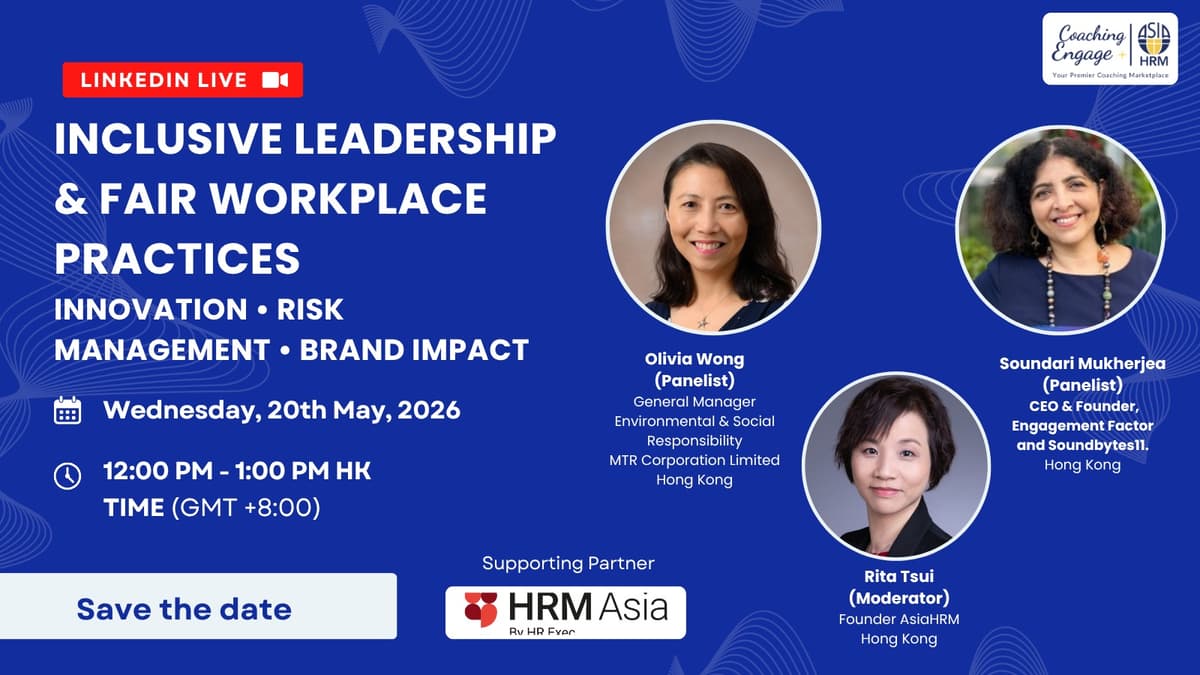
Beyond the Buzzword: What Inclusive Leadership Actually Looks Like in Practice
AsiaHRM’s LinkedIn Live on inclusive leadership reframed inclusion as a core capability, risk‑management tool, and brand differentiator. Panelists emphasized psychological safety for dissent, arguing that true inclusion means employees can respectfully disagree without fear. They illustrated how diverse, multigenerational teams...

CEO Appointments in Asia-Pacific Hit Five-Year High as Boards Double Down on Experience
CEO appointments in Asia‑Pacific surged to a five‑year high in Q1 2026, with 26 of the 77 global hires coming from the region—a 73% jump over the same period last year. Boards leaned heavily on internal pipelines, filling 73% of...

Day 2 of HR Tech Asia 2026: Purpose, People Data, and the Human Side of AI Transformation
Day Two of HR Tech Asia 2026 highlighted that technology alone won’t drive workforce change; the focus shifted to purpose, people data, and AI governance. UOB’s Dean Tong showcased a purpose‑driven reskilling programme with an 80% success rate and a...

CHRO Malaysia 2026: Elevating the HR Function to the Heart of Business Strategy
The CHRO Malaysia 2026 conference will take place June 23‑25 in Kuala Lumpur, focusing on embedding HR at the core of business strategy. Organized by HRM Asia, the event features a main conference and two hands‑on workshops covering data analytics...

The Shadow AI Problem HR Leaders Can No Longer Ignore
Lenovo’s Work Reborn Report, based on a survey of 6,000 employees, reveals that more than 70% of workers use AI weekly, with up to one‑third doing so outside IT oversight. The study labels the rapid, unsupervised adoption an “AI execution...

HR Tech Asia Awards 2026: Celebrating Innovation, Inclusion, and the Future of Work in Asia
The HR Tech Asia Awards 2026 recognized leading HR innovators across the region. The ceremony in Singapore saw Changi Airport Group and Cambridge University Press & Assessment Philippines each win three categories, highlighting culture, wellbeing, diversity, talent retention, and hybrid...

The Benefits Are There. So Why Aren’t Employees Using Them?
Asian firms have expanded mental‑health benefit portfolios, yet utilization remains low. Howden’s 2026 report shows that of the 38% of employees who sought treatment, only 28% used employer‑provided benefits, while 18% feel uncomfortable accessing them. Dr. Maria S. Suva attributes...

Two-Thirds of Gen Z Talent in Singapore Question Employers’ Readiness to Hire Them
A Robert Walters study finds that 67% of Gen Z professionals in Singapore doubt employers are prepared to hire and support them, while 70% of firms claim openness to hiring the cohort. Employer hesitancy peaks at 4%, the highest in...

The Future of Digital Work Takes Shape at HR Tech Asia 2026
HR Tech Asia 2026’s Worktech & AI track turned speculation into practice, gathering senior HR leaders in Singapore on May 5‑6 to discuss real‑world AI integration. Sessions ranged from rethinking KPI‑driven performance to embedding AI agents as collaborative teammates, and from...

The Broken Rung: Why Thailand’s Boardrooms Are Missing Half Their Talent
Thailand’s boardrooms remain starkly male‑dominated, with women occupying just 19% of seats despite rapid digitalisation and value‑chain upgrades. Research by Kearney and Egon Zehnder shows the bottleneck isn’t entry‑level talent but a “broken rung” that stalls high‑performing women between management...

Growing Together: Why Offices in Singapore Are Farming Their Way to Better Culture
Singapore‑based Grobrix is installing subscription‑managed, soil‑free indoor farms in office spaces, turning walls into edible green hubs. A survey of over 500 employees showed 93% felt stronger community and 97% reported a heightened sustainability mindset. The service tackles return‑to‑office disengagement...
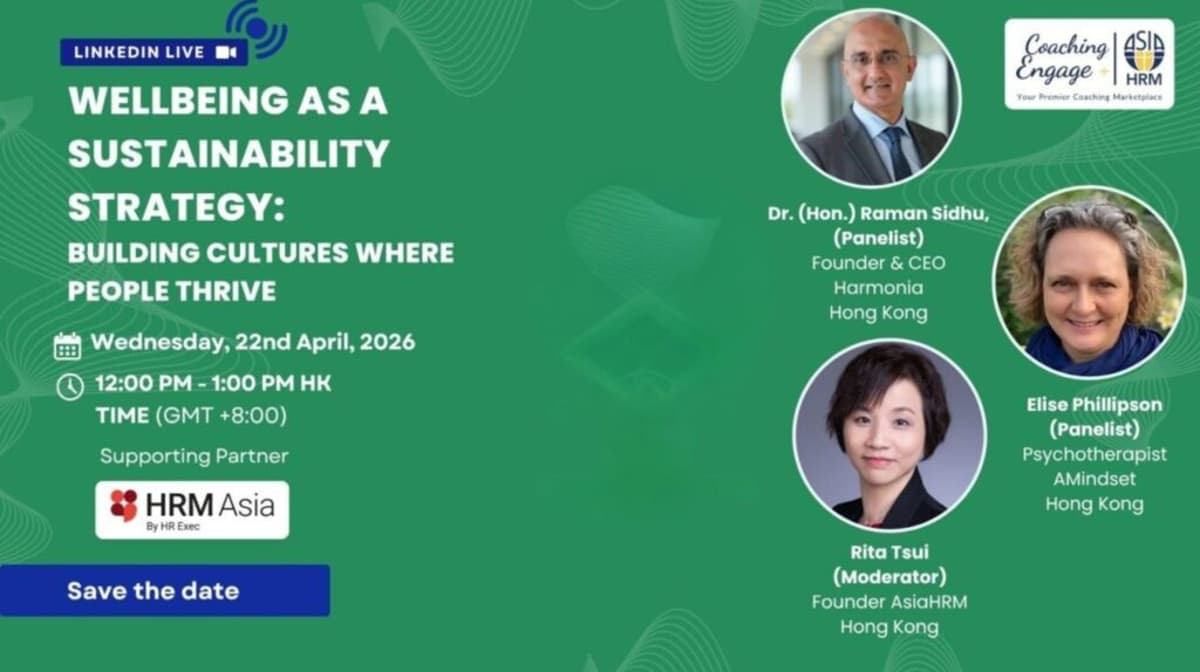
People First, the Profits: The Case for Wellbeing as Strategy
At AsiaHRM’s Sustainability in Business Series, experts highlighted employee wellbeing as a strategic sustainability pillar rather than a peripheral perk. They argued that psychological safety is the prerequisite for autonomy, creativity, and collaboration, which in turn drive productivity and profit....