
Vast Fields of Biologically Active Chemical Space
A new open‑access J. Med. Chem. paper compares hits from a 1.6 billion‑compound make‑on‑demand (MoD) library and a 3.5 million‑compound in‑stock library screened against the 5‑HT2A serotonin receptor. Both libraries delivered a comparable ~24% hit rate, and functional assays showed a mix of agonists and antagonists. When evaluated across 318 GPCRs, the MoD compounds were marginally more promiscuous (2.1% vs 1.7% binding), despite being far less “bio‑like.” The findings challenge the notion that only metabolite‑like molecules are biologically relevant.
From Covalent to Noncovalent 14-3-3 Modulator, Unintentionally
Researchers at the University of Leicester discovered that an acrylamide‑based compound (compound 7) dramatically improves the binding affinity between estrogen‑receptor‑alpha and 14‑3‑3σ, shifting the K_D from 206 nM to 2.8 nM. Unlike the previously studied covalent warhead WR‑1065, compound 7 does not form a...
Fragments in the Clinic: VVD-214
Vividion’s covalent WRN inhibitor VVD‑214 evolved from a vinyl‑sulfone fragment hit (compound 1a) to a clinically viable candidate through a series of empirical SAR steps. Introducing a methyl group (2a) boosted stability and sub‑micromolar cellular potency, while a tert‑butyl cyclopentyl...
Noncovalent Fragments vs WRN
Researchers at Merck and Proteros reported a noncovalent fragment‑based campaign against the Werner syndrome helicase (WRN), a synthetic‑lethal cancer target. Using a 1,020‑compound fluorine‑fragment library screened by 19F‑NMR and a separate 500‑compound SPR screen, they identified seven primary hits, three...
(Not) Getting Misled by Crystal Structures Part 6: Low Ligand Occupancies
A recent study re‑refined roughly 10,000 protein‑ligand structures from the PDB and found that while only 10% originally reported ligand occupancies at or below 0.9, re‑refinement raised that figure to 35%. Fragment‑sized ligands (<300 Da) were especially prone to occupancy loss,...
Fragments vs DsbA: Towards a Chemical Probe
Researchers targeting the bacterial oxidoreductase DsbA—a key virulence factor—have advanced fragment‑based efforts toward a chemical probe. Initial screens identified fragments binding a shallow groove and a hidden cryptic pocket, but affinities were modest (~150 µM). By designing molecules that extend beyond...

Fragments vs the E3 Ligase KLHL12
Researchers at Vanderbilt screened 13,824 fragments against the E3 ligase KLHL12, a protein overexpressed in many cancers but absent from heart tissue. The campaign yielded 35 initial hits, with compound 7k emerging as the most potent, displaying sub‑micromolar affinity in...
From Noncovalent Fragment to (Non)covalent Leads Against PLPro
Researchers at Vanderbilt have leveraged a protein‑observed NMR fragment screen to revive interest in SARS‑CoV‑2 papain‑like protease (PLPro), an essential viral enzyme with few existing inhibitors. From 13,824 fragments, 77 hits were confirmed, leading to a non‑covalent series that progressed...
Malicious Metals Muddy Fragment-to-Lead Optimization
Researchers at the Cleveland Clinic pursued fragment‑based inhibitors of SARS‑CoV‑2 NSP14, a viral exonuclease essential for replication and immune evasion. Initial crystal‑guided merges appeared active in a biochemical assay, prompting optimism about fragment linking. Subsequent resynthesis and rigorous purification revealed...
Selectivity in Cells May Vary
The Chemical Probes Portal’s >30‑fold selectivity rule, originally based on cell‑free assays, is challenged by a new open‑access J. Med. Chem. study comparing DiscoverX kinase panels with NanoBRET cellular profiling. Researchers found that most inhibitors appear less potent in living...
Best Practices for Applying HDX-MS to FBLD
A recent open‑access study demonstrates that hydrogen‑deuterium exchange mass spectrometry (HDX‑MS) can reliably map binding sites of extremely weak fragment hits (up to 7 mM KD) against Cyclophilin D. By optimizing protein concentration at 10 µM and testing fragments at 2.5‑10 mM, the...
3D Fragments vs the Histamine H1 Receptor
Researchers at Vrije Universiteit Amsterdam built an 80‑compound, three‑dimensional fragment library and screened it against the histamine H1 receptor. Only one fragment (1a) showed activity, but iterative optimization yielded the low‑nanomolar antagonist VUF26691 with picomolar cellular potency. The campaign required...

Multivalent Fragments in the Clinic: Muvalaplin
Researchers at Eli Lilly and Monash University have advanced a multivalent fragment, muvalaplin (LY3473329), to target the Kringle IV‑8 domain of apolipoprotein(a). The trimeric molecule binds three copies of KIV8, achieving picomolar inhibition of Lp(a) assembly in vitro and lowering...
XSAR: Crystallographic SAR From Crude Reactions
Researchers at Diamond Light Source and the University of Oxford introduced xSAR, a quantitative crystallographic SAR approach that converts fragments into Morgan fingerprint bits to calculate Positive and Negative Binding Scores (PBS/NBS). Applying PBS to 957 crude‑reaction fragments recovered 23...
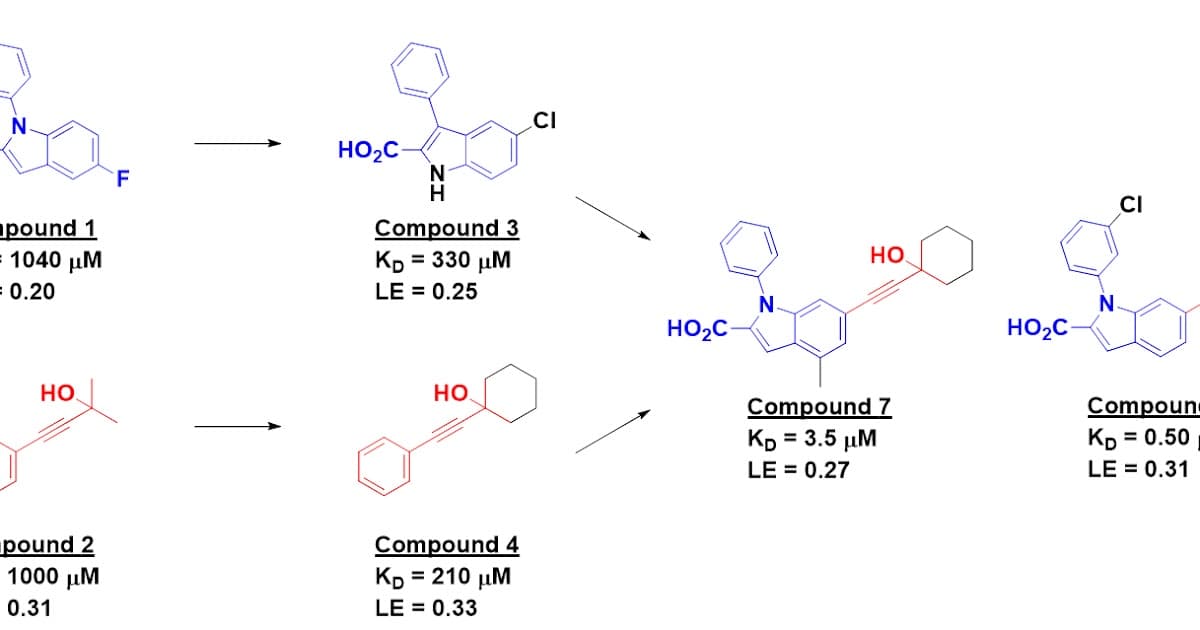
Fragment Merging – and Flipping – on the Leucine Zipper of MITF
Researchers at Novartis used 19F NMR to screen the DNA‑binding domain of the microphthalmia‑associated transcription factor (MITF), a leucine‑zipper protein implicated in melanoma. Only nine fragments emerged from the LEF4000 library, reflecting the target’s difficulty. Two series were merged, yielding...