
Stop Prompting. Design the Loop.
The article argues that developers should move beyond manual prompt engineering and adopt "loop engineering," where automated loops continuously prompt AI coding agents. Loop engineering consists of five building blocks—automations, worktrees, skills, connectors, and sub‑agents—plus persistent memory to track state. Verification oracles such as tests and CI pipelines are essential to keep loops honest, while token and memory consumption become hidden costs. The piece offers a step‑by‑step guide to start building trustworthy loops, especially for CI triage and infrastructure tasks.
Build an EKS Environment Factory with Pulumi and vCluster
Deloitte cut testing environment provisioning time by 89% using a virtual‑cluster model on Amazon EKS, consolidating dozens of clusters into a single host cluster with over 50 vCluster instances. The case study reports roughly 500 QA hours saved annually. Pulumi’s...
Five Stacks Before Lunch: The Parallel Coding Playbook for Pulumi
Pulumi’s new parallel‑coding playbook lets five AI agents work on separate infrastructure issues simultaneously by treating each GitHub issue as a deterministic spec, using Pulumi component contracts and CrossGuard policies. The workflow isolates agents in individual review stacks, leverages git...
Why Choose Pulumi Over Terraform?
Pulumi positions itself as a developer‑centric alternative to Terraform, letting teams write infrastructure as code in mainstream languages such as TypeScript, Python, Go, C#, Java, or YAML. It adds first‑class features like aliases for safe refactoring, built‑in secret encryption, and...
Generating a Pulumi Provider From an OpenAPI Spec
Pulumi announced v1.0 of its Service Provider, now generated directly from the Pulumi Cloud OpenAPI specification. The new provider unlocks a broad "api/*" resource surface, delivering fine‑grained RBAC, IDP, and audit‑log export as code without bespoke provider development. Because the...
Stop Tuning Prompts. Build a Harness.
Anthropic’s Claude Code relies less on a static code index and more on a surrounding "harness" that supplies context, tooling, and governance. The harness consists of a lean root CLAUDE.md file, layered sub‑directory CLAUDE.md files, session hooks, path‑scoped skills, LSP/MCP...
Introducing Pulumi Do: Direct Resource Operations for Any Cloud
Pulumi announced a new CLI command, pulumi do, that lets users create, read, update, delete, and query any cloud resource directly from the terminal without a project, code, or state. The command works across all Pulumi‑supported providers, using the same provider...
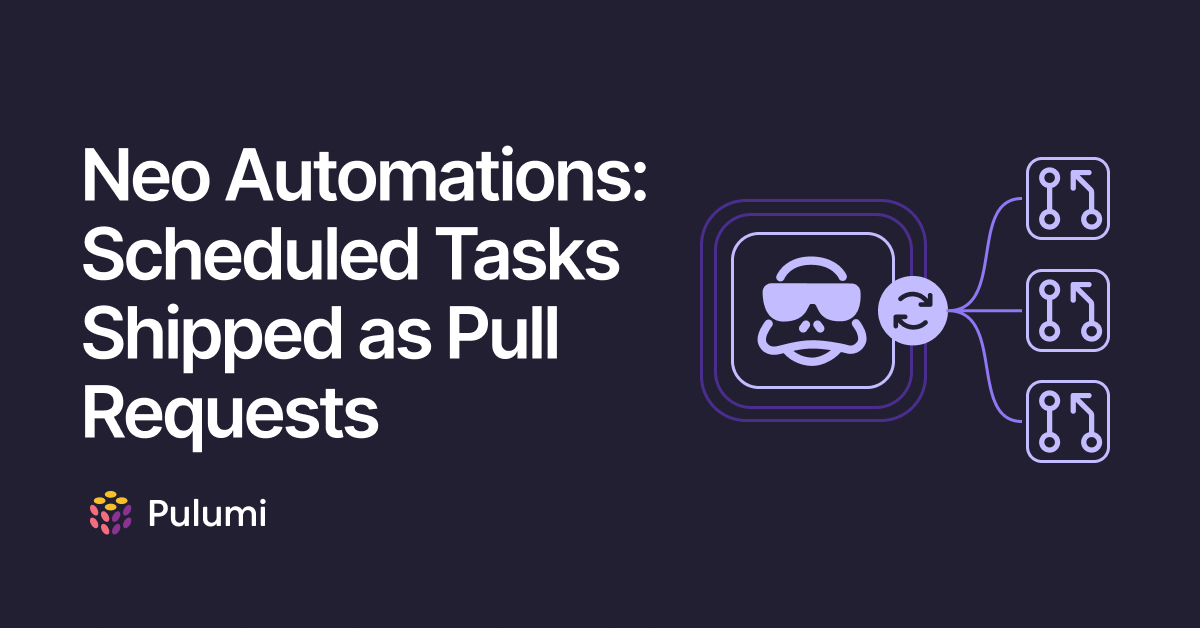
Neo Automations: Scheduled Tasks Shipped as Pull Requests
Pulumi Neo now lets teams schedule infrastructure tasks that automatically run on a chosen cadence and open pull requests with any required changes. The feature includes four ready‑made templates—provider freshness, encryption audit, backup audit, and activity digest—and supports hourly to...
Neo, Now in the Terminal
Pulumi has extended its Neo AI assistant from the cloud console to the developer terminal with the new `pulumi neo` command. The CLI inherits the user’s existing Pulumi login, kubeconfig, environment variables and project files, allowing Neo to operate against...
The Agentic Infrastructure Era
Pulumi announced a suite of new platform features designed to make infrastructure management fully agentic. By leveraging infrastructure-as-code in familiar languages, the company reports that LLM‑driven agents now handle about 20% of deployments, with a goal of exceeding 50% by...
How Building AI Agents Has Changed in 2026
In 2026 building AI agents has shifted from heavyweight framework‑glue code to SDK‑first approaches. Built‑in toolkits from Claude and OpenAI, a skills system, and longer context windows have eliminated the middle layer of infrastructure. Teams now focus on system prompts,...
The Dark Factory Pattern for Infrastructure: Running Pulumi Lights-Out
The article adapts the "dark factory" concept—fully autonomous code generation and deployment—to infrastructure as code, focusing on Pulumi. It outlines a five‑level autonomy ladder, emphasizing that level 5 (dark factory) requires a strict separation between code generators and validators. Pulumi’s Automation...
Connect Any Git or Mercurial Repo to Pulumi with Custom VCS
Pulumi announced Custom VCS, a new Cloud integration that links any Git or Mercurial repository to Pulumi Deployments via webhooks and centrally stored credentials. The feature adds org‑level configuration, eliminating the need to embed secrets in each stack and enabling...

Neo's Integration Catalog: Give Your Agent Access to the Tools It Needs
Pulumi announced the launch of the Neo Integration Catalog, a centralized hub that connects Pulumi Neo to six major DevOps tools—Atlassian, Datadog, Honeycomb, Linear, PagerDuty and Supabase—via the Model Context Protocol. Administrators configure API credentials once, and the encrypted tokens...
Policy Packs Can Now Access Pulumi ESC Environments
Pulumi announced that its policy packs can now reference Pulumi ESC environments, bringing centralized secret and configuration management to policy execution. This integration lets policies pull API tokens, cost thresholds, and other parameters directly from ESC at runtime, mirroring how...