
SparkToro Blog
Marketing insights blog (by SparkToro) delivering data-driven analysis on SEO, search marketing, and audience trends that affect online brands. Co-founder Rand Fishkin (of Moz fame) and team share research and thought leadership pieces that help e-commerce marketers understand consumer behavior and web traffic patterns

Office Hours: Can You Actually Track AI Visibility?
SparkToro’s Office Hours session on March 11, 2026 examined whether brands can be tracked in AI‑driven answer engines. Partnering with Gumshoe.ai, the team ran hundreds of prompts across ChatGPT, Claude, Gemini and Google AI Mode, finding that single‑question rankings are highly unstable. Instead, they propose measuring “visibility percentage” across many prompts, which proved more consistent and actionable. The research suggests marketers should focus on consistent brand language and PR rather than chasing one‑off AI screenshots.
The Death of the Ultimate Guide?
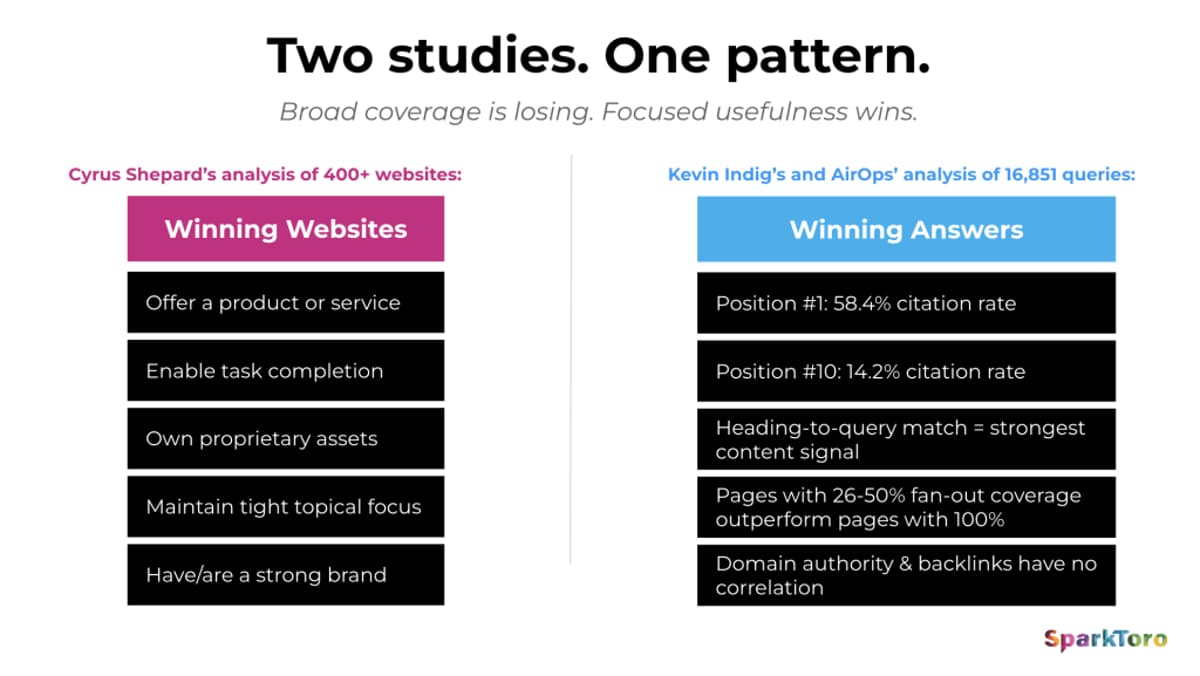
Recent research from Cyrus Shepard and Kevin Indig shows that the era of the “ultimate guide” is waning. Google’s top‑performing sites now share five traits—product or service offering, task completion, proprietary assets, tight topical focus, and strong brand. In parallel,...

Office Hours: B2B Storytelling: How to Make Your Brand Their Favorite
SparkToro’s Office Hours webinar with Jay Acunzo revisits a core B2B truth: audiences choose brands they feel connected to, not the objectively best. The session argues that today’s AI‑driven, content‑saturated landscape makes resonance more critical than sheer volume. Acunzo offers...

5 Strategic Features that Predict Survival in the Zero-Click Era
The rise of the zero‑click era has forced publishers to rethink their business models as Google and AI increasingly answer queries without directing users to external sites. An analysis of 400 websites that survived the 2024‑2026 traffic collapse identified five...

NEW Upgraded Keyword Data in SparkToro’s Audience Research Reports
SparkToro announced upgraded keyword data in its audience research reports, shifting focus from sheer comprehensiveness to relevance. The new system surfaces higher‑intent search terms while automatically filtering out off‑topic queries across verticals such as modern lighting design, Costa Rica travel, and...

New Research: Influence Happens Everywhere, an Analysis of the 5,000 Most-Visited Sites on the Mobile and Desktop Web
SparkToro partnered with Similarweb to analyze click‑stream data from the 5,000 most‑visited mobile and desktop websites in January 2026. The study found that search sites capture 24.12% of global visits, while social (18.55%) and news (8.36%) together account for roughly a...

Why LinkedIn Might Have Two Algorithms — and Why Marketers Should Care
A recent analysis by Christopher Penn suggests LinkedIn runs two distinct algorithmic systems: a retrieval stage that decides whether a post enters a viewer’s candidate pool, and a ranking stage that orders those candidates in the feed. Retrieval relies on signals...

NEW in SparkToro: Uncover the AI Prompt Topics Your Audience Is Using in ChatGPT, Google AI Mode, Claude, and More
SparkToro has launched a new feature that reveals the AI prompt topics audiences use across platforms like ChatGPT, Google AI Mode, and Claude. The tool pairs known search keywords with audience data, runs them through large language models, and returns...

Best Practices Are Meaningless Without Audience Research
The article argues that generic best practices produce mediocre marketing results unless they are informed by audience research. It explains that understanding the specific audience’s preferences, language, and hang‑out places transforms bland tactics into resonant campaigns. Practical methods such as...

How to Overcome the “Link in Comments” Problem on LinkedIn and Other Social Platforms
Marketers increasingly hide URLs in LinkedIn comments to avoid algorithmic demotion, but the platform now suppresses link‑laden comments as well. The authors propose three workarounds: using implied links in the post copy, posting curiosity‑driven “hidden” comments that hint at additional...