The Death of the Ultimate Guide?

Why It Matters
The shift threatens traditional SEO tactics that rely on exhaustive content, urging businesses to build unique utility and brand relevance to stay visible in both search and AI‑driven answers.
Key Takeaways
- •Google rewards sites with products, services, or proprietary assets.
- •Tight topical focus and strong brand boost search resilience.
- •ChatGPT cites pages that match the query headline precisely.
- •Broad, commodity content loses defensibility across search and AI.
Pulse Analysis
For years, the SEO playbook championed the “ultimate guide” – a single, exhaustive page that answered every possible question on a topic. That formula aligned with Google’s early ranking signals, which prized depth and keyword saturation. However, the rise of AI‑driven retrieval and the maturation of Google’s algorithm have exposed the limits of breadth. Modern search engines now prioritize content that cannot be easily replicated by a language model, rewarding sites that deliver tangible outcomes, own unique assets, and command a clear brand identity.
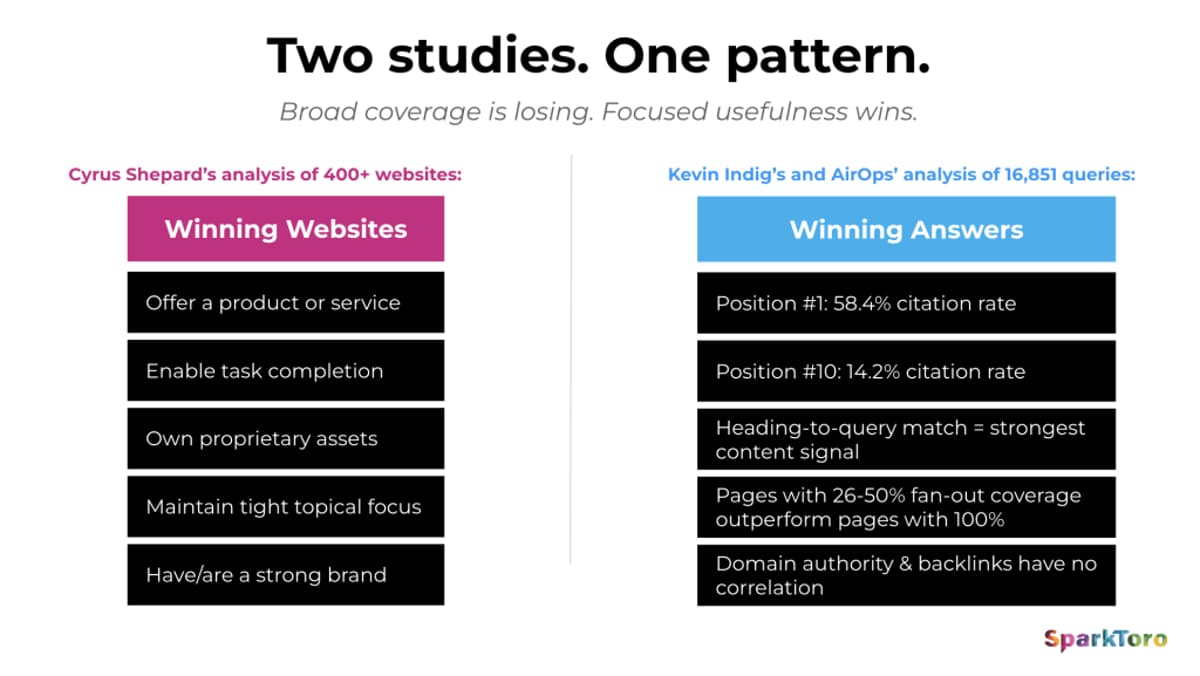
Cyrus Shepard’s analysis of more than 400 websites confirms the shift. Sites that sell a product, enable task completion, host proprietary tools, stay narrowly focused, or enjoy strong brand recognition see win rates up to 70 %, compared with a 13 % baseline for sites lacking these traits. The data suggests that merely publishing well‑written articles is insufficient; businesses must embed functional value into their digital properties. Companies like Dermstore succeed because the visitor can both research and purchase in one place, turning traffic into a defensible revenue channel.
Kevin Indig’s AirOps study of ChatGPT’s citation pipeline reinforces the relevance argument. Pages that mirror the user’s exact query headline capture a 58 % citation rate when positioned first, while broader pages covering many sub‑topics fall behind. Notably, domain authority and backlink volume showed little correlation, indicating that relevance outweighs traditional SEO metrics in AI contexts. Marketers should therefore restructure large guides into focused, query‑specific assets, enrich them with proprietary data, and align site architecture to surface the most relevant result at the top of retrieval lists.
The Death of the Ultimate Guide?
Comments
Want to join the conversation?
Loading comments...