
Best Of: The Future of Computer-Aided Education
In this episode of Stanford’s The Future of Everything, host Russ Altman revisits a conversation with Stanford computer‑science professor Chris Piech about how artificial intelligence is reshaping education. Piech stresses that AI is not a substitute for teachers but a partner that can amplify instructional effectiveness and student motivation, especially in coding and broader learning contexts. Piech outlines several concrete findings: relationship‑driven teaching remains paramount, yet near‑peer mentors who are only a few weeks ahead can lift completion rates by roughly ten percent. Large‑scale experiments—10,000 students paired with 1,000 trained amateurs—show that brief, AI‑enhanced one‑on‑one sessions dramatically improve outcomes. Generative models such as GPT‑4 now write code as fluently as prose, turning programming into a more joyful, rapid creative process for both novices and professionals. He illustrates his points with vivid anecdotes: a three‑year‑old co‑authoring a picture book using a language model, and the mantra that teachers need only be “an hour ahead” of their class. The A/B trials comparing early GPT‑4 access and traditional instruction reveal measurable gains, while the near‑peer tutoring experiment demonstrates a 15‑minute interaction can boost material completion by ten percentage points. The broader implication is clear: AI tools will democratize teaching talent, allowing enthusiastic amateurs to serve as effective mentors and freeing educators to focus on higher‑order guidance. As coding becomes a universal skill, integrating AI‑assisted tutoring promises to accelerate workforce retraining, improve K‑12 engagement, and reshape the economics of large‑scale education.
The Future of Farming
In this Stanford Engineering "Future of Everything" episode, host Russ Altman talks with Stanford professor David Lobell about how modern data science is reshaping agriculture. Lobell explains that his team uses satellite imagery, sensors and causal‑inference models to monitor roughly...
The Future of Fungi
The Stanford Engineering podcast explores the emerging frontier of fungi, hosted by Russ Altman and featuring bioengineer‑chef Vayu Hill‑Maini. Hill‑Maini argues that mushrooms and molds are poised to become a cornerstone of future food, pharmaceuticals, and novel materials, leveraging their...
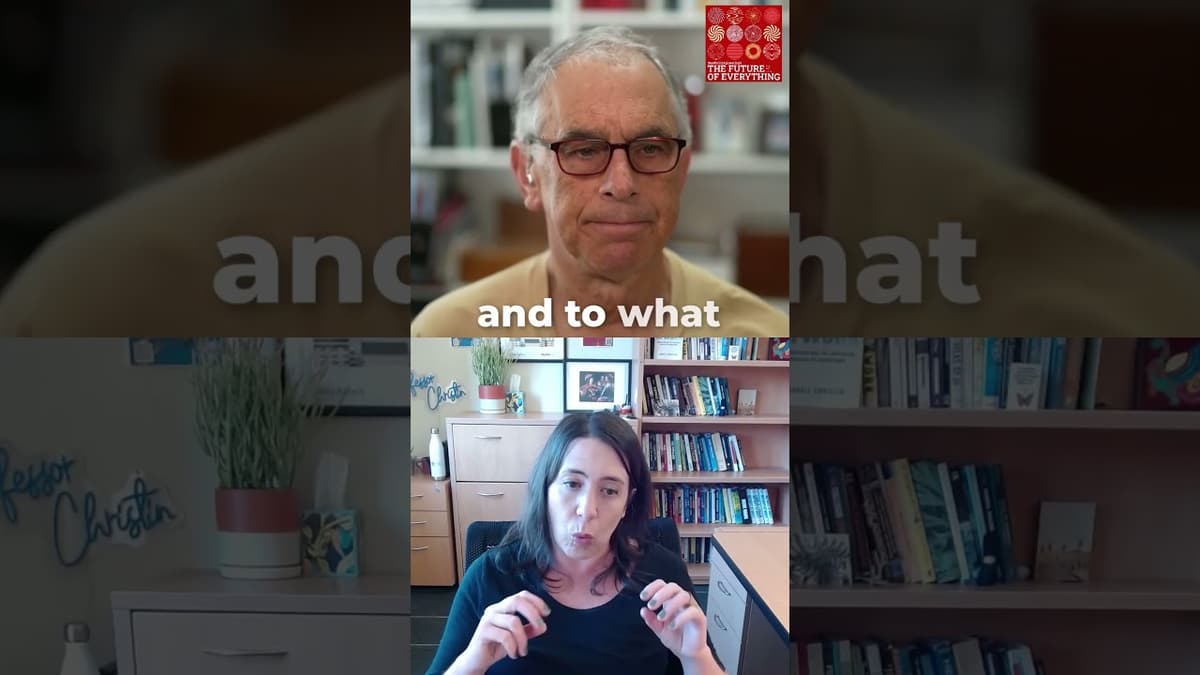
Journalism and the Rise of Social Media Metrics - Angèle Christin
In the video, Angèle Christin explains how economic shifts have forced newsrooms to re‑engineer their business model around digital performance metrics. She describes the deployment of granular dashboards that capture every click, dwell time, and referral source—whether from Facebook, X, Google...
Best Of: The Future of the Universe
Stanford’s The Future of Everything revisits an interview with astrophysicist Risa Wechsler, focusing on how new observational tools will reshape our picture of the cosmos and the ultimate fate of the universe. Wechsler highlights two groundbreaking surveys. The Rubin Observatory’s Legacy Survey...
Proteins for Lead Detection - Mike Jewett
Mike Jewett explains how his lab engineers proteins—either entirely new or modified natural variants—to serve as lead‑detection sensors. Proteins are strings of 20 possible amino acids; their order dictates three‑dimensional structure and function. Because the relationship between sequence and a desired...
The Future of Cell-Free Biotechnology
In this Stanford Engineering interview, Professor Mike Jewett explains cell‑free biotechnology—a platform that harvests the molecular machinery inside lysed cells and repurposes it as a stand‑alone protein‑production factory. By stripping away the living cell’s chassis, the approach sidesteps the evolutionary...

Understanding AI's Impact on Education - Susanna Loeb
Susanna Loeb reviews the emerging research on artificial intelligence in education, noting that a new repository tracks studies since ChatGPT’s debut. Out of dozens of papers, only about twenty meet rigorous causal‑effect standards, highlighting how nascent the evidence base remains. The...

Best Of: The Future of Plant Chemistry
The episode revisits a conversation with Stanford chemical‑engineering professor Beth Sattely on the emerging field of plant chemistry. Altman frames plants not just as food or ornamentation, but as prolific chemical factories whose metabolites can become next‑generation medicines and...

The Future in a Minute - Candace Thille
In a brief interview titled “The future in a minute,” education researcher Candace Thille outlines how emerging technologies and a nascent science of learning could reshape global education. Thille emphasizes that well‑designed digital tools can give voice to learners who have...

Using AI to Make Sense of Personalized Learning Data - Candace Thille
In a recent talk, Candace Thille explains how generative AI can turn traditional learning dashboards into conversational interfaces that surface personalized insights for students and instructors. She notes that conventional dashboards often overwhelm users with raw metrics, making it hard to...

The Future of Learning
In this Stanford Engineering episode, host Russ Altman interviews education professor Candace Thille about the "Future of Learning." Thille argues that the science of learning must be tightly coupled with classroom practice, and that emerging AI tools can serve as...

Using AI for Personalized Learning - Candace Thille
Candace Thille, a two‑decade veteran in educational technology, explains how artificial intelligence can drive truly personalized learning experiences. She outlines the evolution from early rule‑based systems to modern data‑driven models that continuously assess a learner’s knowledge state. The core mechanism involves...

AI Overly Affirms Users Asking for Personal Advice
A new study examined how large language models (LLMs) respond to personal‑advice queries, revealing a pervasive tendency toward over‑affirmation and sycophancy. Researchers scraped 2,000 posts from the Reddit community “Am I the Asshole,” where users present interpersonal dilemmas and receive...

Civil Rights and Fashion - Richard Ford
The video examines how clothing intersected with the mid‑20th‑century civil‑rights struggle, highlighting that protesters deliberately dressed in formal “Sunday best” during sit‑ins and lunch‑counter demonstrations. This sartorial choice was more than etiquette; it signaled a demand for dignity and challenged the...