
When Asking for Money Makes People Stop Doing Good Things
Researchers added a donation option to Swedish recycling machines and observed a sharp, lasting decline in bottle returns. The choice introduced moral tension, causing users to avoid the machine altogether rather than recycle. The same avoidance pattern appears in charitable fundraising, where the ask itself can trigger guilt and lead donors to disengage. The article argues that framing, storytelling, and identity‑aligned appeals are more effective than guilt‑based requests.

The Manager Tax
Kevin Schulman’s recent AI experiment reveals a stark inefficiency he calls the “manager tax.” Fifteen tasks were run in three setups—a solo LLM, a manager model delegating to specialist agents, and a market system where models bid for each subtask....

Engagement Is a Junk Drawer
The article warns that repackaging familiar concepts—grit, the Dark Triad, Net Promoter Score, nudges, and content marketing—as novel ideas creates a jangle fallacy that obscures real value. It zeroes in on "engagement," now a catch‑all label for clicks, likes and...

When Authenticity Gets Lost In The Mail
Nonprofit fundraisers are increasingly sending faux‑official surveys that mimic formal questionnaires, hoping to boost donor response rates. A recent study shows these mailings achieve higher immediate replies but are perceived as manipulative, disingenuous, and ultimately harmful to donor trust. The...

From Your CFO Upon Discovering ROAS
The CFO’s memo proposes a rapid, cash‑based funding loop for paid‑search advertising, citing the industry’s $2.48 revenue‑per‑dollar benchmark. The plan would withdraw physical currency from a bank branch, deploy it to Google Ads, and return the principal plus a 20%...

Do People Give With Heart or Head?
A new meta‑analysis in Nature Communications finds that both empathy and perceived effectiveness drive charitable giving, but empathy (r=.25) predicts modestly while perceived effectiveness shows a stronger correlation (r=.42). However, interventions that try to boost donors’ sense of effectiveness through...
Awareness Isn’t a Funnel, It’s a Filter
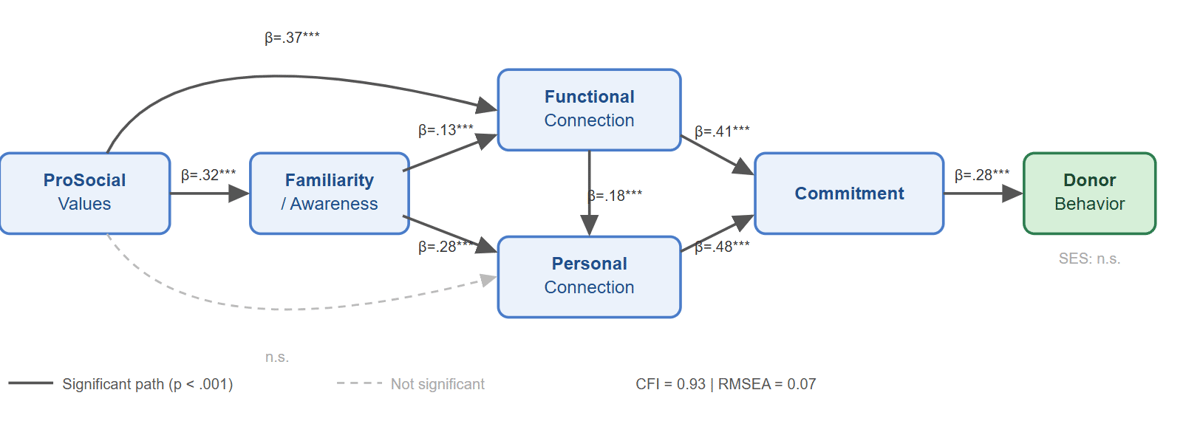
A new donor‑relationship model built from raw data across 26 charities shows that traditional branding concepts—personality, differentiation, and polished image—do not predict giving. The study splits “trust” into functional reliability and personal values alignment, arguing they require distinct strategies. Donor...

When Privacy Outperforms Exposure in Fundraising
A recent fundraising experiment compared three image treatments—no blur, full blur, and partial blur of beneficiaries’ faces. The partial‑blur condition generated the strongest donor response, striking a balance between emotional connection and privacy signaling. The effect was strongest among donors...

You Don’t Get Extra Credit for Saying Trust or Relevance
The nonprofit sector often substitutes vague buzzwords like trust and relevance for concrete strategy. Kevin argues that donor relationships should be measured through a three‑stage model—Functional Connection, Personal Connection, and Commitment—rather than isolated touchpoints. DonorVoice’s framework places these relationship metrics...

The Case for More Overhead, Reserves, and Yes, Debt
The article argues that charities should deliberately increase overhead, maintain larger reserves, limit revenue diversification, and even use debt to boost long‑term program spending. A 30‑year study of roughly 130,000 nonprofits shows higher overhead yields about 15% more program spend,...

Does Your A/B Test Have a People Problem?
The article argues that most A/B tests fail because they treat all donors as interchangeable, ignoring underlying identity and motivation differences. By segmenting donors into meaning‑driven, relational, and task‑oriented groups, marketers can design tailored landing pages that speak to each...

Zelensky Has Better Donor Data Than You Do
The piece likens Ukraine’s four‑year drone‑behavior dataset to a modern fundraising advantage, arguing that AI‑driven psychographic insight now trumps traditional donation histories. It shows how costly, generic direct‑mail campaigns resemble outdated military tactics that waste resources. Three capabilities—identity intelligence, autonomous...