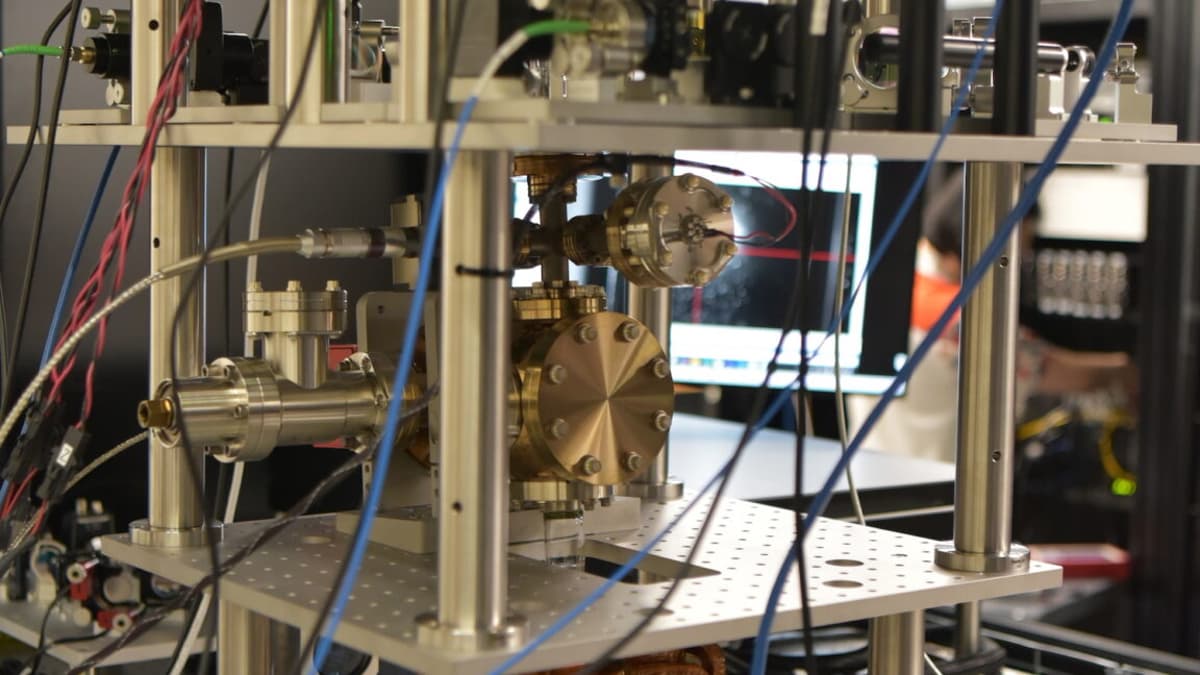
Sooner than Expected? Useful Quantum Error Correction Promised for 2028.
Companies Mentioned
Why It Matters
If Amazon and QuEra meet the 2028 timeline, industry‑scale quantum advantage could arrive years earlier than most forecasts, reshaping sectors like chemistry, materials science, and cryptography. The progress also pressures competitors to accelerate error‑correction research and highlights the importance of parallel advances in classical algorithmic efficiency.
Key Takeaways
- •Amazon and QuEra target error‑corrected quantum computer by 2028.
- •QuEra's neutral‑atom platform demonstrated 3,000‑qubit grid, aiming for logical qubits.
- •Quantinuum's Helios trapped‑ion system achieves 0.00003 single‑qubit error rate.
- •Quantum advantage claims shrink as classical algorithms become more optimized.
- •Practical quantum applications need thousands of high‑quality hardware qubits.
Pulse Analysis
The 2028 horizon set by Amazon and QuEra marks a bold acceleration in the quantum computing timeline. Their Libra device promises a million‑scale operation count across hundreds of logical qubits, leveraging neutral‑atom technology that can densely pack qubits while offering all‑to‑all connectivity via laser‑controlled atom movement. Although the platform excels at scalability, challenges such as atom heating and slow transport must be resolved to achieve the high fidelity required for error correction. Success would give cloud customers immediate access to quantum chemistry and materials simulations that are currently out of reach for noisy intermediate‑scale quantum (NISQ) machines.
In parallel, Quantinuum's Helios trapped‑ion processor showcases a different path to usefulness: ultra‑high qubit quality. With single‑qubit error rates of 3 × 10⁻⁵ and two‑qubit errors below 8 × 10⁻⁴, Helios can execute deep circuits that classical supercomputers cannot simulate within realistic timeframes. Its innovative software layer abstracts physical qubits into virtual ones, automatically handling qubit selection and error‑correction routines. This abstraction lowers the barrier for developers, allowing them to focus on algorithms while the system manages the complex physics of ion cooling and gate operations.
The broader narrative remains a tug‑of‑war between quantum hardware breakthroughs and classical algorithmic ingenuity. Recent work from Q‑CTRL and Multiverse Computing demonstrates how classical optimizations can dramatically shrink claimed quantum advantages, turning a 3,000‑fold speedup into a modest 36‑fold gain. As the community refines both sides, the market will likely see incremental, verifiable advantages before full‑scale, error‑corrected quantum supremacy. Stakeholders should monitor roadmap milestones, error‑rate trends, and the evolving quantum‑advantage tracker to gauge when truly transformative applications become commercially viable.
Sooner than expected? Useful quantum error correction promised for 2028.
Comments
Want to join the conversation?
Loading comments...