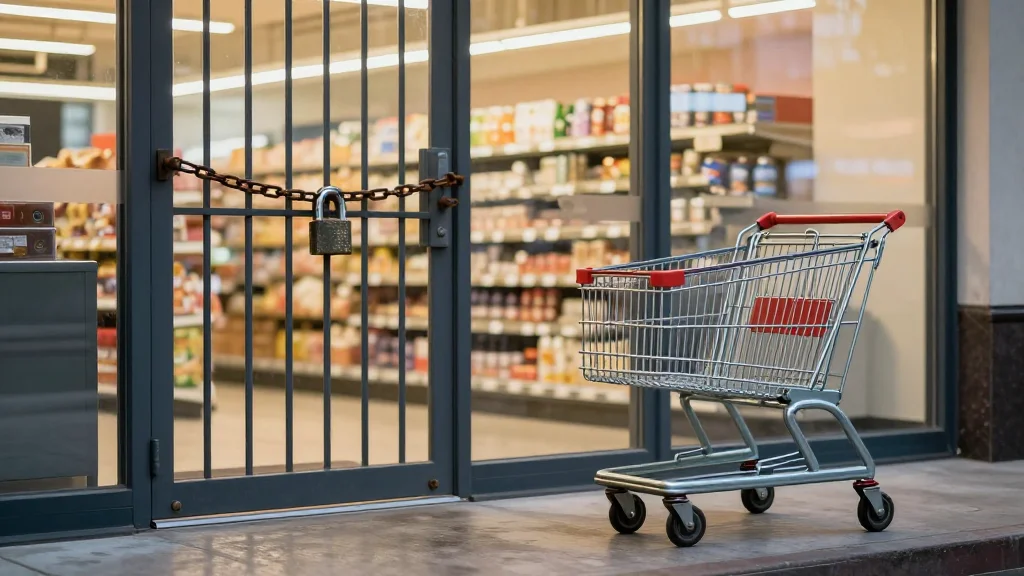
Albertsons and Kroger Accelerate Store Closures Amid Merger Fallout and Shifting Shopper Habits

Companies Mentioned
Why It Matters
The accelerated store closures by Albertsons and Kroger illustrate how legacy grocery chains are adapting to a market where price‑sensitive consumers are reshaping demand. By trimming underperforming locations, the companies aim to protect profitability, but the moves also reduce grocery access in certain neighborhoods, raising concerns about food deserts and community impact. The state lawsuit over merger‑related costs adds a legal and financial dimension to the restructuring narrative. If courts award the $10.35 million sought by the states, it could encourage more aggressive state oversight of large retail consolidations, potentially deterring future merger attempts that might otherwise promise economies of scale. Overall, the developments signal a shift from growth through acquisition toward efficiency and digital expansion, a trend that will likely reverberate across the broader retail ecosystem.
Key Takeaways
- •Albertsons and Kroger announced closures of at least five stores, cutting over 500 jobs.
- •A coalition of eight states and D.C. is suing the chains for $10.35 million in merger‑related investigation costs.
- •The aborted merger cost the companies roughly $1.5 billion in fees and legal expenses.
- •Online grocery sales rose 32% to $12.7 billion in December 2025, outpacing traditional formats.
- •Kroger laid off 1,000 corporate employees following the failed merger.
Pulse Analysis
The twin strategies of store rationalization and digital investment reflect a broader industry pivot. Historically, grocery giants have relied on scale to negotiate with suppliers and dominate shelf space. The Kroger‑Albertsons merger would have epitomized that model, but antitrust resistance and the subsequent financial fallout have forced both firms to reconsider. By shedding low‑margin locations, they are preserving cash flow and reallocating resources toward high‑growth channels such as curbside pickup, delivery, and smaller urban formats that better align with today’s consumer preferences.
From a competitive standpoint, the closures could create openings for regional players and discounters like Aldi and Lidl, which have been expanding aggressively. These competitors operate with leaner cost structures and can thrive in markets where the big chains are pulling back. Moreover, the legal precedent set by the states’ claim may raise the bar for future consolidation attempts, prompting retailers to focus more on organic growth and technology partnerships rather than large‑scale mergers.
Looking forward, the success of Albertsons and Kroger will hinge on how quickly they can translate their digital investments into sustainable sales. The 32% surge in online grocery spend indicates strong consumer appetite, but profitability remains a challenge due to delivery costs and thin margins. If the companies can leverage data analytics to optimize inventory, personalize promotions, and improve fulfillment efficiency, they may offset the revenue loss from closed stores. Conversely, failure to adapt could accelerate market share erosion, cementing the shift toward a more fragmented, value‑oriented grocery landscape.
Albertsons and Kroger Accelerate Store Closures Amid Merger Fallout and Shifting Shopper Habits
Comments
Want to join the conversation?
Loading comments...