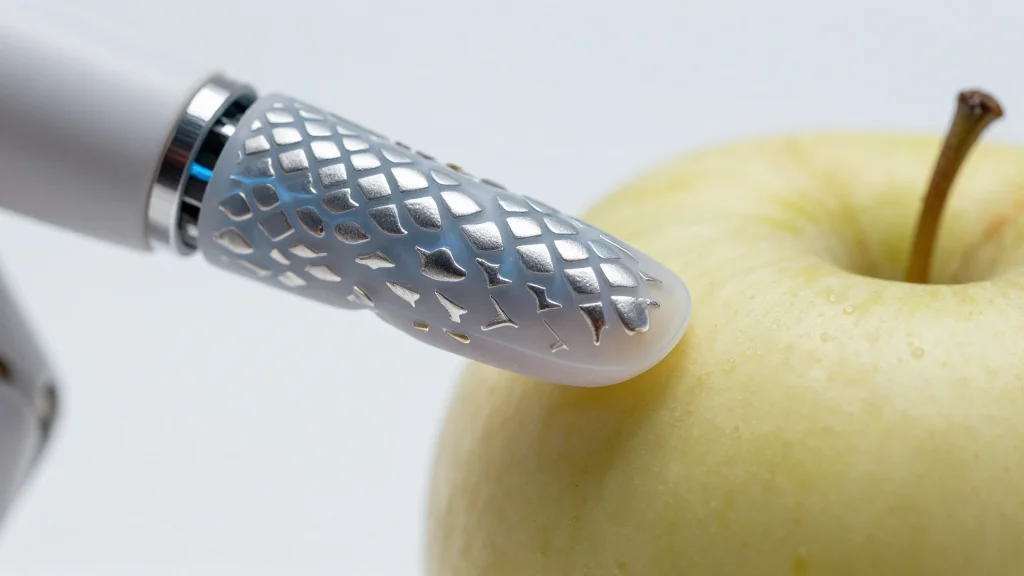
Fish-Scale Sensor Gives Robots a Better Sense of Touch
Key Takeaways
- •Sensor amplifies bending signal 177× versus bare electrodes
- •Detects 0.005° bends, responds in 0.6 ms, 100k cycles durability
- •Resolves 1.8 µm surface features and 1000 Hz vibrations
- •Achieves 92% accuracy classifying kiwi ripeness during grasp
- •Rigid PZT scales on silicone give flexible, durable tactile skin
Pulse Analysis
Tactile perception remains the missing link for many soft‑robotic systems that already excel at visual recognition. Traditional flexible sensors trade off softness for sensitivity, or vice‑versa, limiting their usefulness in real‑world handling. By mimicking the fish‑scale/dermis architecture, the new giant piezocapacitive sensor isolates strain to microscopic air gaps while keeping the bulk material compliant. This design concentrates the electric field within high‑permittivity PZT flakes, turning minute bends into large capacitance swings without sacrificing durability—a rare combination in tactile hardware.
The engineering payoff is evident in the sensor’s performance metrics. A 0.005° angular resolution and sub‑millisecond response time allow the device to track rapid surface undulations, while its ability to operate over 100,000 bending cycles demonstrates industrial‑grade longevity. The amplified signal also makes it possible to resolve features as small as 1.8 µm and differentiate vibration frequencies around 500‑1000 Hz, effectively giving robots a sense of texture comparable to human fingertips. Compared with conventional side‑by‑side capacitive layouts, the fish‑scale gating film boosts the capacitance change by roughly 177×, turning a previously weak signal into a robust data stream suitable for real‑time control loops.
Beyond the laboratory, this technology could reshape automation in sectors where visual cues fall short. In horticulture, the sensor’s ability to infer firmness and ripeness during a normal grasp eliminates the need for separate firmness testers, streamlining sorting lines and reducing waste. Manufacturing and healthcare robotics stand to benefit as well, gaining reliable feedback for delicate assembly or patient‑contact tasks. Scaling the approach to larger sensor arrays will require precise patterning of the scale geometry, but if achieved, the market for high‑fidelity tactile skins—projected to exceed $1 billion by 2030—could see rapid adoption across a spectrum of intelligent machines.
Fish-scale sensor gives robots a better sense of touch
Comments
Want to join the conversation?