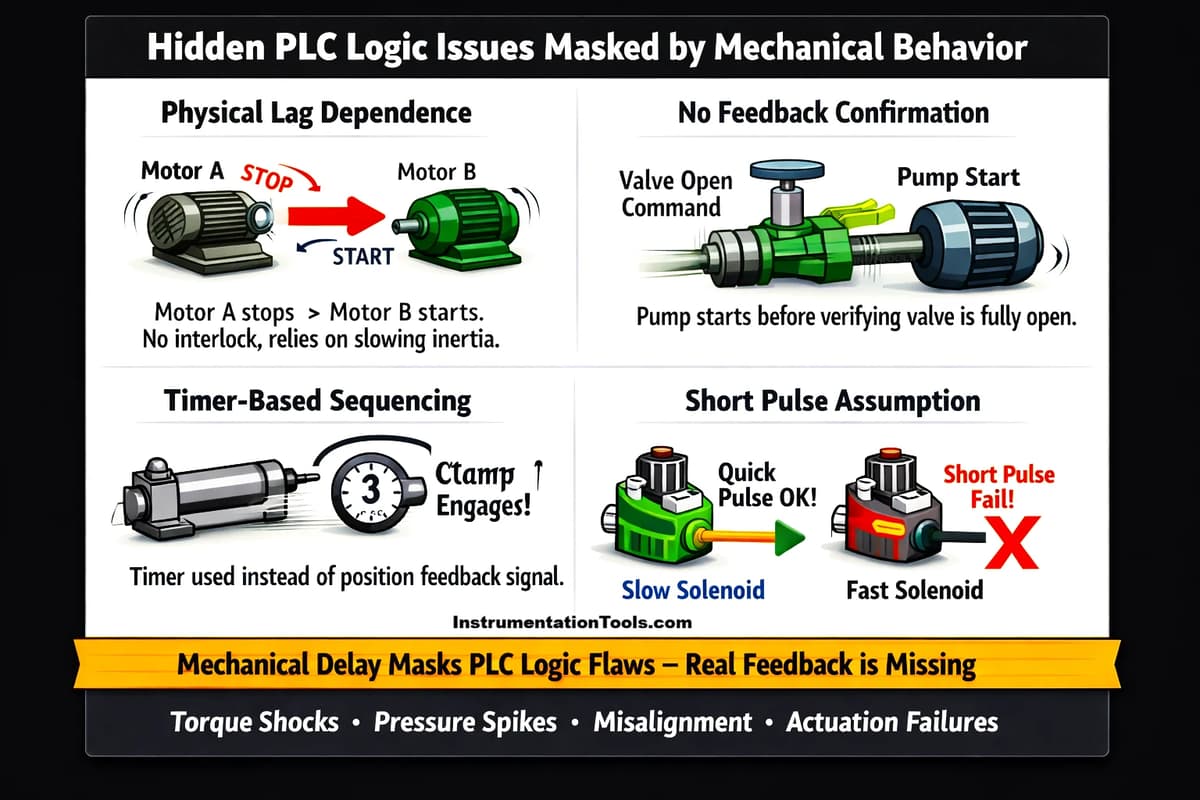
Mechanical Delays Masking PLC Program Errors
Key Takeaways
- •Inertia masks missing interlocks, creating hidden safety gaps
- •Timer‑based sequencing fails when air pressure or load varies
- •Fast actuators expose short‑pulse output errors in PLC code
- •Feedback verification prevents torque shocks and water‑hammer events
Pulse Analysis
Mechanical inertia is a double‑edged sword in automation. During start‑up, the natural lag of motors, valves and conveyors can smooth over gaps in PLC programming, making a system appear stable even when critical interlocks or status checks are absent. Engineers may mistakenly attribute reliability to solid code, while the real safety net is the physical delay that buys time for the next command to execute.
When plant conditions evolve—higher line speeds, newer low‑inertia drives, or upgraded fast‑acting valves—the hidden buffers vanish. The same PLC logic that once relied on a 2‑second motor coast‑down now triggers an immediate start of a downstream motor, producing torque spikes, belt wear, or gear impact. Similarly, fixed timers that assume a pneumatic cylinder extends in three seconds can cause partial clamping if air pressure drops or seals wear, leading to misalignment and component stress. These failures are not just mechanical; they stem from a control strategy that assumes timing rather than confirming real‑world states.
The remedy is to replace guesswork with explicit feedback. Use position sensors, limit switches, or VFD status bits to verify that an actuator has reached its intended state before proceeding. Replace timer‑based delays with status‑based interlocks, and define minimum pulse widths that match the fastest field devices in the system. Conduct validation tests that vary speed, load and hardware type to ensure the PLC logic remains robust under all realistic conditions. By grounding control sequences in actual device feedback, plants eliminate hidden risks and achieve true reliability, not just a veneer of stability provided by mechanical lag.
Mechanical Delays Masking PLC Program Errors
Comments
Want to join the conversation?