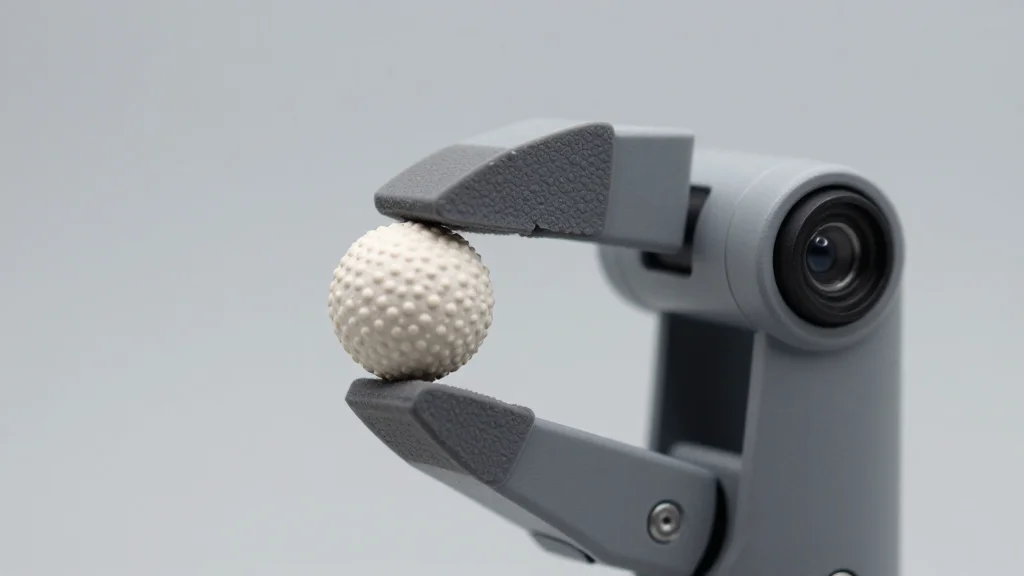
Robots Learn to Feel What Vision Misses
Key Takeaways
- •Inkjet-printed tactile array detects 23 Pa loads in 48 ms
- •Vision accuracy falls below 10 lux; tactile resolves 2 mm features
- •Combined system maps millimeter‑scale objects in low‑light or occlusion
- •Sensor array endures 5,000 loading cycles without performance loss
- •Approach enables autonomous manipulation in hazardous or space environments
Pulse Analysis
Robotic perception has long relied on cameras to locate and identify objects, but visual systems stumble when lighting is poor, focus shifts, or objects are partially hidden. Researchers at Yonsei University and the University of Southern California have tackled this gap by pairing a standard RGB‑Depth camera with a flexible, inkjet‑printed tactile sensor array. The hybrid design mirrors the human habit of looking first and touching second, providing a fallback channel that activates when visual confidence drops. This sensory redundancy promises more reliable operation in environments where humans cannot safely intervene.
The tactile module consists of a 10 × 10 capacitive pressure grid fabricated with silver electrodes on a deformable substrate. It registers forces as low as 23 Pa, responds within 48 ms, and maintains calibration across more than 5,000 loading cycles. In tests, the combined system reconstructed three‑dimensional profiles of pill‑scale objects, detecting protrusions as small as 2 mm even under illumination below 10 lux where camera mean average precision fell from 0.995 to 0.706. By fusing depth data with pressure maps, the robot can resolve surface geometry that would otherwise be invisible to vision alone.
Industries that operate in unstructured or hazardous settings stand to gain immediately. Space‑bound manipulators, nuclear decontamination robots, and autonomous inspection units can now grasp irregular components without relying on perfect lighting or line‑of‑sight. The technology also opens pathways for precision micromanipulation in pharmaceuticals, where reading blister‑pack geometry is critical. Future work will focus on real‑time sensor fusion algorithms and scaling tactile resolution beyond the current millimeter range. As the cost of inkjet‑printed sensors drops, large‑scale deployment could become a standard feature of next‑generation industrial robots.
Robots learn to feel what vision misses
Comments
Want to join the conversation?