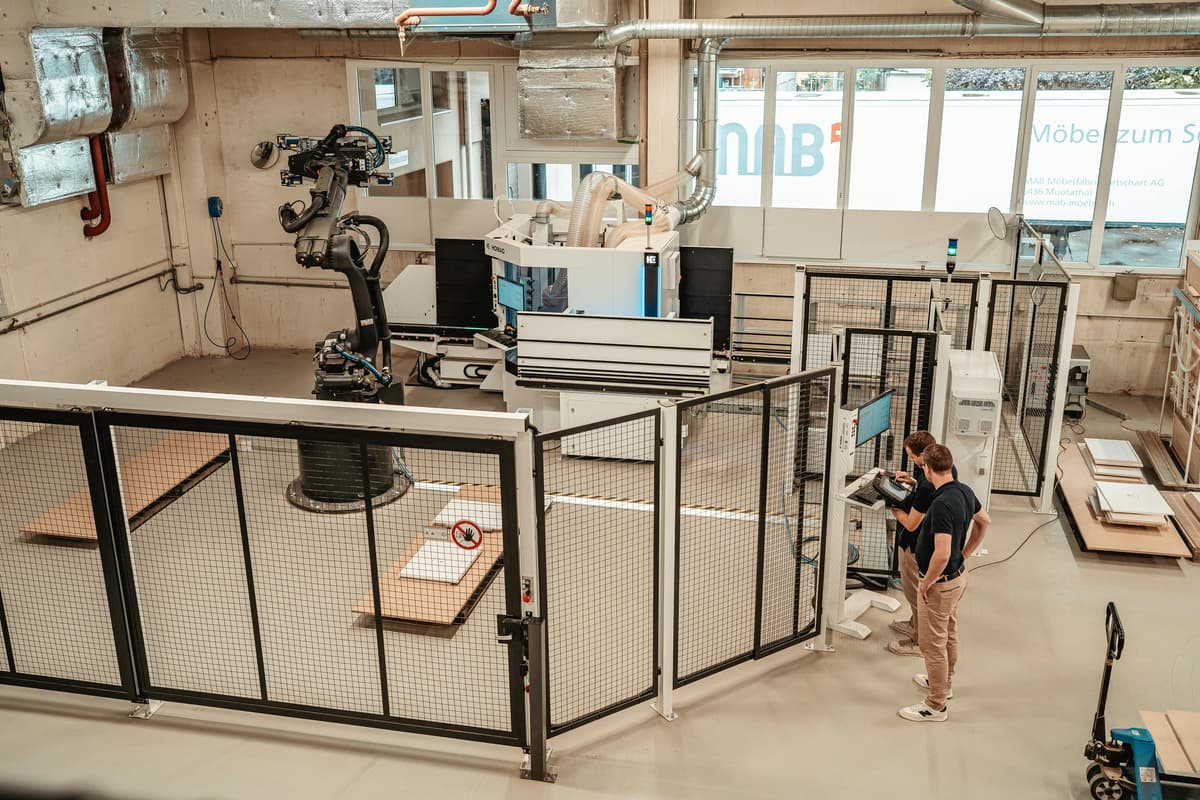
3D Point Cloud Enables Robots to ‘See’
Why It Matters
The cell eliminates a labor‑intensive bottleneck, boosts productivity and enables true one‑off customization in woodworking, a sector facing skilled‑labor shortages. It demonstrates how advanced machine‑vision can make high‑mix, low‑volume production economically viable.
Key Takeaways
- •Robot picks chaotic stacks, reads barcodes, loads CNC autonomously
- •3D point‑cloud pipeline runs faster than CNC, avoiding vision bottleneck
- •HALCON combines 2D/3D methods, works under ambient workshop light
- •Vacuum gripper safety logic stops motion if grip threshold fails
- •MAB Möbel achieved continuous operation and higher throughput since 2025
Pulse Analysis
The woodworking industry has long wrestled with a paradox: customers demand highly customized, batch‑size‑one products, yet the sector suffers from labor shortages and costly manual handling. By embedding a six‑axis robot equipped with a 3D laser scanner, HOMAG Bohrsysteme transforms this challenge into an opportunity. The scanner generates a dense point cloud that captures each board’s exact geometry, even when the stack is disordered and illuminated by ambient light. MVTec’s HALCON software then extracts the top layer, estimates pose, and reads barcodes, feeding precise instructions to the DrillTeq V‑310 CNC. This seamless vision‑to‑motion pipeline eliminates the need for pre‑sorting, dramatically reducing upstream handling time.
From a technical standpoint, the system’s strength lies in its tightly coupled hardware‑software architecture. HALCON’s hybrid 2D/3D operators enable robust detection across varied wood finishes—from matte veneers to high‑gloss laminates—while the vacuum gripper’s integrated pressure monitoring guarantees safe, repeatable picks. A custom stacking algorithm evaluates stack stability in real time, preventing collapse and ensuring deterministic robot paths. All components communicate through standard industrial protocols, allowing deterministic timing, comprehensive diagnostics, and 24/7 serviceability without exotic hardware. The result is a cell whose throughput is limited by the CNC’s cycle time, not by vision processing.
For manufacturers, the implications are profound. Automating the loading and unloading stage frees skilled workers for higher‑value tasks, cuts labor costs, and supports true mass customization. The successful deployment at MAB Möbel showcases a scalable model that can be replicated across the sector, accelerating digital transformation in a traditionally manual industry. As machine‑vision technology matures, more woodworking firms are likely to adopt similar solutions, reshaping supply chains and competitive dynamics.
3D point cloud enables robots to ‘see’
Comments
Want to join the conversation?
Loading comments...