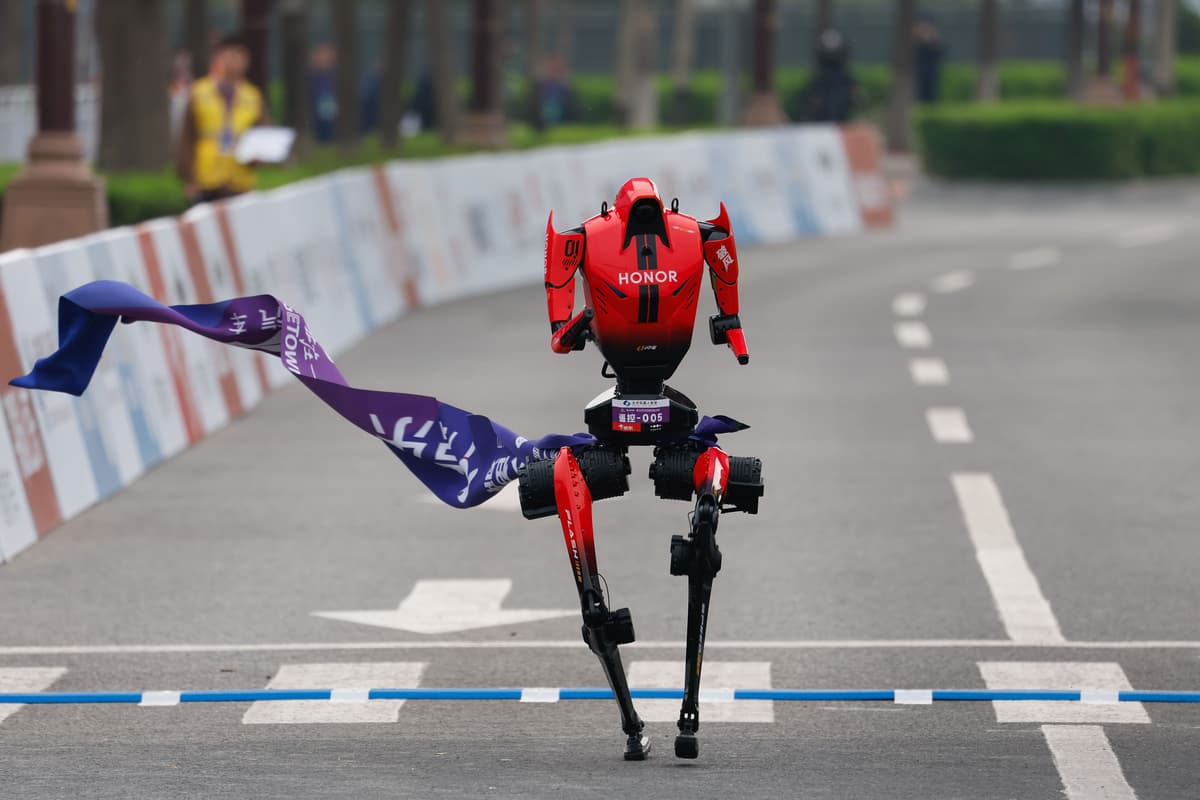
A Humanoid Robot Set a Half-Marathon Record in China

Companies Mentioned
Why It Matters
The breakthrough demonstrates that humanoid robots can now outperform elite athletes in specific physical tasks, signaling a new benchmark for AI‑driven mobility and potential commercial applications in logistics, emergency response, and beyond.
Key Takeaways
- •Honor robot ran half marathon in 50:26, beating record by 7 minutes
- •Over 100 humanoid robots from 76 institutions competed alongside 12,000 human runners
- •Robots used AI for balance, pace control, and real‑time terrain adaptation
- •A remote‑controlled Honor robot posted 48:19, the fastest time recorded
- •Robotics advances highlight China’s strategic push for global AI and hardware leadership
Pulse Analysis
The Beijing E‑Town Humanoid Robot Half Marathon captured global attention when Honor’s autonomous robot crossed the finish line in 50 minutes and 26 seconds, eclipsing the human world record of 57:20 set by Uganda’s Jacob Kiplimo. More than a hundred robots representing universities, research labs, and private firms lined up against a backdrop of 12,000 human runners, underscoring China’s ambition to showcase its leadership in advanced robotics. The event, staged on separate tracks for safety, highlighted how quickly robotic endurance has progressed from two‑and‑a‑half‑hour finishes just a year ago to sub‑hour performances.
Technically, the winning robot—nicknamed “Blitz”—combined a near‑meter‑long leg design with sophisticated balance sensors and a liquid‑cooling system borrowed from smartphone technology to stave off overheating. Its AI algorithms continuously adjusted stride length, cadence, and foot placement, allowing it to maintain a steady pace on varied terrain without human intervention. A parallel entry, operated via remote control, achieved an even faster 48:19, illustrating the complementary roles of autonomy and teleoperation in pushing performance limits. The race also exposed reliability gaps; several robots fell or required assistance, reminding developers that speed alone does not guarantee robustness.
Beyond the spectacle, the achievement signals a turning point for the commercial viability of humanoid platforms. Faster, more energy‑efficient robots could soon transition from research labs to real‑world roles such as warehouse order picking, disaster‑area reconnaissance, and even delivery services in crowded urban settings. As Chinese firms like Honor accelerate development, Western competitors will likely intensify R&D investments, sparking a new wave of innovation in AI‑driven locomotion. The race thus serves as both a benchmark and a catalyst, reshaping expectations for what autonomous machines can accomplish in the next decade.
A Humanoid Robot Set a Half-Marathon Record in China
Comments
Want to join the conversation?
Loading comments...