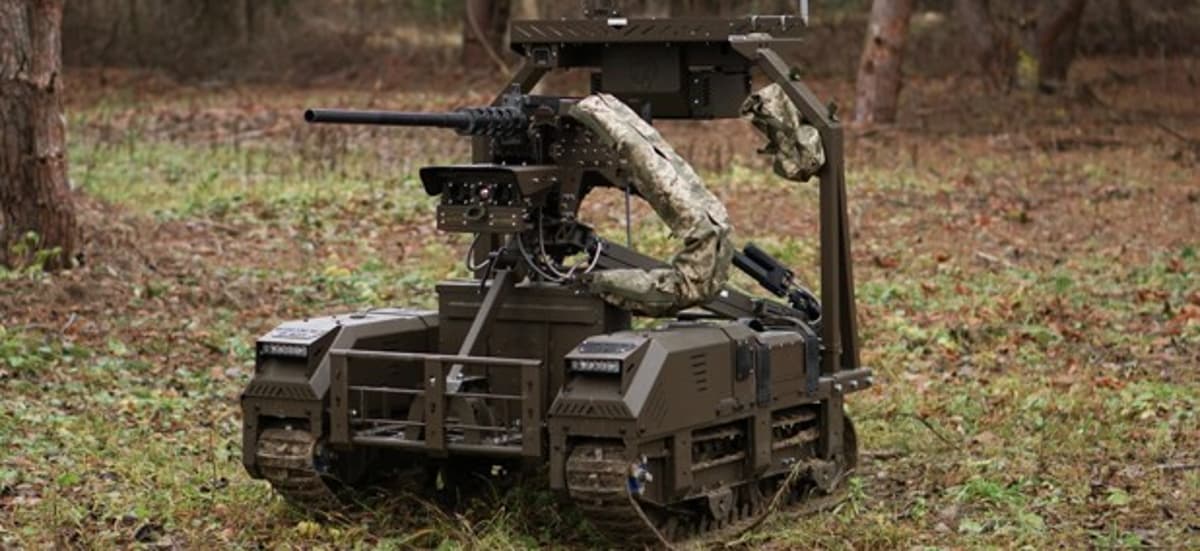
A Ukrainian Ground Robot Defended a Position From Russian Assault for Six Weeks
Why It Matters
The operation proves that low‑cost unmanned ground systems can sustain prolonged defensive roles, reshaping battlefield tactics and accelerating global military adoption of robotic combat platforms.
Key Takeaways
- •Droid TW 12.7 held a key intersection for 45 days
- •Robot operated from 10 km away, preventing any Ukrainian casualties
- •UGVs now perform 80% of front‑line logistics tasks
- •Battery life and ammo capacity remain critical operational constraints
- •Human oversight is mandated to avoid autonomous lethal decisions
Pulse Analysis
Ukraine’s recent use of the Droid TW 12.7 unmanned ground vehicle (UGV) underscores a rapid shift toward robotic warfare on the front lines. By holding a strategic crossroads for six weeks, the remotely operated machine‑gun platform demonstrated that inexpensive, off‑the‑shelf technology—costing roughly $10,000‑$30,000 per unit—can deliver sustained defensive firepower while keeping soldiers out of harm’s way. The operation was tightly integrated with aerial drones that provided real‑time surveillance, enabling operators to identify threats and engage them instantly, a model that blends traditional infantry tactics with modern sensor networks.
Despite the tactical success, Ukrainian officials cite persistent challenges that limit broader deployment. Battery endurance and ammunition load remain the primary logistical bottlenecks; solutions range from higher‑capacity power packs to modular battery swaps. Training operators for UGVs is also more complex than for UAVs, requiring deep terrain analysis and obstacle navigation skills akin to autonomous‑vehicle development. Moreover, ethical constraints keep lethal decision‑making firmly in human hands, reflecting public concern over fully autonomous weapons. These constraints shape how quickly the Ukrainian Ministry of Defense can scale robot usage toward its goal of 100% unmanned logistics.
The implications extend far beyond Ukraine’s borders. NATO allies and other militaries are watching the experiment closely, as it offers a low‑cost blueprint for integrating ground robots into conventional forces. Parallel research, such as the U.S. Army’s Tactical Joint Embedding Predictive Architecture (JEPA), aims to give unmanned systems predictive intelligence, allowing them to anticipate enemy movements and pre‑position assets. As autonomy improves, a single soldier could command multiple UGVs across diverse missions, potentially redefining the future of combined arms operations worldwide.
A Ukrainian ground robot defended a position from Russian assault for six weeks
Comments
Want to join the conversation?
Loading comments...