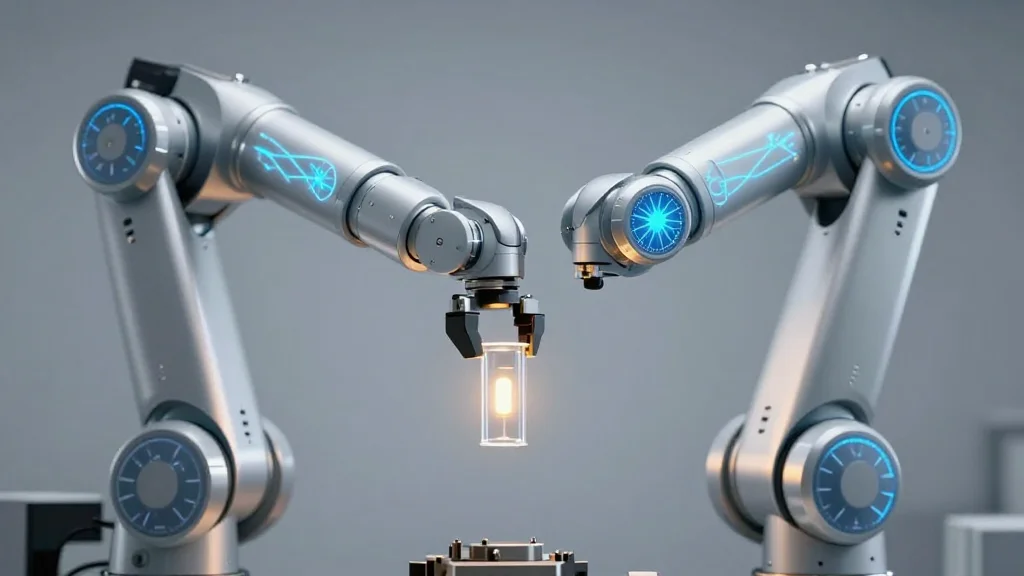
ABB Robotics Delivers New Industry-Ready Physical AI at Automate 2026
Companies Mentioned
Why It Matters
Physical AI shortens the time and cost to deploy accurate robot intelligence, giving manufacturers a competitive edge in flexibility and productivity. ABB’s integrated hardware‑software approach accelerates industry adoption of autonomous, collaborative robots.
Key Takeaways
- •ABB launches Physical AI Toolchain for faster robot model training.
- •New PoWa cobot family offers higher speed and payload capacity.
- •Collaboration with Aura Sensae adds real-time safe proximity sensing.
- •AI‑powered palletising cell boosts product density and cuts handling costs.
- •AVR platform integrates vision, motion, navigation for autonomous versatility.
Pulse Analysis
The launch of ABB’s Physical AI Toolchain marks a pivotal shift from static, pre‑programmed robots to systems that can learn and adapt in real time. By unifying data synthesis, model training, and deployment within a single stack, ABB reduces the traditional simulation‑to‑real gap that has hampered industrial AI adoption. The recent partnership with NVIDIA, which introduced RobotStudio® HyperReality, provides the computational backbone for this transition, enabling synthetic and real‑world data to converge with industrial‑grade precision. This convergence is expected to lower development cycles and expand the scope of tasks robots can perform autonomously.
At Automate 2026, ABB showcased tangible applications that illustrate the toolchain’s potential. The PoWa cobot family delivers higher payloads and speeds, while the partnership with Aura Sensae introduces HEXOPUS capacitive sensing for safe, dynamic human‑robot interaction. An AI‑driven palletising cell demonstrated on‑the‑fly decision‑making that maximizes product density and cuts material‑handling expenses. Additionally, OmniCore™ EyeMotion software and speak‑through technology highlight how vision and natural‑language interfaces can be retrofitted onto existing hardware, broadening the appeal of ABB’s autonomous versatile robotics (AVR) platform across manufacturing, logistics, and automotive lines.
The broader market implications are significant. As manufacturers seek resilience and flexibility amid supply‑chain volatility, ABB’s end‑to‑end AI‑powered portfolio positions it ahead of rivals still reliant on siloed hardware or software solutions. The ability to train robots faster, validate performance across simulated and real environments, and deploy them with minimal re‑engineering lowers total cost of ownership. Analysts anticipate accelerated adoption of collaborative robots (cobots) and autonomous mobile robots (AMRs) in sectors ranging from electronics to food processing, driving a wave of productivity gains and new business models centered on intelligent automation. ABB’s 7,000‑strong workforce and global ecosystem of partners suggest it is well‑placed to capitalize on this emerging demand.
ABB Robotics delivers new industry-ready physical AI at Automate 2026
Comments
Want to join the conversation?
Loading comments...