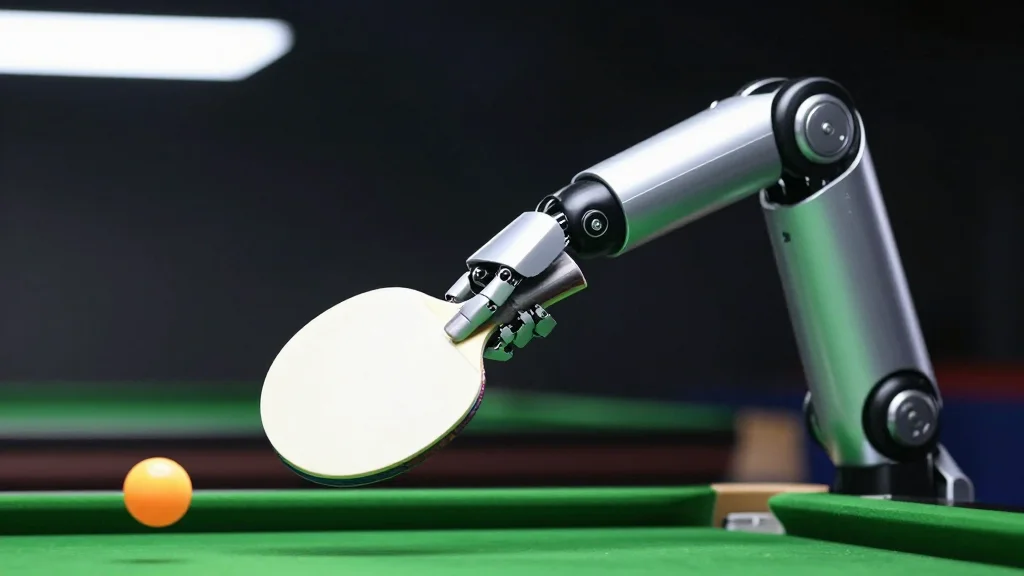
Ace Ping‑Pong Robot Beats Amateurs, Marks New Milestone in Real‑World AI

Companies Mentioned
Why It Matters
Ace’s victory demonstrates that AI can move beyond simulated environments into the messy, high‑speed physical world, a transition that has long been a barrier for robotics. By proving that perception, reasoning and actuation can be tightly coupled at human‑level speeds, the project opens pathways for robots that can safely interact with humans in factories, warehouses, and hospitals where unpredictability is the norm. The breakthrough also reshapes the competitive landscape of robot sports, turning them into credible testbeds for next‑generation control algorithms. Success in a sport as demanding as table tennis validates the underlying technology stack, encouraging investment and accelerating the timeline for commercial applications that require split‑second decision making.
Key Takeaways
- •Ace defeated 3 of 5 high‑level amateur players in live matches
- •Recorded 1 win in 7 matches against Japanese league pros Minami Ando and Kakeru Sone
- •Repelled 75% of incoming balls using precise control
- •Combines perception, AI decision engine, and an eight‑joint high‑speed arm
- •Sony AI plans public demos and entry into international robot‑sports tournaments this year
Pulse Analysis
The Ace robot is a concrete illustration of the convergence between deep learning and high‑performance mechatronics. Historically, robotics breakthroughs have been incremental—improving one component at a time—while AI advances have been dominated by virtual games. Ace collapses that divide by embedding a vision‑based neural network directly into a feedback loop that drives a physical actuator in under 10 ms. This integration reduces latency, a critical factor that has limited robots from matching human reflexes.
From a market perspective, the demonstration could catalyze a wave of venture capital into embodied AI startups that focus on perception‑action loops rather than pure software. Companies that have traditionally excelled in simulation, such as OpenAI and DeepMind, may now face competition from hardware‑centric players who can deliver end‑to‑end solutions. The competitive edge will hinge on data collection—Ace’s training on thousands of spin‑rich rallies provides a dataset that is difficult for pure‑software firms to replicate.
Looking ahead, the key question is scalability. While Ace excels in a controlled lab, real‑world deployment demands robustness to lighting changes, wear‑and‑tear, and safety certifications. If Sony can translate the prototype into a modular platform that other manufacturers can adopt, the ripple effect could accelerate automation in sectors where rapid, adaptive motion is essential, from autonomous drones navigating cluttered environments to surgical robots performing delicate procedures. The next public match will be a litmus test for whether the technology can survive the scrutiny of a broader audience and move from a research curiosity to a commercial catalyst.
Ace Ping‑Pong Robot Beats Amateurs, Marks New Milestone in Real‑World AI
Comments
Want to join the conversation?
Loading comments...