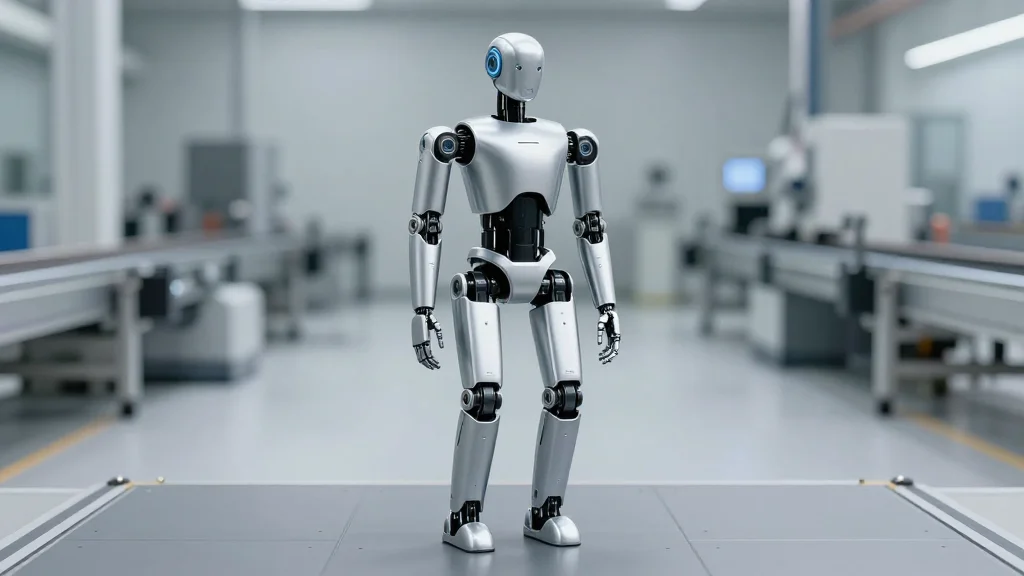
AGIBOT WORLD CHALLENGE 2026 Advances Embodied AI Competition From Simulation to Real-Robot Testing at ICRA 2026
Companies Mentioned
Why It Matters
By integrating real‑robot validation into the scoring system, the challenge narrows the simulation‑to‑deployment gap, accelerating the rollout of robust embodied AI solutions across industry sectors.
Key Takeaways
- •526 teams from 27 countries competed in two embodied AI tracks
- •Real‑robot finals used AGIBOT G2, emphasizing stability and long‑horizon tasks
- •EWMBench and Genie Sim 3.0 provide unified simulation‑to‑real metrics
- •Vivo’s PrismBot won Reasoning to Action; NeoVerse‑ABot topped World Model
- •New supermarket benchmark tests full‑stack navigation, manipulation, and decision‑making
Pulse Analysis
The rapid progress of embodied artificial intelligence has outpaced the metrics used to judge it. While simulation environments such as MuJoCo or Habitat enable rapid iteration, they often hide physical nuances that only appear on a real robot. AGIBOT’s WORLD CHALLENGE 2026, staged alongside ICRA 2026, directly addressed this gap by requiring finalists to run their algorithms on the AGIBOT G2 humanoid in Vienna. By placing robot stability, sensor fidelity, and long‑horizon task reliability at the core of scoring, the event set a new benchmark for what constitutes a deployable AI system.
The competition split into Reasoning to Action (R2A) and World Model (WM) tracks, reflecting the twin pillars of embodied intelligence: purposeful planning and accurate prediction of physical dynamics. Teams trained on the open‑source AGIBOT WORLD dataset and were evaluated first in Genie Sim 3.0, then in the offline real‑robot phase using EWMBench’s standardized metrics. Winners PrismBot (Vivo) and NeoVerse‑ABot demonstrated not only high simulation scores but also robust performance when faced with object drops, grasp failures, and unstructured environments, proving the efficacy of the dual‑track approach.
Beyond the contest, AGIBOT released a full‑stack toolchain that links data collection, simulation, and hardware testing, and introduced a real‑supermarket benchmark that mimics retail logistics from navigation to item placement. This end‑to‑end framework lowers the barrier for startups and research labs to validate real‑world readiness, accelerating the transition from academic prototypes to commercial robot services. As more organizations adopt these standardized benchmarks, the industry can expect faster iteration cycles, clearer performance baselines, and ultimately, a broader rollout of autonomous robots in warehouses, hospitals, and consumer spaces.
AGIBOT WORLD CHALLENGE 2026 Advances Embodied AI Competition from Simulation to Real-Robot Testing at ICRA 2026
Comments
Want to join the conversation?
Loading comments...