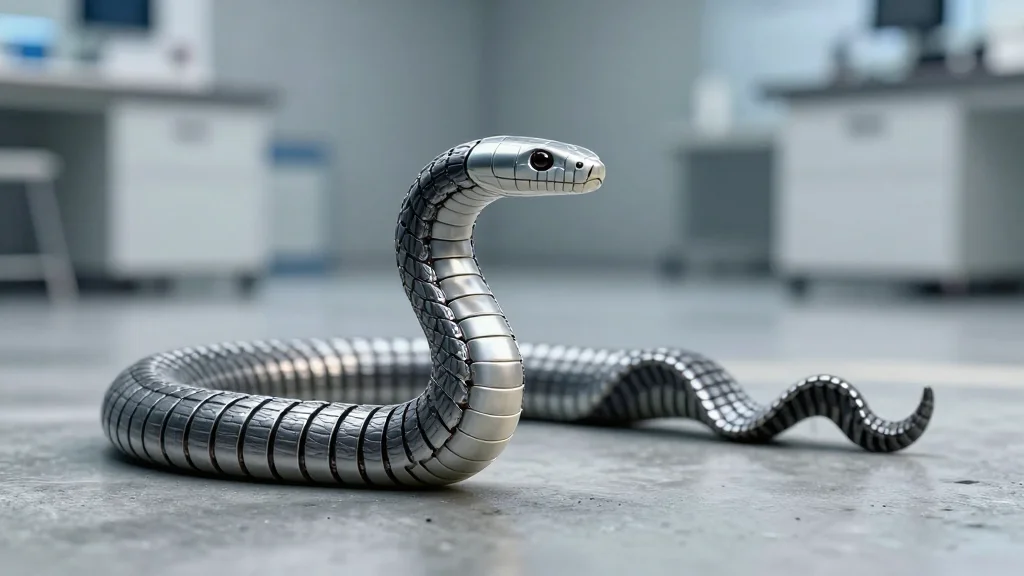
AI-Guided Snakebot Unlocks Rolling Move that Doubles Speed per Unit Power
Why It Matters
The efficiency boost dramatically lengthens operational time for rescue and exploration robots, making them more viable in disaster zones and planetary missions. Autonomous gait selection reduces reliance on human control, accelerating adoption across safety‑critical industries.
Key Takeaways
- •Rolling gait doubles speed per power unit on flat terrain
- •Deep reinforcement learning selects optimal gait using sensor data
- •Observation buffer stabilizes rolling, enabling precise straight‑line travel
- •Hybrid rolling‑undulating strategy extends battery life in rescue missions
- •Team plans robots that autonomously assess terrain and choose movement
Pulse Analysis
Snake‑like robots have long been touted for their ability to infiltrate tight spaces, making them attractive for search‑and‑rescue, infrastructure inspection, and even extraterrestrial exploration. Their slender, articulated bodies can slither through rubble, crawl over uneven ground, and float on water, but the undulating gait that mimics a real snake demands many actuators working in concert, quickly draining batteries and limiting operational endurance. As a result, developers have been searching for locomotion strategies that preserve the robot’s flexibility while cutting power consumption, a challenge that has now found a promising solution in Osaka Metropolitan University’s latest research.
The Osaka team, led by Dr. Akio Yamano, applied deep reinforcement learning together with a novel “observation buffer” that aggregates angular velocity, acceleration and body‑state data from onboard sensors. The algorithm learns when to transition between traditional undulation and a newly discovered rolling motion, in which the robot reshapes its head and tail into a circular profile and rolls by shifting its centre of gravity. Laboratory tests showed the rolling gait achieved roughly twice the travel speed per unit of power on level ground, while the hybrid approach extended mission time by up to 40 % on mixed terrain.
Doubling speed per watt has immediate implications for disaster‑zone deployments, where every extra minute of battery life can translate into saved lives. The technology also aligns with the growing interest in planetary rovers that must traverse vast, featureless plains with minimal energy reserves. By automating gait selection, future snakebots could operate with little human oversight, adapting on the fly to debris, slopes or water hazards. Commercially, the breakthrough opens doors for firms building inspection drones, pipeline monitors and defense contractors seeking agile, low‑power robots, positioning Osaka Metropolitan University as a key innovator in the emerging field of intelligent locomotion.
AI-guided snakebot unlocks rolling move that doubles speed per unit power
Comments
Want to join the conversation?
Loading comments...