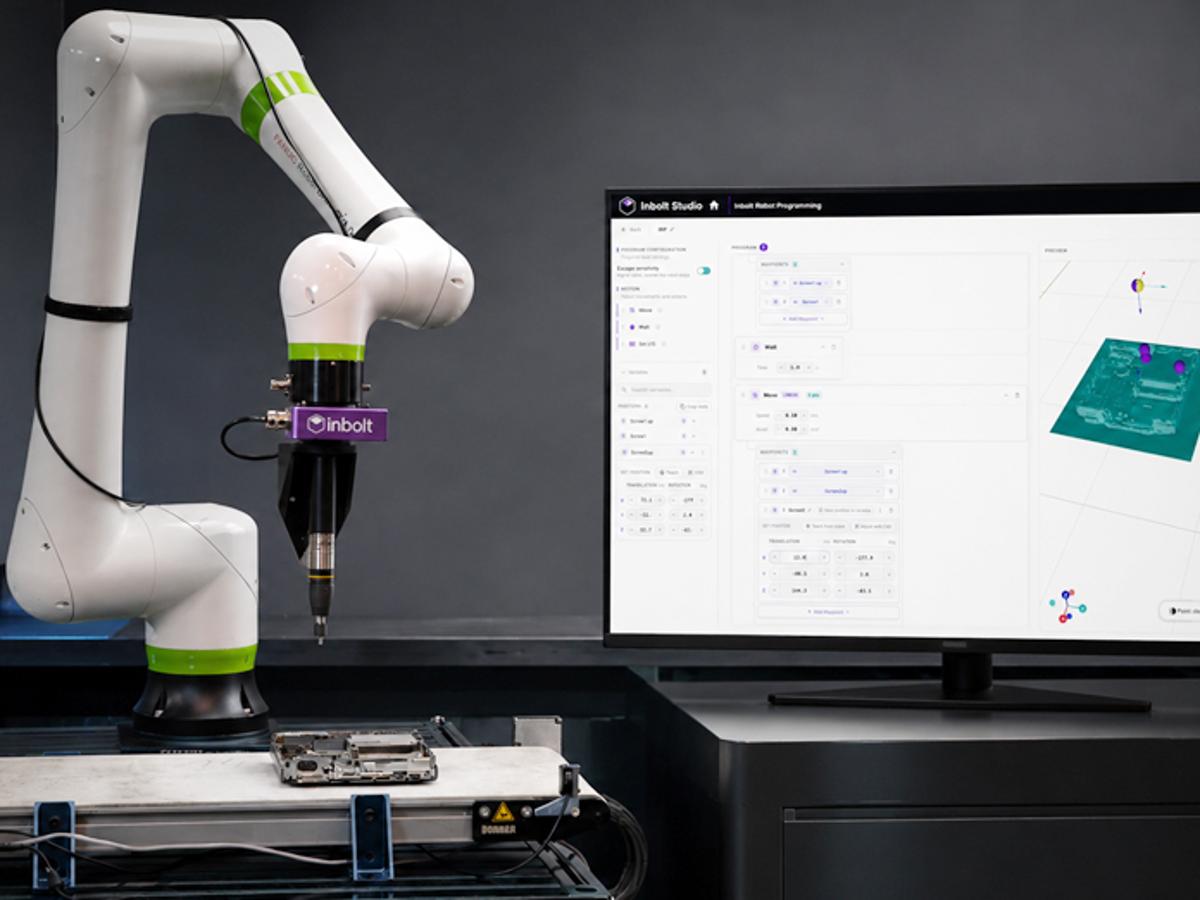
Automate 2026: Inbolt Launches Vision-Enabled Robot Programming Capabilities
Companies Mentioned
Why It Matters
The offering cuts robot deployment time from weeks to minutes, slashing engineering costs and accelerating automation rollouts. It also gives manufacturers a single AI intelligence layer that works across multiple robot brands, simplifying integration and future‑proofing assets.
Key Takeaways
- •One‑shot robot commissioning removes weeks of manual trajectory tuning
- •CAD‑based programming syncs digital twin with real‑world parts instantly
- •Native control now supports FANUC, KUKA, ABB, Universal Robots, Comau, Yaskawa
- •Vision model updates broaden part detection and provide live performance metrics
- •Unified AI layer streamlines multi‑brand robot fleets on existing hardware
Pulse Analysis
The manufacturing sector has long wrestled with a disconnect between digital twins and the physical reality of the shop floor. Engineers typically spend weeks hand‑tuning robot trajectories after a virtual commissioning phase, because even millimeter‑scale mismatches cause errors. Inbolt’s new Robot Programming tackles this friction by allowing programs to be authored directly on the CAD geometry; at runtime, a trained vision model identifies the exact part location and adjusts the robot’s path on the fly. This eliminates the iterative teach‑pendant process and turns the digital twin into a live, executable blueprint.
Beyond the programming breakthrough, Inbolt’s expanded Robot Control now runs natively on Yaskawa machines, joining FANUC, KUKA, ABB, Universal Robots and Comau. By streaming corrected joint commands at the robot’s native control frequency, the platform ensures that perception data and motion execution stay tightly coupled. The broader brand coverage means manufacturers can deploy a single AI layer across heterogeneous fleets without retrofitting hardware, a key advantage as factories adopt collaborative and mobile robots for mixed‑model production.
The updated vision model further strengthens Inbolt’s value proposition by supporting a wider array of parts and offering a dashboard that displays detection confidence, position data, and live performance tests. This transparency helps engineers troubleshoot edge cases and certify reliability for high‑mix, low‑volume lines. As AI‑driven automation accelerates, solutions that unify perception, planning and control—while remaining hardware‑agnostic—are poised to become the industry standard, giving early adopters a competitive edge in speed to market and cost efficiency.
Automate 2026: Inbolt launches vision-enabled robot programming capabilities
Comments
Want to join the conversation?
Loading comments...