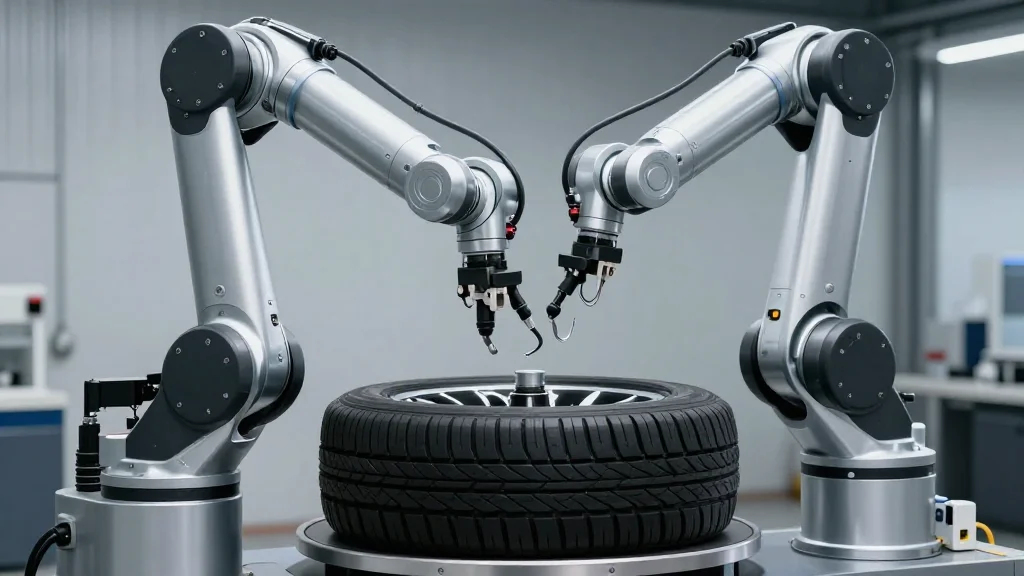
Automated Tire Unveils SmartBay, AI Robot That Changes Tires Without Removing Wheels

Why It Matters
SmartBay could reshape the economics of automotive after‑market service by decoupling labor availability from throughput. If the robot delivers on its time‑saving claims, shops may reduce staffing costs while handling higher volumes, a crucial advantage as the industry grapples with a shrinking pool of skilled technicians. Beyond cost, the technology signals a broader shift toward AI‑driven automation in traditionally manual trades. Successful deployment may encourage other service‑bay functions—such as brake servicing or suspension work—to explore robotic assistance, accelerating the digital transformation of automotive maintenance.
Key Takeaways
- •SmartBay changes and balances tires without removing the wheel, using a patented process
- •Targets a 45‑minute door‑to‑door service for four tires, with a goal of 30 minutes as AI improves
- •One technician can oversee up to three SmartBay‑equipped bays, boosting labor efficiency
- •Fits within a standard 12‑foot service bay, requiring minimal infrastructure changes
- •Addresses technician shortages and higher tire wear from electric‑vehicle adoption
Pulse Analysis
SmartBay arrives at a moment when the automotive service sector is under pressure from two converging trends: a chronic shortage of skilled technicians and the rapid adoption of electric vehicles, which often demand more frequent tire replacements due to higher torque and regenerative braking. By automating the most physically demanding steps—wheel lifting, tire dismounting, mounting and balancing—Automated Tire, Inc. is betting that the value of labor savings will outweigh the capital outlay for the robot.
Historically, automation in automotive repair has focused on diagnostics and paint shops, where repeatable processes lend themselves to robotics. Tire changing, however, has remained a manual craft because of the variability in wheel designs, sensor placements and environmental conditions. SmartBay’s use of computer vision to identify lug patterns, tire pressure monitoring sensors and road grime represents a technical leap that could set a new benchmark for adaptive robotics in the field.
The market impact will hinge on adoption speed and cost‑effectiveness. Dealerships with high service volume can amortize the equipment cost quickly, but independent shops may be slower to invest unless leasing models or performance‑based pricing emerge. Moreover, consumer perception will be critical; any high‑profile failure could stall broader acceptance. If SmartBay proves reliable, it may trigger a cascade of AI‑driven solutions across other service‑bay tasks, reshaping the labor landscape and potentially redefining the skill set required for future automotive technicians.
Automated Tire Unveils SmartBay, AI Robot That Changes Tires Without Removing Wheels
Comments
Want to join the conversation?
Loading comments...