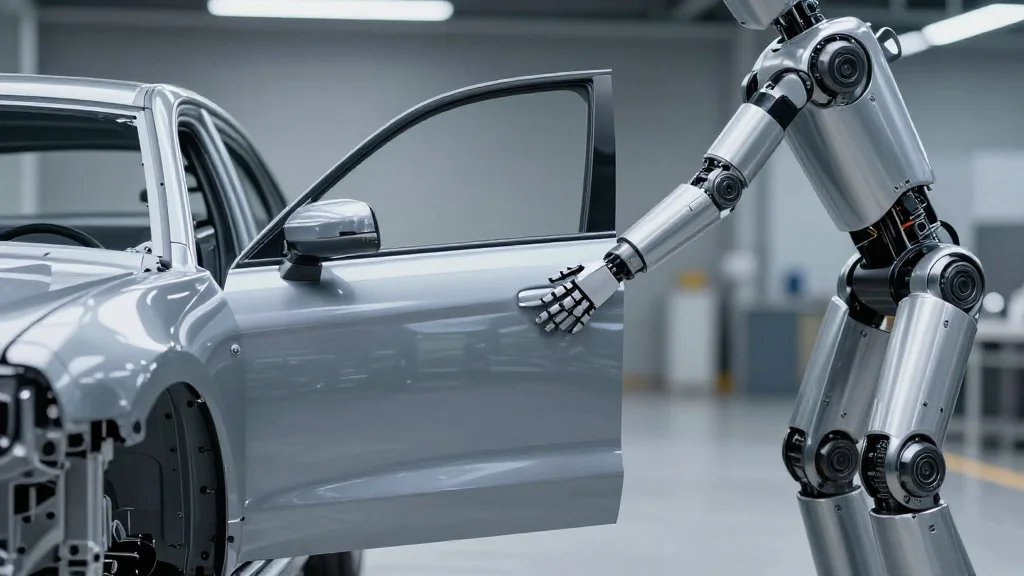
Automotive Manufacturing Expected to Fuel Humanoid Robot Growth
Companies Mentioned
Why It Matters
The shift promises to offset rising labor costs and safety risks in auto factories, accelerating broader industrial automation. Early success will set ROI benchmarks that influence robot adoption across logistics, aerospace, and consumer sectors.
Key Takeaways
- •Humanoid robot market projected $25 billion by early 2030s
- •Annual shipments could hit 1.8 million units by 2036
- •Average robot price expected to fall from $114,700 to $37,000 by 2030
- •Operating cost may drop below $5 per hour in high‑utilization plants
- •Payback period could shrink to six months for early adopters
Pulse Analysis
The surge in humanoid‑robot development is reaching a tipping point as automotive manufacturers seek to automate repetitive and hazardous tasks. A new IDTechEx forecast places the global market for humanoid robots at roughly $25 billion by the early 2030s, with annual shipments climbing toward 1.8 million units by 2036. Structured assembly lines, predictable workflows, and mounting labor‑cost pressures make car factories an ideal proving ground, positioning them as the largest early‑adoption segment among industrial users. The forecast also highlights a shift from traditional fixed‑axis arms toward anthropomorphic platforms capable of handling tools and parts with human‑like dexterity.
Cost dynamics are reshaping the business case for humanoid deployment. IDTechEx expects average selling prices to tumble from about $114,700 today to roughly $37,000 by 2030, while high‑utilization plants could run robots for less than $5 per hour. Yet price alone will not drive adoption; manufacturers must achieve seamless workflow integration, maintain operational stability, and secure sufficient task continuity to realize a six‑month payback—projected for successful pilots as early as 2026. Manufacturers that invest in advanced perception stacks and modular software will further compress integration timelines, unlocking additional cost savings.
The ripple effects extend beyond the factory floor. Faster, cheaper humanoids promise to alleviate labor shortages, reduce injury rates, and enable more flexible production schedules, potentially reshaping supply‑chain economics. Suppliers of sensors, AI software, and lightweight actuators stand to benefit from the scaling demand, while legacy equipment vendors may need to partner or acquire robotics capabilities to stay relevant. As automotive OEMs pilot these systems, the industry will gain critical data on ROI thresholds, informing broader adoption across logistics, aerospace, and even consumer‑grade applications. Regulators will also watch closely as robots assume roles previously reserved for humans, prompting updates to safety standards and liability frameworks.
Automotive Manufacturing Expected to Fuel Humanoid Robot Growth
Comments
Want to join the conversation?
Loading comments...