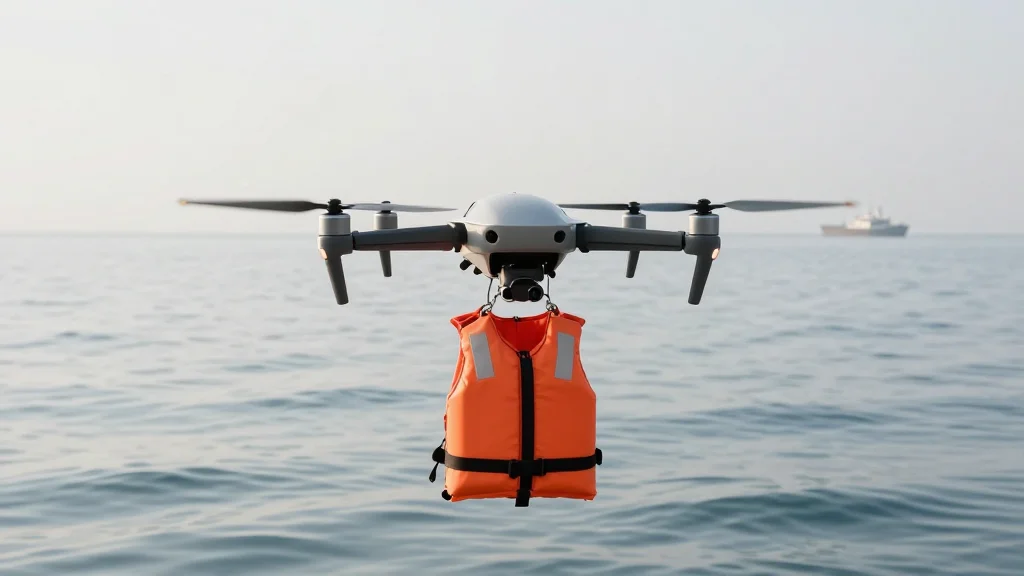
Autonomous Drone Can Deliver Life Jackets to People that Fall Overboard
Why It Matters
Reducing the response window from minutes to seconds can triple survival time in cold water, reshaping maritime safety standards and opening a market for automated rescue equipment.
Key Takeaways
- •Drone weighs 24.8 kg, carries 20 kg payload, 30‑minute flight
- •Three cameras (RGB, infrared, thermal) enable night and heat detection
- •Autonomous search algorithm predicts drift, achieving >80% detection rate
- •Landing time reduced to three seconds, preserving battery life
Pulse Analysis
The maritime industry has long struggled with the latency inherent in traditional man‑overboard rescues, where a vessel must decelerate, deploy a boat, and search in a limited visual range. By elevating the search platform to an autonomous drone, operators gain a bird’s‑eye view and can leverage thermal imaging to spot a victim even in darkness or rough seas. This technological leap not only accelerates the delivery of life‑saving equipment but also feeds precise GPS coordinates to nearby rescue vessels, streamlining coordination and reducing human error.
Beyond the immediate safety benefits, the drone’s modular design and payload capacity create new commercial opportunities. Shipping lines, cruise operators, and offshore platforms could integrate the system as a standard safety feature, potentially lowering insurance premiums and complying with stricter international regulations such as SOLAS amendments. The rapid three‑second landing capability further enhances operational efficiency, preserving the limited 30‑minute flight window for search rather than recovery. As autonomous navigation algorithms mature, we can expect scalability to larger fleets and integration with existing vessel monitoring systems.
Regulatory approval remains a hurdle, given the heavily governed maritime environment, but early adoption by coast guards could serve as a proving ground. Successful trials would generate data to satisfy classification societies and flag states, paving the way for broader market penetration. In the long term, the convergence of drone autonomy, AI‑driven drift modeling, and real‑time data sharing could redefine emergency response protocols across the global shipping industry, setting a new benchmark for life‑preserving innovation.
Autonomous drone can deliver life jackets to people that fall overboard
Comments
Want to join the conversation?
Loading comments...