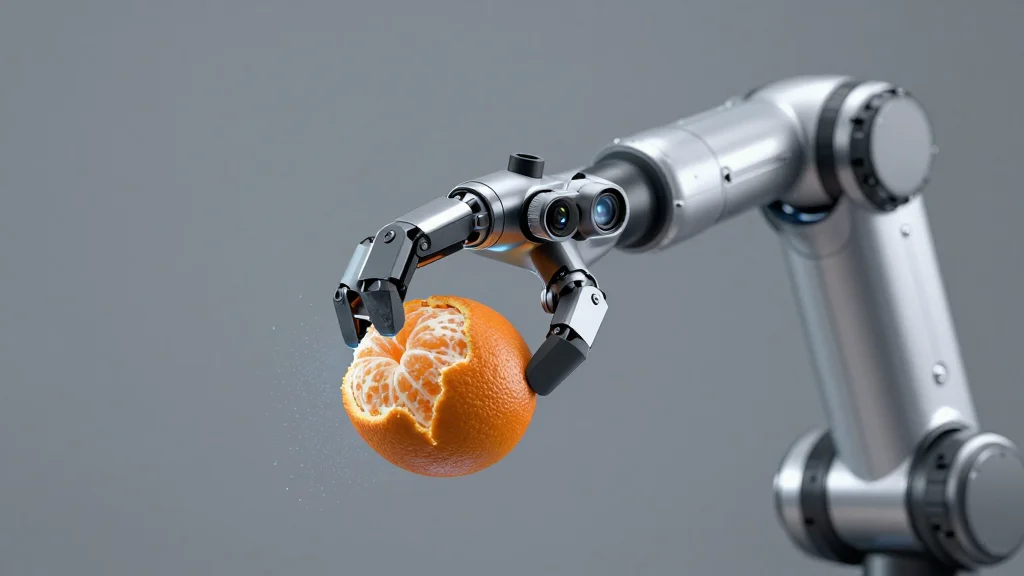
Bananas, Cups and Peelers: Robots Learn How to Handle Curved Objects Like Fruits and Tools
Why It Matters
The breakthrough reduces the need for bespoke programming, accelerating deployment of robots in domestic and industrial settings where shape variability is the norm. It paves the way for more adaptable, cost‑effective automation solutions.
Key Takeaways
- •Geometrically aware system maps surface directions for irregular objects
- •Stereo camera creates 3‑D point cloud guiding robot arm motions
- •Transfer learning lets robot apply one shape skill to another
- •Method tolerates partial, noisy data via diffusion smoothing
- •Future work aims to automate keypoint labeling for soft objects
Pulse Analysis
The new system hinges on a stereoscopic vision setup that captures a dense 3‑D point cloud of any object, from bananas to kitchen tools. By feeding this data into a diffusion‑based algorithm, the robot computes orientation fields that act as a dynamic guide for its manipulator. This object‑centric representation abstracts the task from specific geometries, allowing a single learned motion to be re‑applied to entirely new shapes without manual re‑programming.
In laboratory trials the robot demonstrated remarkable versatility, performing peeling, slicing and cleaning on objects it had never encountered before. The diffusion smoothing makes the method resilient to gaps and noise in the sensor feed, a common hurdle in real‑world environments. Such robustness could transform household automation, where robots must handle a plethora of everyday items, and also benefit manufacturing lines that deal with irregular parts, reducing change‑over times and engineering overhead.
Looking ahead, the researchers aim to eliminate the current requirement for manually labeled keypoints, leveraging AI to auto‑detect salient features on the fly. Extending the approach to soft, deformable objects like sponges will further broaden its applicability in food processing and healthcare. As the technology matures, it promises to lower integration costs and accelerate the adoption of flexible robotic assistants across consumer and enterprise markets.
Bananas, cups and peelers: Robots learn how to handle curved objects like fruits and tools
Comments
Want to join the conversation?
Loading comments...