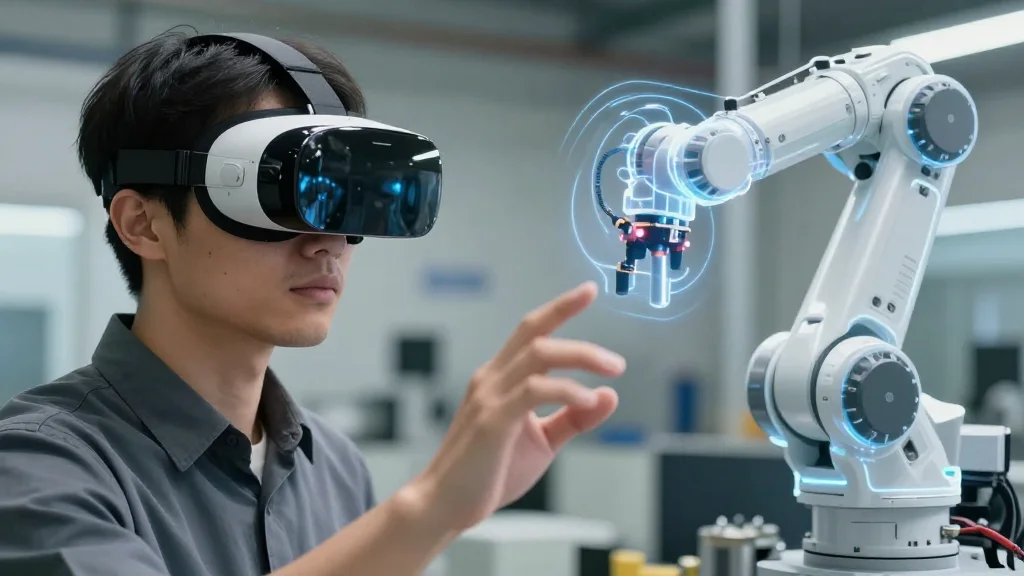
Beyond the Factory Floor: XR Training for the Next Industrial Era
Why It Matters
MASTER demonstrates how immersive training can cut costs, improve safety and accelerate workforce readiness for the next wave of automation, a critical need for manufacturers competing in the digital era.
Key Takeaways
- •MASTER offers code‑free robot programming via XR.
- •Platform integrates OpenXR and ROS for easy industrial adoption.
- •AI‑driven Dreamer tool accelerates creation of 3D training assets.
- •Users report high satisfaction and faster skill acquisition.
- •Future roadmap adds XR support for maintenance and technical assistance.
Pulse Analysis
Industry 4.0 is reshaping European factories, but the rapid rollout of collaborative robots creates a talent gap that traditional classroom methods struggle to fill. Immersive technologies such as virtual, augmented and mixed reality provide a safe sandbox where trainees can experiment with complex machinery without risking production downtime or safety incidents. MASTER, the EU‑funded Horizon initiative, capitalizes on this premise by delivering a cloud‑based XR environment that mirrors real‑world robotic cells, allowing multiple remote users to practice programming and operation in sync.
The platform’s differentiators lie in its low‑code approach and AI‑enhanced asset generation. By enabling code‑free robot programming and gaze‑based controls, even non‑engineers can orchestrate task sequences, while the Dreamer SDK extracts 3D meshes from image streams to populate training scenarios at speed. Integration with OpenXR and the open‑source ROS framework means factories can plug the solution into existing automation stacks without extensive re‑engineering. Early user feedback highlights improved comprehension of robotic kinematics and a measurable lift in confidence, translating into reduced onboarding time and lower training expenditures.
Looking ahead, MASTER’s roadmap envisions a shift from pure education to operational support, leveraging the same XR foundation for maintenance guidance and real‑time technical assistance. As Industry 5.0 emphasizes human‑centric production, the ability to overlay digital instructions onto physical equipment will become a competitive differentiator. The project’s open‑asset model also invites SMEs and large OEMs alike to contribute new modules, fostering an ecosystem that could standardize XR‑based training across the continent and accelerate the broader adoption of advanced manufacturing technologies.
Beyond the Factory Floor: XR Training for the Next Industrial Era
Comments
Want to join the conversation?
Loading comments...