Bio-Hybrid Robots Turn Food Waste Into Functional Machines
•December 22, 2025
0
Why It Matters
The approach proves that food‑industry by‑products can become high‑performance robotic components, advancing circular manufacturing and opening new avenues for sustainable automation.
Key Takeaways
- •Langoustine exoskeletons repurposed from food waste for robots
- •Hybrid design lifts 500 g, grasps diverse objects, swims 11 cm/s
- •Silicone coating extends lifespan; synthetic parts are reusable
- •Biological variability challenges uniform performance, needs tunable controllers
- •Approach opens path for sustainable bio‑hybrid implants and sensors
Pulse Analysis
The robotics community has long looked to nature for inspiration, yet most bio‑inspired machines still rely on metal, plastic or composite parts. This reliance limits the sustainability potential of such designs, as the manufacturing footprint remains comparable to conventional robots. By turning discarded crustacean shells into structural elements, EPFL’s CREATE Lab bridges the gap between biomimicry and circular economy, showing that waste streams can supply the high‑strength, flexible frameworks that nature has already optimized.
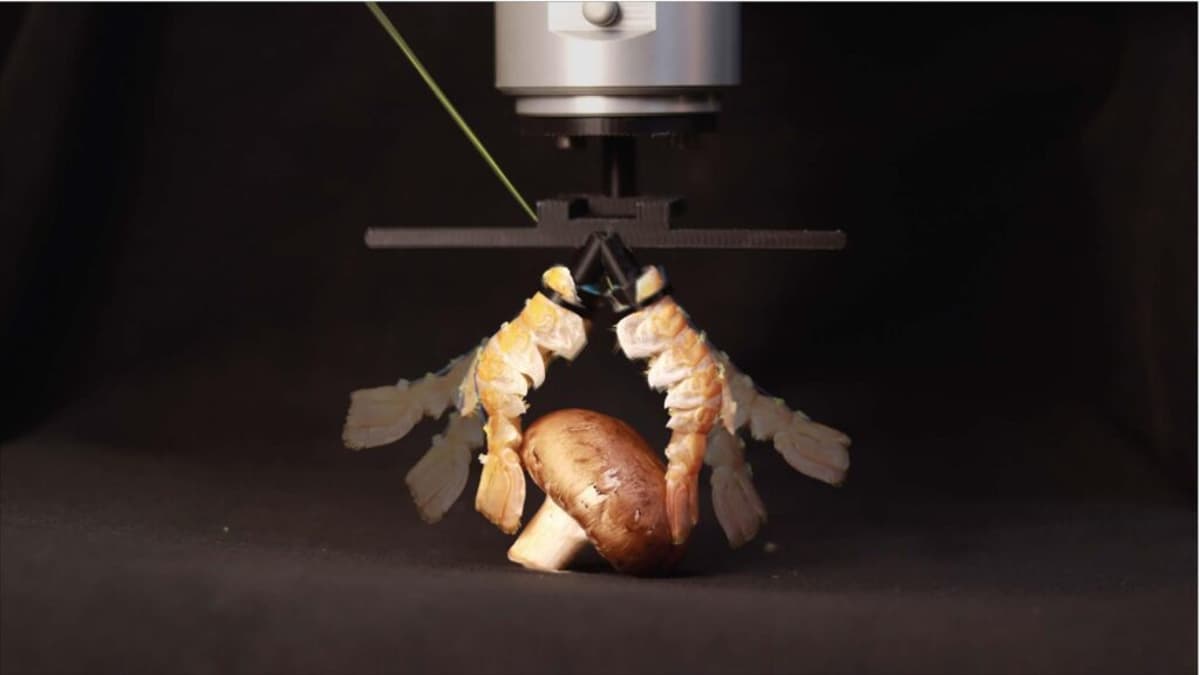
Technically, the researchers integrated a soft elastomer actuator within each exoskeleton segment and sealed the assembly with a silicone coating to protect against degradation. Mounted on a motorized base, the hybrid device demonstrated a 500‑gram payload capacity, a versatile gripper that adapts to irregular shapes, and a swimming robot that propels itself at 11 cm s⁻¹ using flapping fin‑like shells. Crucially, after a task cycle the synthetic components can be detached, cleaned and redeployed, while the biological shells can be composted or further processed, establishing a repeatable design‑operate‑recycle workflow.
The broader impact reaches beyond laboratory demos. Industries seeking greener supply chains—such as food processing, biomedical devices, and environmental monitoring—can leverage bio‑derived components to cut material costs and carbon footprints. Challenges remain, notably the inherent variability of natural parts, which demands adaptive control strategies. Nonetheless, the successful proof‑of‑concept signals a shift toward sustainable, bio‑hybrid automation that could redefine how engineers source and reuse materials in the next generation of intelligent machines.
Bio-hybrid robots turn food waste into functional machines
0
Comments
Want to join the conversation?
Loading comments...