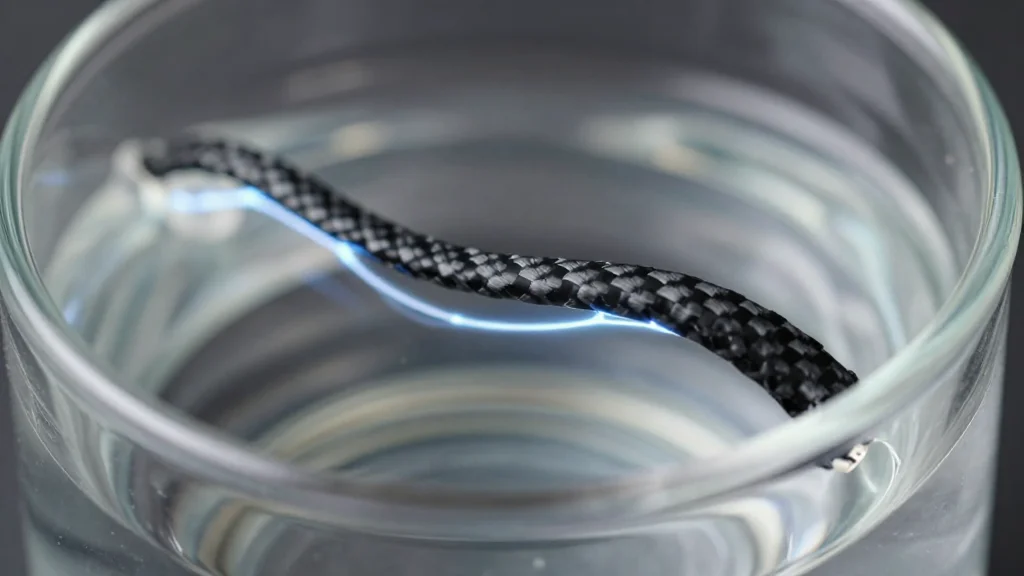
Carbon Fibers Bend and Straighten Under Electric Control
Why It Matters
The ability to electrically control pristine carbon fibers eliminates complex fabrication steps, opening scalable pathways for micro‑actuators and synthetic muscles in soft robotics and precision manipulation. It also offers a low‑weight, high‑strength alternative to existing smart‑material actuators.
Key Takeaways
- •Asymmetric ion insertion causes fiber bending.
- •No coatings needed; uses pristine carbon fibers.
- •Wireless actuation achieved with bipolar electrochemical cell.
- •Bending amplitude tunable by voltage and fiber length.
- •Potential for micro‑actuators in soft robotics.
Pulse Analysis
The rise of smart materials has transformed sensor and actuator design, yet most micro‑scale solutions require elaborate coatings or composite structures that hinder mass production. Carbon fibers, already prized for their tensile strength and low density, now join this arena as active elements that respond directly to electrical stimuli. By leveraging the intrinsic porosity of commercially available fibers, researchers bypass the need for additional functional layers, simplifying manufacturing pipelines and reducing cost.
The core of the technology is a closed bipolar electrochemical cell, where the fiber acts as a floating electrode immersed in an electrolyte containing lithium perchlorate and a benzoquinone/hydroquinone redox couple. When a voltage is applied, ions intercalate preferentially into the rough side of the fiber, creating an uneven electrical double layer that generates differential strain and causes the fiber to bend. Reversing the potential expels the ions, restoring the original shape. This reversible, wireless actuation is controlled by voltage magnitude, pulse duration, and fiber length, offering precise tuning of motion without direct wiring—a critical advantage at micrometer scales.
The implications extend across soft robotics, micromanipulation, and biomedical devices. Arrays of such fibers could function as synthetic muscles, providing rapid, lightweight actuation for wearable exosuits or minimally invasive surgical tools. Moreover, the principle is adaptable: altering pore geometry, surface chemistry, or electrolyte composition can tailor response speed, bending direction, and operating voltage. As industries seek scalable, high‑performance micro‑actuators, carbon‑fiber‑based systems present a compelling, versatile platform poised for rapid commercialization.
Carbon fibers bend and straighten under electric control
Comments
Want to join the conversation?
Loading comments...