Cevotec Advances Robotic Lamination to Close Automation Gap in Complex Composite Aerostructures
Why It Matters
The solution bridges the automation gap in aerospace composites, cutting labor dependence and boosting throughput, which can lower costs and accelerate program schedules for manufacturers.
Key Takeaways
- •Samba system enables robotic lamination of complex composite geometries
- •Step Retrofit Kit upgrades existing robots with FPP-based layup
- •cevoGripper provides conformable fiber handling for tight radii
- •cevoVision validates patch dimensions before placement, ensuring repeatability
- •Modular retrofit allows phased automation investment matching production needs
Pulse Analysis
The aerospace industry relies on high‑performance composite aerostructures to meet weight‑saving and fuel‑efficiency targets, but manufacturing these parts remains labor‑intensive. Automated fiber placement (AFP) has improved productivity for large, relatively flat panels, yet it falters on mid‑size components with tight radii, double curvatures, or transition zones where tool access is limited. As a result, many critical sections still depend on skilled technicians, creating bottlenecks and variability in quality. Closing this automation gap is essential for scaling production of next‑generation aircraft and defense platforms.
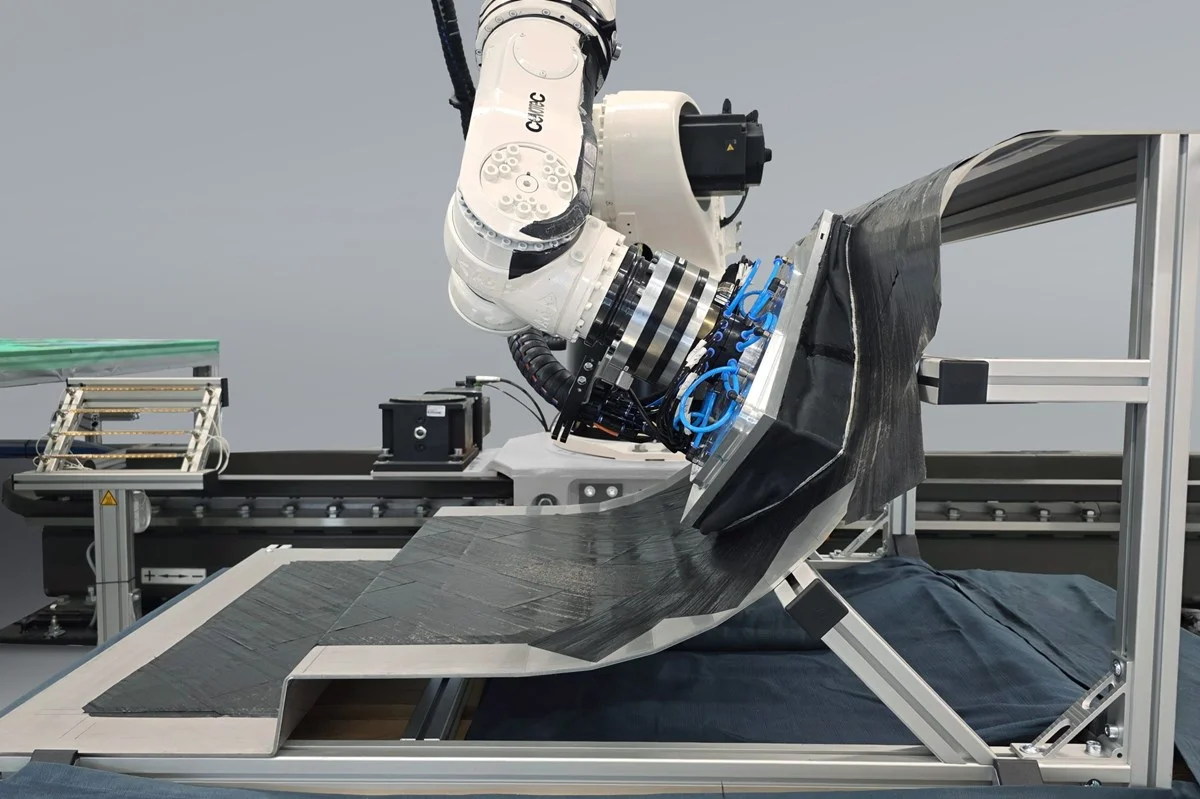
Cevotec’s Samba platform tackles the gap by applying fiber patch placement (FPP) through robotic lamination. The system executes direct‑push, rolling and multi‑push‑roll motions, allowing patches to conform continuously to complex 3‑D surfaces. The newly launched Samba Step Retrofit Kit transforms existing robot cells into FPP‑capable workstations without a full line redesign. It bundles the cevoGripper end‑effector for adaptive handling, the cevoVision vision system for real‑time dimensional verification, and Samba_OS with Artist Studio software for automated program generation. This modular approach delivers repeatable layup, tighter tolerances and reduced scrap.
The ability to automate previously manual features promises measurable cost reductions and shorter cycle times for aerospace OEMs and tier‑1 suppliers. By shifting layup rates from labor‑driven to robot‑driven processes, manufacturers can scale production volumes while maintaining consistent quality, a critical factor for high‑mix, low‑volume programs. Moreover, the retrofit model lowers entry barriers, enabling incremental investment aligned with demand growth. As composite usage expands across commercial, military and space sectors, solutions like Cevotec’s are poised to become a standard component of the digital manufacturing toolkit.
Cevotec advances robotic lamination to close automation gap in complex composite aerostructures
Comments
Want to join the conversation?
Loading comments...