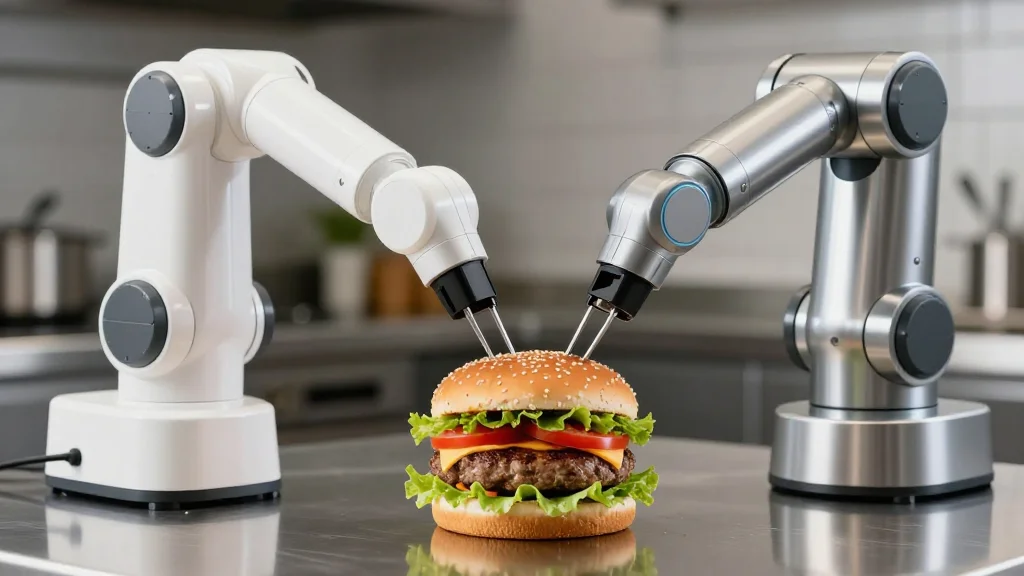
Chef Robotics Advances Bi-Manual Physical AI System for Prep Table Food Assembly Powered by a Food Foundation Model
Why It Matters
The technology brings advanced robotics to the fragmented, labor‑intensive prep‑table segment, unlocking efficiency and consistency for a wide range of foodservice operators. By leveraging a foundation model, Chef reduces development time and enables rapid adaptation to new menus, giving adopters a competitive edge.
Key Takeaways
- •Bi‑manual robot handles complex prep‑table assembly tasks
- •Food Foundation Model enables single AI for diverse food manipulations
- •System learns via imitation, reducing programming time
- •Designed for wash‑down, food‑safe environments across venues
- •Supports zero‑shot ingredient onboarding and self‑improvement
Pulse Analysis
Physical artificial intelligence is moving beyond assembly lines into the chaotic world of back‑of‑house prep tables, where a single worker must combine dozens of ingredients into a finished dish. Chef Robotics, known for high‑throughput conveyor‑line robots that have already produced over 100 million servings, announced a new bi‑manual system that tackles lower‑volume, higher‑complexity tasks such as burger and burrito assembly. By adding two coordinated arms, the robot can mimic human dexterity, opening automation possibilities for ghost kitchens, hospitals, stadiums and other venues that still rely heavily on manual labor.
The breakthrough is powered by Chef’s Food Foundation Model (FFM), a single foundation model that replaces a suite of task‑specific vision‑language‑action networks. Trained through imitation learning, the FFM watches human demonstrations and extracts task representations that transfer across different robot kinematics and end‑effectors. This approach overcomes the limitations of conventional models that struggle with deformable, wet, or sticky food items. The model also supports language‑prompted commands, zero‑shot ingredient onboarding, and continuous self‑improvement, allowing new menu items to be added with minimal data.
From a business perspective, the bi‑manual AI system expands Chef’s addressable market from large‑scale manufacturers to the fragmented prep‑table segment that represents billions of dollars in annual foodservice spend. Its food‑safe, wash‑down hardware and collaborative design enable safe operation alongside human staff, reducing labor costs while maintaining consistency and yield. As restaurants and institutional cafeterias seek to scale operations post‑pandemic, a flexible, learning‑driven robot that can adapt to new recipes quickly becomes a strategic asset. The technology signals a shift toward generalized, foundation‑model‑driven robotics across the broader food industry.
Chef Robotics Advances Bi-Manual Physical AI System for Prep Table Food Assembly Powered by a Food Foundation Model
Comments
Want to join the conversation?
Loading comments...