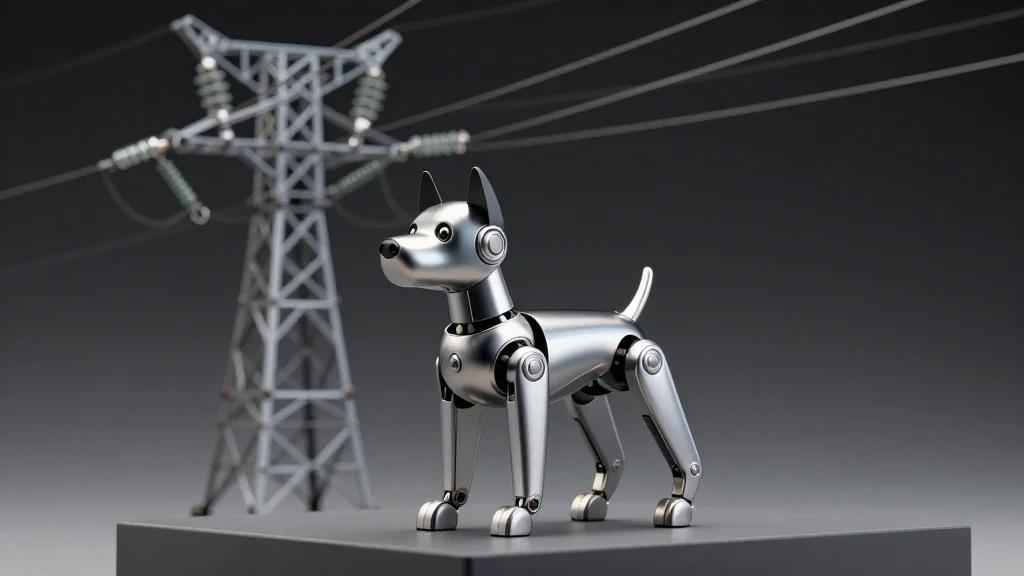
China Invests $1 Billion in 8,500 Humanoid and Robot Dogs for Power‑Grid Automation

Why It Matters
China’s $1 billion robot investment marks a watershed for industrial automation, demonstrating that large‑scale, government‑driven robotics can be applied to critical national infrastructure. By automating inspection and maintenance, the initiative promises to improve grid reliability, lower operational costs, and reduce occupational hazards for line workers. The move also signals to global manufacturers that China is willing to fund cutting‑edge robotics at a scale that can reshape supply chains and set new performance benchmarks for power‑grid management worldwide. The deployment highlights a strategic divergence in how major economies address aging infrastructure. While the United States debates massive capital projects and regulatory reforms, China is betting on AI‑enabled robotics to extend the lifespan of existing assets. This contrast could influence future policy debates, as other nations observe whether autonomous systems can deliver the promised efficiency gains without the need for wholesale grid replacement.
Key Takeaways
- •State Grid Corporation of China allocated 6.8 billion yuan (~$1 billion) for robotics procurement.
- •8,500 robots will be purchased, including 5,000 quadruped robot dogs and thousands of humanoid/dual‑arm units.
- •Robots will handle inspection of substations, transmission lines, and maintenance of ultra‑high‑voltage equipment.
- •Pilot deployments slated for three provinces by end‑2026, with nationwide rollout planned for 2027.
- •The program aims to cut outage frequency, maintenance costs, and worker injury rates.
Pulse Analysis
China’s decision to pour a billion dollars into grid robotics is less about a single technology push and more about cementing a broader strategic narrative: that autonomous systems can safeguard national security by protecting the backbone of the economy. Historically, large‑scale automation projects have struggled with integration challenges, but the convergence of mature legged‑robot platforms, edge AI, and high‑bandwidth communications reduces those barriers. By embedding robots directly into the SCADA ecosystem, China is creating a feedback loop where data collected by autonomous agents informs real‑time grid control, potentially ushering in a new era of predictive maintenance.
From a competitive standpoint, the procurement gives domestic firms a massive, guaranteed revenue stream, allowing them to achieve economies of scale that foreign rivals cannot match. Companies such as DJI (known for drones) and emerging Chinese legged‑robot startups are likely to secure contracts, accelerating their R&D pipelines. This could shift the global robotics supply chain eastward, pressuring Western manufacturers to either partner with Chinese firms or accelerate their own government‑backed programs.
Finally, the initiative may reshape policy discourse beyond China. If the robot‑driven grid demonstrates measurable reliability gains, it could provide a template for other nations facing similar infrastructure dilemmas, especially those with limited fiscal space for massive grid overhauls. The key question remains whether the technology can deliver on its promises at scale, or whether the robots will become another costly pilot that never fully integrates. The next two years will be the proving ground, and the outcomes will likely inform the next wave of public‑sector robotics investment worldwide.
China Invests $1 Billion in 8,500 Humanoid and Robot Dogs for Power‑Grid Automation
Comments
Want to join the conversation?
Loading comments...