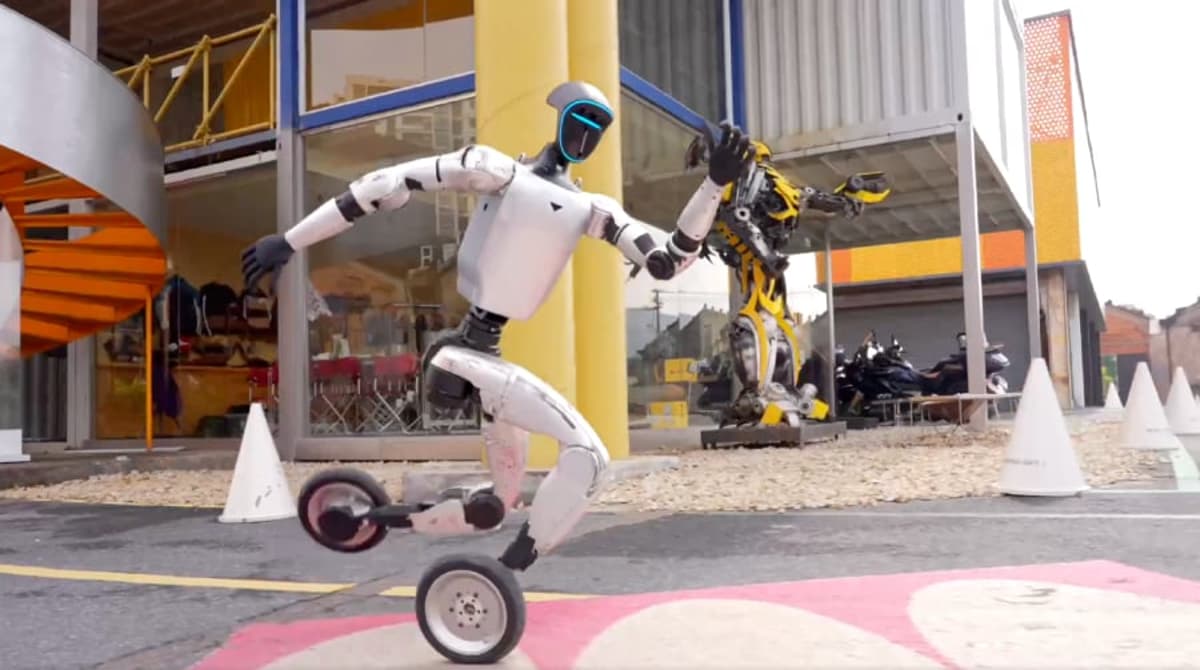
China’s Unitree G1 Humanoid Robot Skates, Spins, and Flips in New Demo

Why It Matters
Hybrid locomotion bridges the efficiency‑versus‑adaptability gap, making humanoid robots more viable for real‑world tasks and accelerating commercial adoption across industries.
Key Takeaways
- •G1 combines wheels, legs, and skates for real‑time locomotion switching
- •Hybrid design cuts energy use while keeping terrain adaptability
- •AI‑driven simulation trains complex moves before physical execution
- •Unitree positions G1 as a general‑purpose platform for data collection
- •Demo highlights feasibility of balance on slippery ice surfaces
Pulse Analysis
The latest video from Unitree Robotics showcases its G1 humanoid robot gliding on roller‑skates, ice‑skates, spinning on a single leg and even executing front flips. Unlike most humanoids that rely solely on articulated legs, the G1 features a hybrid chassis that can instantly switch between legged walking, wheeled rolling and skated motion. This flexibility lets the robot travel quickly across smooth floors while retaining the ability to negotiate uneven terrain, a long‑standing trade‑off in mobile robotics. The demonstration underscores how far locomotion control has progressed in just a few years.
The fluidity of the G1’s movements stems from advanced AI‑driven motion planning and high‑fidelity simulation training. Engineers feed the robot thousands of virtual scenarios, allowing it to learn balance adjustments for low‑friction surfaces such as ice before any hardware test. By merging wheel efficiency—lower power consumption and higher speed—with leg agility, the platform reduces operational energy by an estimated 30 % compared with pure‑leg designs. This hybrid approach also simplifies mechanical complexity, as wheels handle routine transport while legs engage only when obstacles demand.
From a market perspective, Unitree’s hybrid humanoid could accelerate adoption of general‑purpose robots in logistics, retail and research labs, where both speed and dexterity are prized. The G1‑D variant already bundles multiple cameras and interchangeable hands, positioning the system as a data‑collection hub for training embodied AI models. Competitors such as Boston Dynamics and AgiBot are racing to add similar multimodal locomotion, suggesting a shift toward versatile platforms rather than niche specialists. If the G1 can replicate its demo performance in uncontrolled environments, it may set a new benchmark for commercial humanoid robotics.
China’s Unitree G1 Humanoid Robot Skates, Spins, and Flips in New Demo
Comments
Want to join the conversation?
Loading comments...