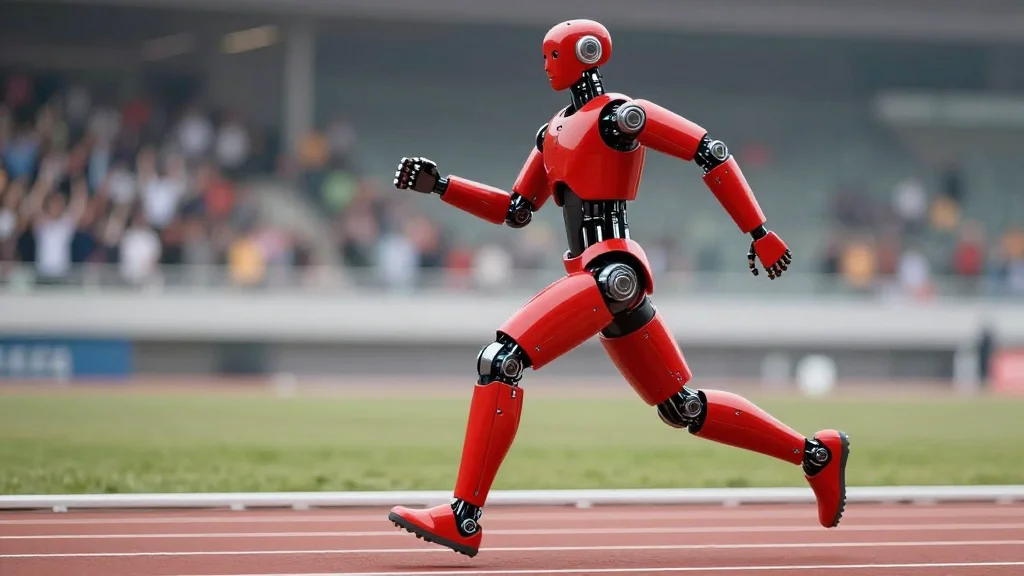
Chinese Humanoid Robot Lightning Beats Half-Marathon World Record in Beijing

Companies Mentioned

Why It Matters
Lightning’s record‑breaking run signals that humanoid robots are moving from controlled labs into unpredictable public spaces, a transition that could reshape logistics, manufacturing, and public safety. By demonstrating sub‑hour endurance on uneven city streets, the robot validates edge‑computing architectures that process sensor data locally, reducing reliance on cloud latency and opening pathways for real‑time decision‑making in critical applications. The achievement also intensifies the technology rivalry between China and the United States. While U.S. firms have historically led in sophisticated bipedal platforms, China’s state‑backed push and rapid iteration cycles could narrow the gap, influencing global supply chains, talent flows, and future standards for human‑robot interaction.
Key Takeaways
- •Lightning completed the 21.1‑km half‑marathon in 50:26, beating the human record of 57:20 by ~7 minutes.
- •More than 300 robots from 26 teams raced alongside 12,000 human participants in Beijing.
- •Last year’s winning robot finished in 2:40:42; this year’s time reflects a 70% improvement in speed.
- •IDC forecasts >510,000 humanoid robot shipments by 2030, a ~95% CAGR.
- •China’s Q1 industrial robot output rose 33.2% YoY, underscoring rapid sector growth.
Pulse Analysis
Lightning’s performance is less a one‑off stunt and more a bellwether for the commercialization trajectory of humanoid robotics. Historically, breakthroughs in bipedal locomotion have been incremental—Boston Dynamics’ Atlas, for example, took years to achieve stable running. Honor’s ability to compress that timeline into a single competitive season suggests that Chinese firms are leveraging massive data pipelines, government subsidies, and a dense ecosystem of component suppliers to accelerate development cycles.
From a market perspective, the race underscores a shift from niche research prototypes to products that can generate revenue streams. If Honor can package the underlying perception and control stack into a modular kit, it could undercut Western incumbents on price while offering comparable performance. This would force established players to either double down on premium, highly specialized applications or to seek strategic alliances with Chinese manufacturers.
Strategically, the event serves as a soft power showcase. By framing the robot’s victory as a national achievement, Beijing signals its intent to lead in next‑generation automation, potentially influencing standards bodies and export policies. However, rapid scaling also brings regulatory challenges: safety certifications, liability frameworks, and public acceptance will need to keep pace with technical advances. The next quarter will likely see policymakers grapple with these issues as pilots move from test tracks to warehouses and hospitals.
Chinese Humanoid Robot Lightning Beats Half-Marathon World Record in Beijing
Comments
Want to join the conversation?
Loading comments...