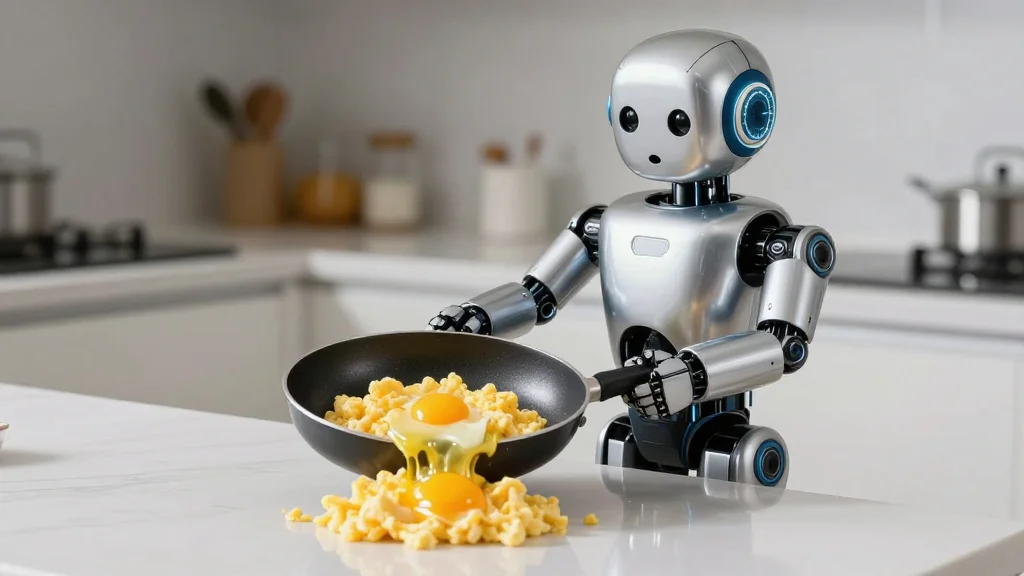
Chinese SeeLight S1’s Egg Disaster Fuels Debate on Home Robot Viability

Why It Matters
The SeeLight S1 episode underscores a pivotal moment for consumer robotics: the transition from controlled lab settings to unpredictable home environments. As China’s aging demographic creates a looming demand for assistive technologies, the ability of robots to perform simple, everyday tasks reliably will determine market adoption and shape investment flows. Moreover, the government’s digital ID mandate signals a regulatory environment that could either accelerate trust in humanoids or impose burdens that slow commercialization. If GigaAI can resolve the dexterity and AI perception gaps highlighted by the egg demo, it could set a template for mass‑market domestic robots worldwide. Conversely, repeated high‑profile failures may reinforce consumer skepticism, limiting the sector’s growth to niche industrial or research applications and prompting competitors to focus on more incremental, task‑specific devices.
Key Takeaways
- •GigaAI’s SeeLight S1 costs about $28,000 and is equipped with two claw‑like arms on a wheeled base.
- •A public demo showed the robot producing overcooked scrambled eggs and undercooked tomatoes, sparking criticism.
- •China plans to begin household trials of the SeeLight S1 in Wuhan homes in early 2027, with a price‑cut goal of 50% by 2028.
- •The HEIS program has assigned unique 29‑digit IDs to over 28,000 humanoid robots across 200 models to monitor safety.
- •Demographic pressures—an aging population and shrinking workforce—are driving Chinese firms to prioritize elder‑care robot applications.
Pulse Analysis
The SeeLight S1 mishap is less a technical footnote than a market inflection point. Historically, home robotics has been dominated by low‑cost, single‑function devices—robot vacuums, lawn mowers, and pet feeders. GigaAI’s ambition to bundle cooking, cleaning, and caregiving into a single platform represents a bold, high‑risk bet on embodied AI. The scrambled‑egg failure illustrates the current limits of perception‑action loops: visual recognition, force control, and real‑time decision‑making still lag behind human intuition in cluttered, variable settings.
China’s regulatory response—mandatory digital IDs—could become a competitive advantage if it builds consumer confidence in safety and traceability. However, the added compliance overhead may raise production costs, potentially offsetting the aggressive price‑reduction roadmap. Competitors like Japan’s SoftBank Robotics and South Korea’s Hyundai Robotics are watching closely; any misstep by GigaAI could open space for more modest, modular solutions that avoid the all‑in‑one promise.
Looking forward, the decisive factor will be iterative learning at scale. If GigaAI can collect extensive household interaction data during the 2027 Wuhan pilots and feed it back into its AI models, the robot’s performance could improve dramatically within a few years. Yet the public’s tolerance for early‑stage blunders is thin, especially when the product is marketed as a caregiver for vulnerable seniors. The next six months—when the first families interact with the SeeLight S1—will likely determine whether China’s domestic robot dream advances or retreats to a more cautious, incremental path.
Chinese SeeLight S1’s Egg Disaster Fuels Debate on Home Robot Viability
Comments
Want to join the conversation?
Loading comments...