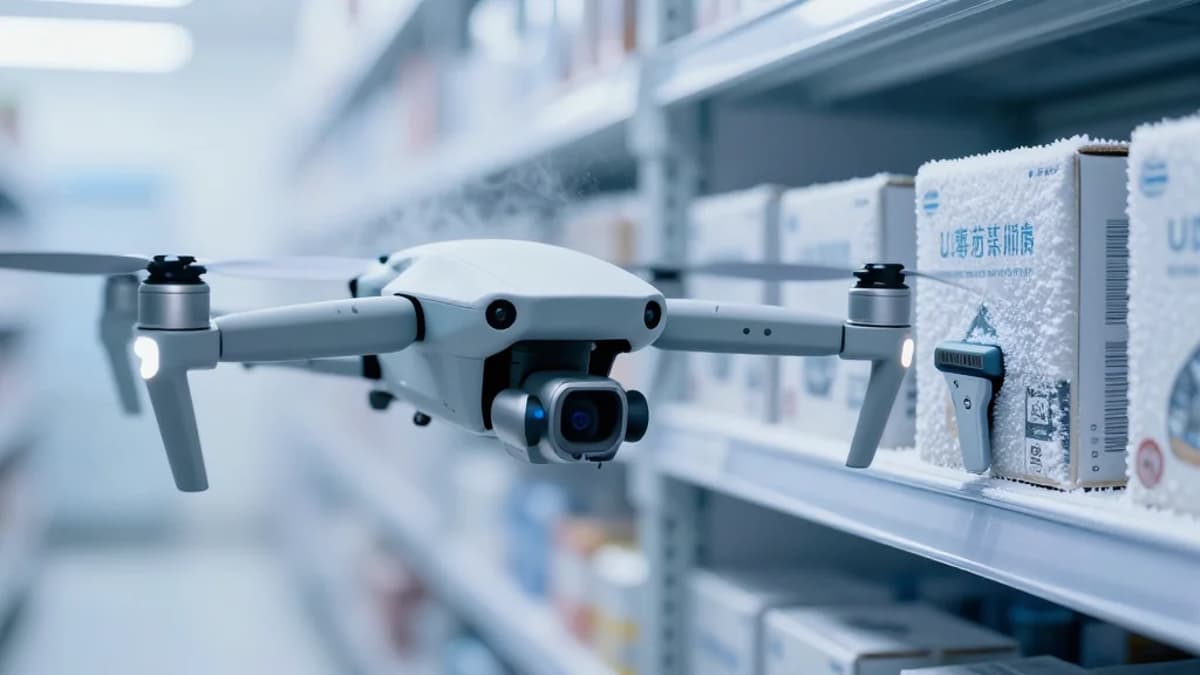
Corvus Robotics Launches Dedicated Cold Chain Drones for Autonomous Inventory in Sub-Zero Warehouses
•February 9, 2026
0
Companies Mentioned

Why It Matters
By automating freezer inventory, the system cuts labor costs, enhances worker safety, and provides real‑time data critical for fast‑moving, perishable SKUs in the cold‑chain market.
Key Takeaways
- •Drones operate down to -20 °F without human intervention
- •Continuous cycle counts improve freezer inventory accuracy
- •Reduces labor exposure and associated safety risks
- •Adaptive barcode scanners read frosted labels reliably
- •Operates without Wi‑Fi, markers, or lighting modifications
Pulse Analysis
Cold‑chain logistics has long struggled with accurate inventory in sub‑zero environments, where temperature swings, condensation and limited human access impede traditional scanning methods. Existing solutions often rely on fixed scanners or manual counts, leading to delayed data, higher labor expenses, and safety concerns for workers braving freezer aisles. Corvus Robotics’ entry addresses this gap by marrying autonomous aerial platforms with ruggedized sensing, enabling continuous, high‑frequency inventory audits that keep pace with rapid SKU turnover and strict FIFO requirements.
The technical breakthrough lies in the drones’ thermal‑insulated chassis, AI‑driven flight control, and industrial‑grade barcode cameras that auto‑adjust focus and exposure despite frost or glare. By eliminating the need for Wi‑Fi, localization markers or specialized lighting, the system integrates seamlessly into existing warehouse layouts. Its Robots‑as‑a‑Service model further reduces upfront capital, offering subscription‑based access to hardware, software updates, and automated battery management, as demonstrated in Kroger’s pilot where labor exposure dropped dramatically and inventory accuracy improved.
Industry analysts see this as a catalyst for broader cold‑chain automation, especially as frozen food sales and pharmaceutical temperature‑sensitive products expand. Companies adopting Corvus One can expect lower operational costs, enhanced safety compliance, and data‑driven replenishment that optimizes space utilization. Competitors will need comparable resilience to extreme temperatures to stay relevant, positioning Corvus Robotics as a potential benchmark for next‑generation warehouse robotics.
Corvus Robotics Launches Dedicated Cold Chain Drones for Autonomous Inventory in Sub-Zero Warehouses
0
Comments
Want to join the conversation?
Loading comments...