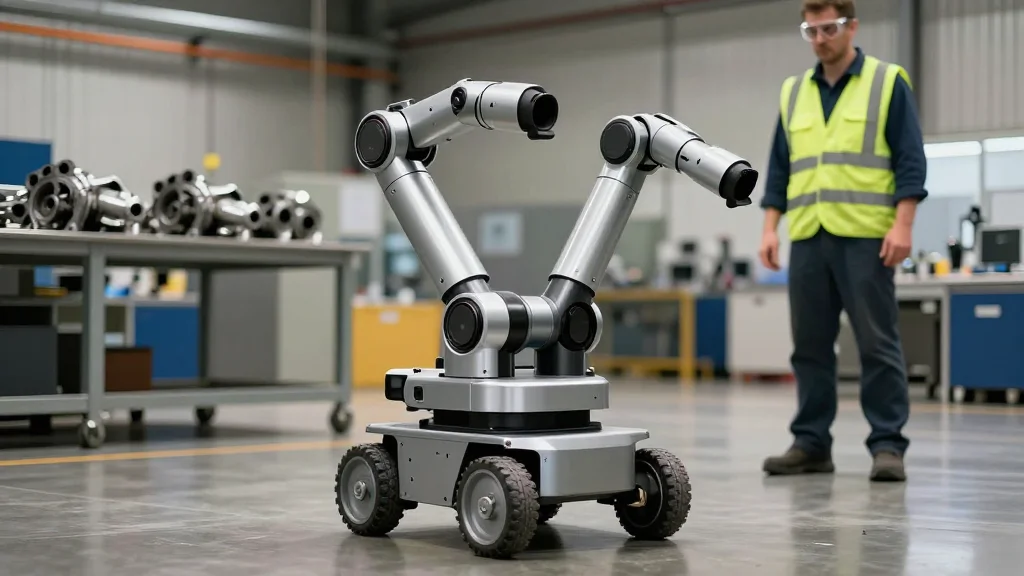
Daegu Launches First Mobile Dual‑Arm Robot on Automotive Parts Plant

Why It Matters
The deployment signals a shift from static, single‑arm automation toward mobile, multi‑arm systems that can adapt to changing production layouts. For manufacturers, this promises higher utilization of floor space and the ability to reconfigure workcells without costly infrastructure changes. For the robotics industry, the pilot validates a new class of hardware that blends the flexibility of autonomous mobile robots with the dexterity of dual‑arm manipulators, potentially opening a market segment that bridges traditional cobots and fully autonomous factory robots.
Key Takeaways
- •Daegu city launches Korea's first field demo of a mobile dual‑arm robot at SL's plant.
- •Robot jointly developed by SL and Neuromeka, supervised by Daegu Mechatronics & Materials Institute.
- •Project funded by the Ministry of Trade, Industry and Energy's Megacity Cooperation Advanced Industry Development Support Project.
- •Dual‑arm AMR will handle full substrate processing workflow, aiming to improve efficiency and safety.
- •Three‑month pilot will inform a possible wider rollout across Daegu and export opportunities.
Pulse Analysis
South Korea has long been a leader in industrial robotics, but most deployments have relied on fixed, single‑arm cobots that require dedicated safety zones. The Daegu pilot breaks that mold by introducing mobility and dual‑arm dexterity, a combination that could redefine how factories think about automation footprints. Historically, manufacturers hesitated to adopt mobile robots due to concerns over safety and reliability; the dual‑arm approach mitigates these worries by enabling more human‑like interaction, which can be easier for workers to trust.
From a market perspective, the successful demonstration could catalyze a wave of investments in similar platforms, especially as OEMs seek to future‑proof their lines against rapid product variation. Companies like Fanuc and ABB have already hinted at mobile cobot concepts, but a proven, production‑grade system could give Korean firms a competitive edge. Moreover, the involvement of the Daegu Mechatronics & Materials Institute suggests a strong academic‑industry pipeline that can accelerate iterative improvements.
Looking ahead, the key challenge will be scaling the technology while keeping integration costs low. If the pilot delivers measurable gains—such as a 15‑20% reduction in cycle time or a noticeable drop in worker injury reports—larger manufacturers may adopt the model, prompting a shift toward more fluid, collaborative factories across Asia and beyond.
Daegu Launches First Mobile Dual‑Arm Robot on Automotive Parts Plant
Comments
Want to join the conversation?
Loading comments...