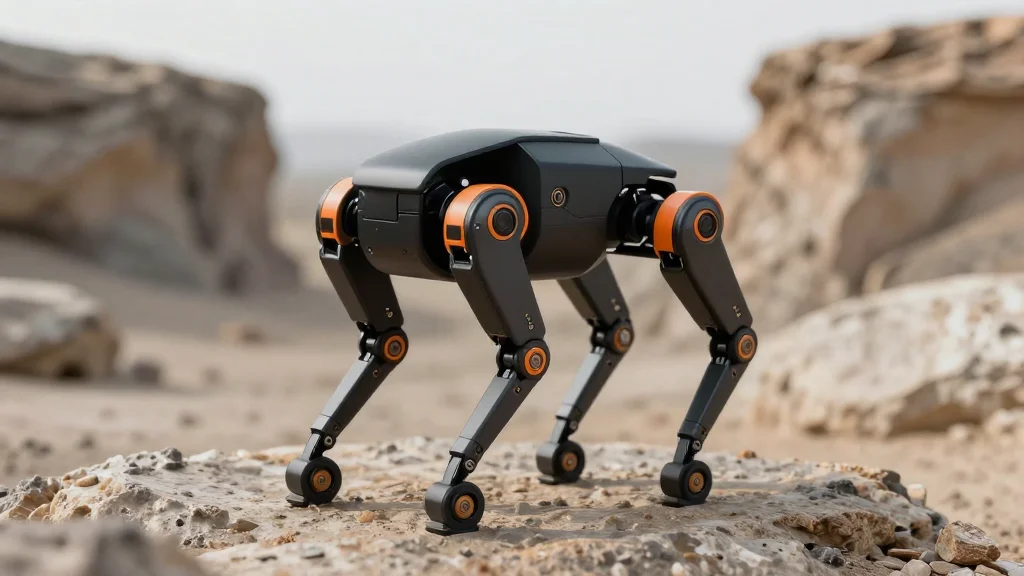
Deepvein Mining Tech Wins Gold for Quadrupedal Exploration Robots, Cutting Survey Time by 95%

Why It Matters
The Deepvein award highlights a turning point where autonomous robotics move from niche prototypes to commercially viable tools that directly impact mining economics. By compressing exploration timelines and reducing costs, the technology addresses two of the industry's most pressing challenges: the need for rapid resource identification and the imperative to lower capital expenditures amid volatile commodity prices. Additionally, the safety benefits—minimizing human exposure to hazardous environments—align with growing ESG expectations, making robotic solutions attractive to investors and regulators alike. If adopted at scale, Deepvein’s quadrupedal robots could reshape the competitive landscape, forcing traditional equipment suppliers to integrate advanced autonomy or risk obsolescence. The ripple effect may also stimulate ancillary markets, such as AI‑driven data analytics and remote operation services, further embedding digital transformation within the mining sector.
Key Takeaways
- •Deepvein Mining Tech wins Gold at the 2026 NY Product Design Awards for its quadrupedal exploration robots
- •Robots reduce data‑collection cycles from ~12 months to one week, a 95% time reduction
- •Workflow costs drop by roughly 40% on African mining assets
- •Each robot can autonomously gather 30‑50 geological samples per operating cycle
- •Company plans to expand the platform to transport, inspection, maintenance and site rehabilitation
Pulse Analysis
Deepvein’s triumph reflects a broader inflection point in the mining industry, where the economics of discovery are being reengineered by autonomous systems. Historically, exploration has been a capital‑intensive, high‑risk phase, often consuming 30‑40% of a project’s total budget. By delivering a 40% cost cut and compressing the timeline to a week, Deepvein not only improves the internal rate of return for mining firms but also reshapes the risk profile for investors. The quadrupedal design, reminiscent of Boston Dynamics’ Spot, demonstrates that legged locomotion can now be reliably deployed in the abrasive, temperature‑extreme environments of mineral deposits—a capability that wheeled or tracked platforms have struggled to match.
Competitors such as Caterpillar and Komatsu have announced their own autonomous drilling and haulage solutions, yet few have presented a fully integrated sampling robot that couples hardware agility with end‑to‑end data management. Deepvein’s advantage lies in its holistic software stack, which automates route planning, sample logging and geological data synthesis, turning raw field observations into actionable intelligence in near real‑time. This integration reduces the need for separate data‑processing teams and accelerates decision‑making, a critical factor when commodity markets swing rapidly.
Looking forward, the next challenge will be scaling the technology across diverse geological settings and regulatory regimes. While the African deployments provide a compelling proof point, success in jurisdictions with stricter environmental oversight—such as the European Union or Canada—will require demonstrable compliance and robust cybersecurity safeguards. If Deepvein can navigate these hurdles, its platform could become the de‑facto standard for autonomous exploration, compelling legacy equipment manufacturers to either partner or acquire similar capabilities. The award, therefore, is not merely a design accolade; it is a market signal that the era of robot‑first mineral discovery is arriving.
Deepvein Mining Tech Wins Gold for Quadrupedal Exploration Robots, Cutting Survey Time by 95%
Comments
Want to join the conversation?
Loading comments...