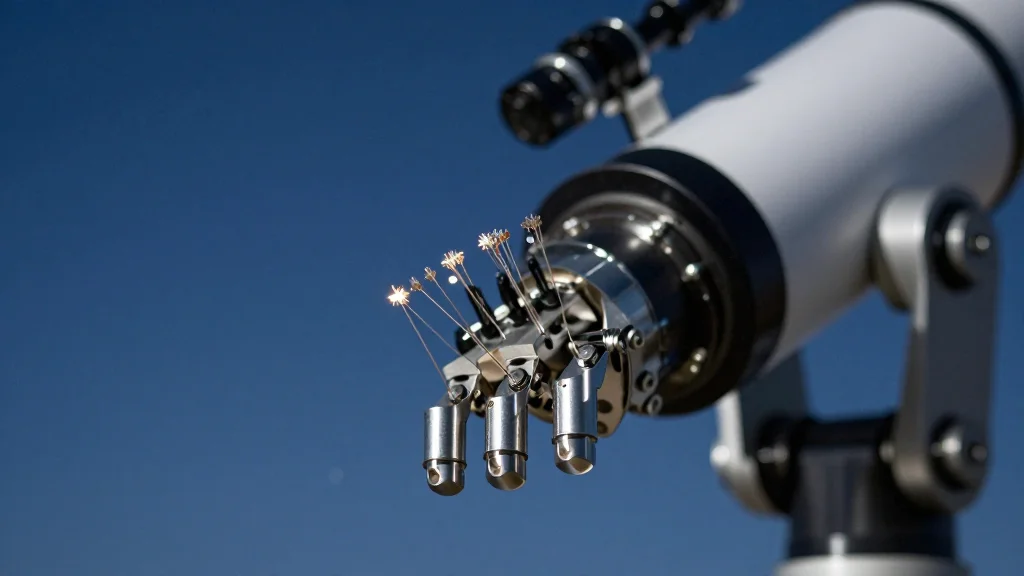
DESI Telescope Deploys 5,000 Robotic Fingers to Map Dark Energy

Why It Matters
DESI’s robotic fingers prove that autonomous, high‑precision actuation can sustain continuous, high‑volume data collection without human intervention. This breakthrough lowers operational costs for large observatories and reduces the risk of human error, setting a new standard for how complex scientific instruments are built and run. The technology also showcases a scalable model for other sectors that demand micrometer‑level accuracy at scale, potentially accelerating automation in manufacturing, aerospace, and healthcare. For the cosmology community, the robotic platform directly enabled a data set that challenges the long‑standing assumption of a constant dark energy. By delivering unprecedented measurement fidelity, DESI forces theorists to revisit models of cosmic expansion, influencing funding priorities and research directions for the next decade of fundamental physics.
Key Takeaways
- •DESI uses 5,000 robotic fingers to position fiber optics with micrometer precision.
- •The system has surveyed 14 million galaxies over three years, generating ~30 TB of data per night.
- •March 2025 results hint that dark energy may be evolving, sparking renewed theoretical debate.
- •Robotic autonomy reduces manual alignment time from hours to seconds, boosting survey efficiency.
- •Future telescopes (Rubin, Euclid) are adopting similar robotic fiber positioning technologies.
Pulse Analysis
DESI’s deployment of thousands of micro‑actuators marks a turning point in how large‑scale scientific instruments achieve precision. Historically, spectroscopic surveys relied on manual fiber placement or limited robotic units, constraining the number of simultaneous observations. By scaling to 5,000 independent fingers, DESI has shattered that ceiling, delivering a data throughput that rivals commercial data centers. This shift mirrors trends in other industries where modular, distributed robotics replace monolithic, centrally‑controlled systems, offering resilience and flexibility.
The cosmological implications are equally profound. The instrument’s ability to capture high‑quality spectra across a massive swath of the sky has produced a data set that directly challenges the ΛCDM model’s assumption of a static dark energy term. While the statistical significance remains under debate, the mere fact that a robotic platform enabled such a paradigm‑shifting observation underscores the strategic value of investing in advanced automation for fundamental research.
Looking ahead, the lessons from DESI will inform the design of next‑generation observatories. Engineers will likely prioritize modular robotic arrays that can be upgraded in situ, extending instrument lifespans and reducing downtime. Moreover, the operational data—logs of finger movements, error rates, and maintenance cycles—will become a valuable resource for the broader robotics community, offering real‑world performance benchmarks that are rarely available from laboratory tests. In short, DESI is not just mapping the universe; it is mapping a future where autonomous precision robotics are integral to scientific discovery.
DESI Telescope Deploys 5,000 Robotic Fingers to Map Dark Energy
Comments
Want to join the conversation?
Loading comments...