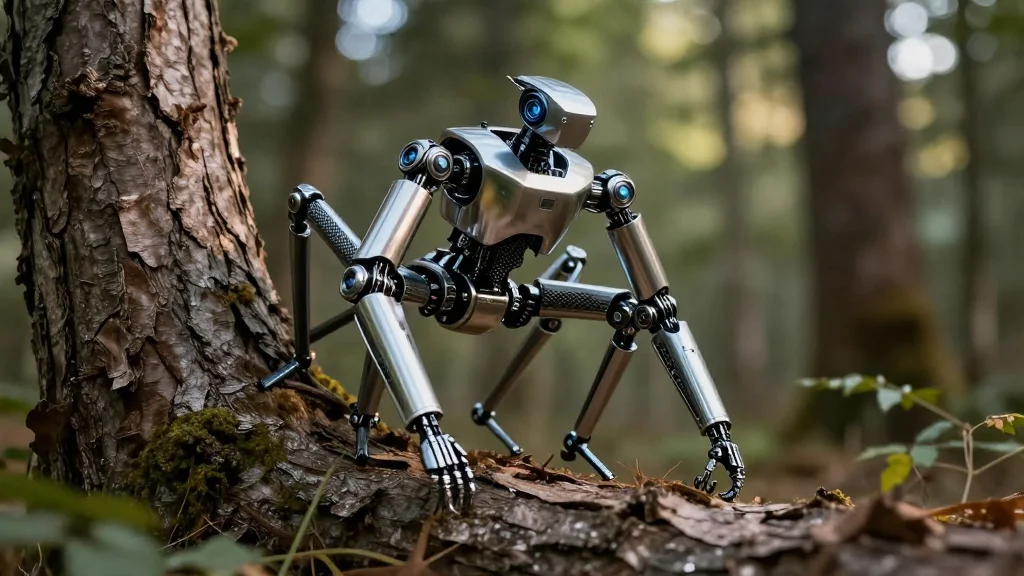
Duke Researchers Unveil Argus, a 20‑Legged Robot Scoring 0.91 on Dynamic Isotropy

Why It Matters
Argus challenges the prevailing assumption that robot agility must be achieved by mimicking specific animals. By grounding design in dynamic isotropy, the research offers a quantitative framework for comparing and creating new robot bodies, potentially accelerating innovation across sectors that demand robust, terrain‑agnostic machines. If the approach scales, it could lower development costs and simplify control software, making advanced field robots more accessible to smaller firms and research labs. Moreover, the prototype’s ability to maintain operation after leg damage hints at inherent fault tolerance, a critical attribute for missions where maintenance is impossible. This could reshape how defense, disaster‑response, and space agencies evaluate platform resilience, influencing procurement and mission planning.
Key Takeaways
- •Argus features 20 telescoping legs, each costing $300.
- •Dynamic isotropy score of 0.91, near the theoretical maximum of 1.
- •Robot can carry a 10‑pound (4.5 kg) payload and climb vertical surfaces.
- •Over 1,500 simulations guided the design, focusing on symmetry rather than biomimicry.
- •Tests showed continued operation after three leg failures and ability to push a 1‑meter cube.
Pulse Analysis
The Argus breakthrough underscores a paradigm shift from biologically inspired to mathematically derived robot architectures. Historically, robotics has leaned on familiar animal forms to solve locomotion challenges, but those designs inherit the directional biases of their biological counterparts. By quantifying isotropy, Duke’s team provides a metric that can be directly optimized, opening a design space previously unexplored.
From a market perspective, the low per‑leg cost and modularity could democratize multi‑leg platforms. Companies that have struggled with the high expense of custom leg mechanisms may adopt a standardized 20‑leg kit, accelerating product cycles. However, scaling the design will require advances in lightweight materials and power efficiency; the current prototype’s payload is modest, and battery life was not disclosed.
Looking ahead, the real test will be integration into mission‑critical systems. If Argus‑style robots can demonstrate reliability in harsh environments—such as offshore wind turbine inspections or lunar regolith traversal—they could become the new baseline for field robotics. The study also invites competition: other labs may now benchmark their designs against the isotropy score, potentially sparking a wave of research focused on symmetry optimization rather than incremental hardware tweaks.
Duke Researchers Unveil Argus, a 20‑Legged Robot Scoring 0.91 on Dynamic Isotropy
Comments
Want to join the conversation?
Loading comments...