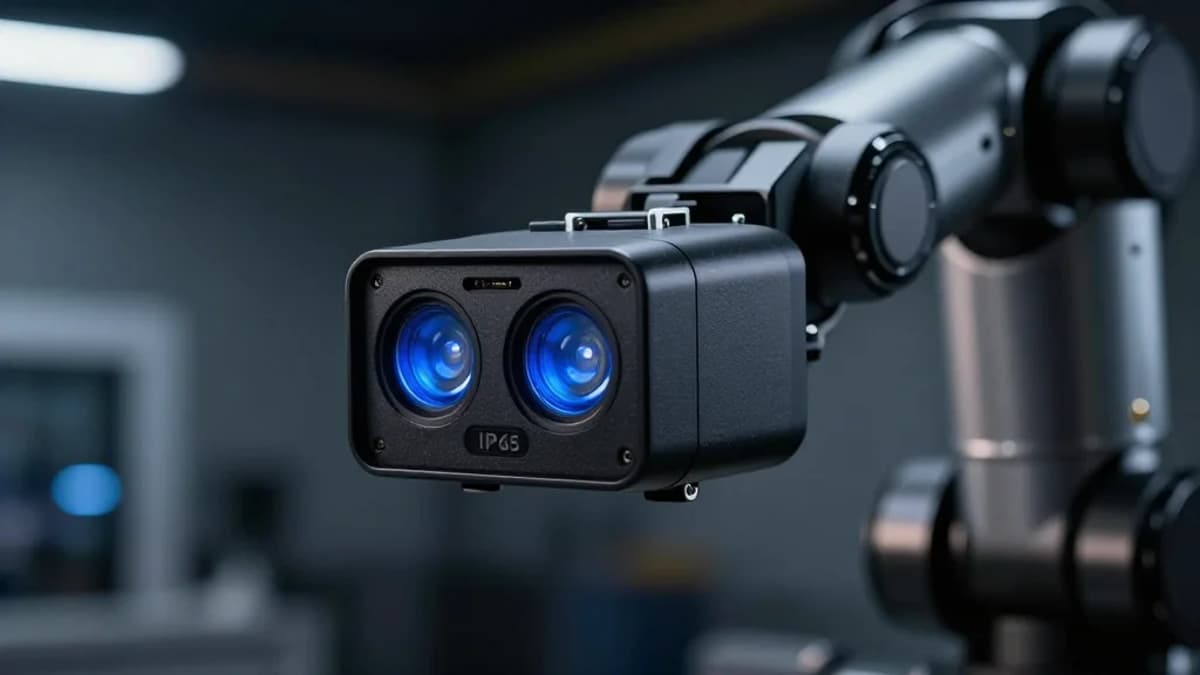
E-Con Systems Launches DepthVista Helix 3D CW iToF Camera for Robotics and Industrial Automation
•February 18, 2026
0
Why It Matters
Precise, low‑latency 3‑D perception is essential for autonomous robots handling complex tasks, and the Helix’s accuracy and interference mitigation enable reliable operation in crowded warehouse environments. This makes e‑con a strategic supplier for next‑generation robotic vision systems.
Key Takeaways
- •<1% depth deviation across 0.2‑2 m range.
- •1.2 MP depth at 60 fps, IP67 sealed.
- •Dual VCSEL reduces interference in multi‑robot setups.
- •Seamless integration with NVIDIA Jetson Orin platforms.
- •SDK provides Linux drivers, visualization, and sample apps.
Pulse Analysis
The industrial robotics market is rapidly embracing time‑of‑flight (ToF) imaging as a cornerstone for reliable 3‑D perception. Continuous‑Wave iToF sensors, such as the one embedded in e‑con’s DepthVista Helix, offer high‑resolution depth data without the latency penalties of pulsed systems. This technology aligns with the broader shift toward edge‑compute vision, where compact, power‑efficient cameras feed real‑time geometry to AI models running on platforms like NVIDIA Jetson. By delivering dense point clouds at 60 fps, the Helix addresses the growing demand for precise obstacle detection and object manipulation in dynamic warehouse and manufacturing settings.
Beyond raw sensor performance, the Helix distinguishes itself through a dual VCSEL illumination architecture that actively mitigates multi‑camera interference—a common challenge in multi‑robot deployments. The IP67‑rated enclosure and flexible GMSL2, MIPI, and USB interfaces simplify rugged integration across diverse robotic platforms. Coupled with the DepthVista SDK, developers gain immediate access to V4L2‑based Linux drivers, depth‑confidence filtering tools, and reference applications for pose estimation, dramatically shortening the prototype‑to‑production timeline. This software‑hardware synergy reduces engineering overhead and enables faster iteration on vision‑driven use cases such as bin‑picking, palletisation, and smart agriculture.
Strategically, the Helix positions e‑con Systems as a pivotal player in the convergence of embedded vision and autonomous automation. As manufacturers seek scalable, cost‑effective depth solutions, the camera’s compatibility with NVIDIA Orin series processors ensures it can be embedded in high‑performance compute stacks without extensive redesign. Competitors offering lower‑resolution or single‑frequency ToF modules may struggle to match the Helix’s blend of precision, robustness, and developer support. Consequently, the product is likely to accelerate adoption of advanced robotic vision across logistics, material handling, and safety‑critical applications, reinforcing the trend toward fully autonomous, AI‑driven factories.
e-con Systems Launches DepthVista Helix 3D CW iToF Camera for Robotics and Industrial Automation
0
Comments
Want to join the conversation?
Loading comments...