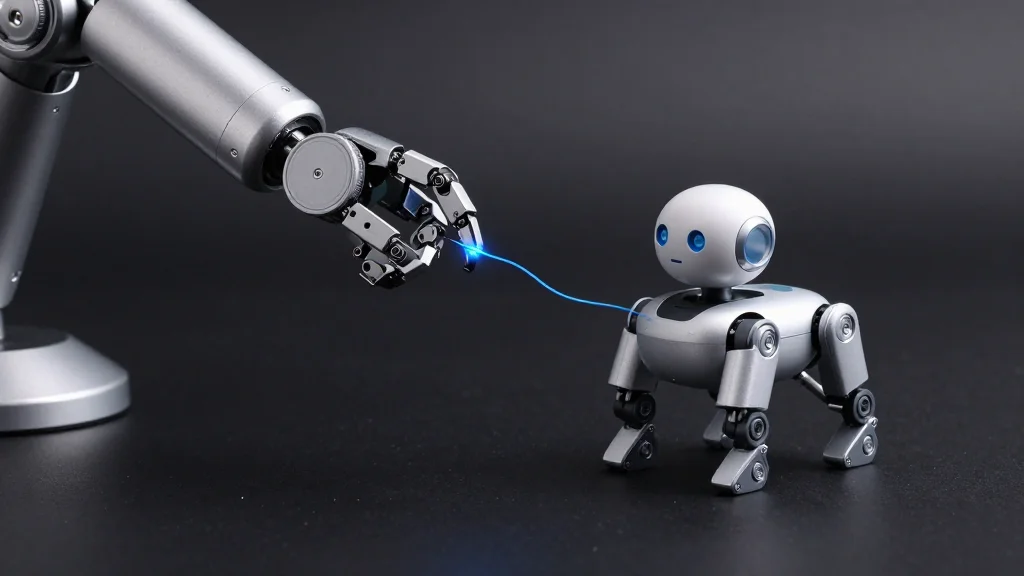
EPFL Unveils Kinematic Intelligence Framework for Zero‑Shot Robot Skill Transfer

Companies Mentioned
Why It Matters
Cross‑platform skill transfer addresses a long‑standing bottleneck in robotics: the high cost of retraining or re‑programming each new robot model. By abstracting task intent from hardware specifics, EPFL’s framework can accelerate deployment of advanced manipulation in high‑mix, low‑volume production, where frequent robot changes are common. Service robots, too, stand to benefit; a household assistant could learn a new cleaning motion on one platform and instantly apply it to a different chassis, expanding the market for modular robot ecosystems. Beyond immediate efficiency gains, the technology could catalyze a new wave of robot‑as‑a‑service offerings. Cloud‑based skill libraries could be curated, validated once, and then downloaded to any compatible edge device, lowering the barrier for small and medium‑size enterprises to adopt sophisticated automation without deep AI expertise.
Key Takeaways
- •Zero‑shot skill transfer achieved with 91.4% success rate on cross‑platform tasks
- •Skill degradation reduced by 63% compared with standard behavior cloning
- •Inference latency under 8 ms per trajectory step on edge NPUs
- •Framework released open‑source under Apache 2.0 with ROS 2 Humble support
- •Funded by Swiss National Science Foundation; hardware donated by Franka Emika
Pulse Analysis
The Kinematic Intelligence framework arrives at a moment when manufacturers are wrestling with the cost of robot heterogeneity. Historically, each new arm required a bespoke control stack, inflating integration budgets and extending time‑to‑value. EPFL’s latent‑space approach sidesteps this by treating the robot as a conduit rather than a constraint, echoing the software‑defined networking paradigm that decoupled network functions from hardware. This conceptual shift could democratize advanced manipulation, allowing smaller players to tap into a shared pool of learned behaviors.
From a competitive standpoint, the open‑source release forces incumbents—such as ABB, KUKA and Fanuc—to either adopt the framework or accelerate their own proprietary solutions. Companies that already provide middleware (e.g., ROS‑Industrial, Open Robotics) are well‑positioned to embed Kinematic Intelligence into their stacks, potentially creating a de‑facto standard for skill portability. Meanwhile, hardware vendors may respond by offering tighter integration with the framework, marketing their robots as "plug‑and‑play" for any learned task.
Looking ahead, the biggest test will be scaling beyond controlled lab environments. Real‑world factories introduce variability in payload, compliance and sensor noise that could stress the latent representation. If EPFL’s approach proves robust, we could see a cascade of third‑party skill marketplaces, where developers sell verified manipulation policies much like app stores today. That would fundamentally alter the economics of robotics, turning skill development into a scalable, recurring revenue stream and accelerating the broader adoption of automation across sectors.
EPFL Unveils Kinematic Intelligence Framework for Zero‑Shot Robot Skill Transfer
Comments
Want to join the conversation?
Loading comments...