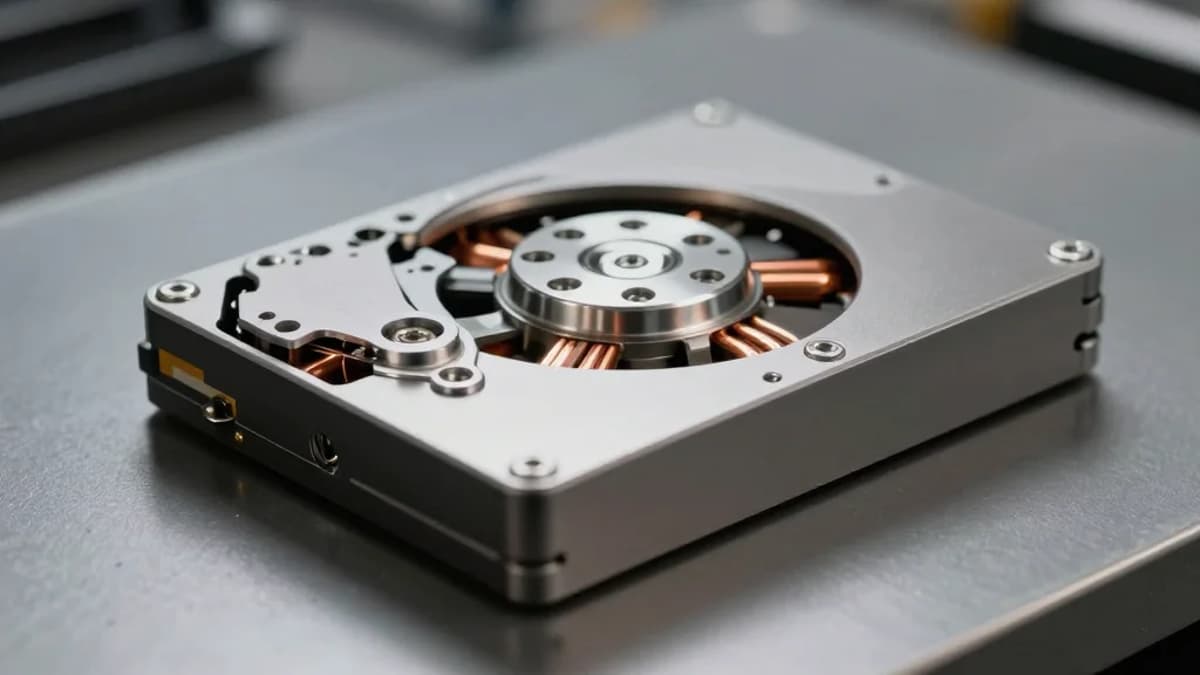
FAULHABER BXI: Made for the Next Generation of Robotics
•March 10, 2026
0
Why It Matters
The BXI’s high torque density and compact integration enable next‑generation robots to achieve human‑like dexterity without sacrificing space or efficiency, accelerating advanced automation adoption.
Key Takeaways
- •BXI delivers up to 20 Nm torque in 34 mm length
- •Integrated motor, planetary gear, and 15‑bit encoder form compact unit
- •Operates up to 50 V, suitable for high‑power‑density robots
- •Flat aluminum housing provides corrosion resistance and thermal dissipation
- •Seamless integration with FAULHABER MC5010 controller simplifies commissioning
Pulse Analysis
Robotic platforms are increasingly demanding drive solutions that combine high torque, precision, and minimal footprint. The FAULHABER BXI addresses this trifecta by leveraging an internal‑rotor architecture with 21 pole pairs and an iron‑core winding, which yields a low cogging torque and exceptional torque density. Its 20 Nm output at just 34 mm length translates to faster joint acceleration and finer motion control, essential for applications ranging from delicate gripping to full‑body humanoid articulation. By operating across a 0‑50 V range, the BXI fits seamlessly into diverse power architectures while maintaining robust performance.
Beyond raw specifications, the BXI’s value lies in its system‑level integration. The unit bundles a stepped planetary gearhead and a 15‑bit SSI absolute encoder within a flat aluminum housing, eliminating the need for separate components and reducing assembly complexity. This integrated approach not only frees valuable space but also improves thermal management and corrosion resistance, extending service life in demanding environments. When paired with FAULHABER’s MC5010 motion controller and Motion Manager software, engineers benefit from plug‑and‑play commissioning, real‑time torque monitoring, and advanced compensation algorithms, accelerating development cycles for precision‑critical robots.
The launch of the BXI signals a broader shift toward compact, high‑performance actuation in the robotics market. As manufacturers pursue more anthropomorphic designs and tighter form factors, drive systems that deliver maximum power in minimal volume become a competitive differentiator. FAULHABER’s solution positions it to capture a growing share of sectors such as collaborative robots, autonomous mobile platforms, and medical exoskeletons, where every millimeter and gram counts. The BXI’s blend of torque density, integration ease, and software support sets a new benchmark for future‑ready robotic actuation.
FAULHABER BXI: Made for the Next Generation of Robotics
0
Comments
Want to join the conversation?
Loading comments...