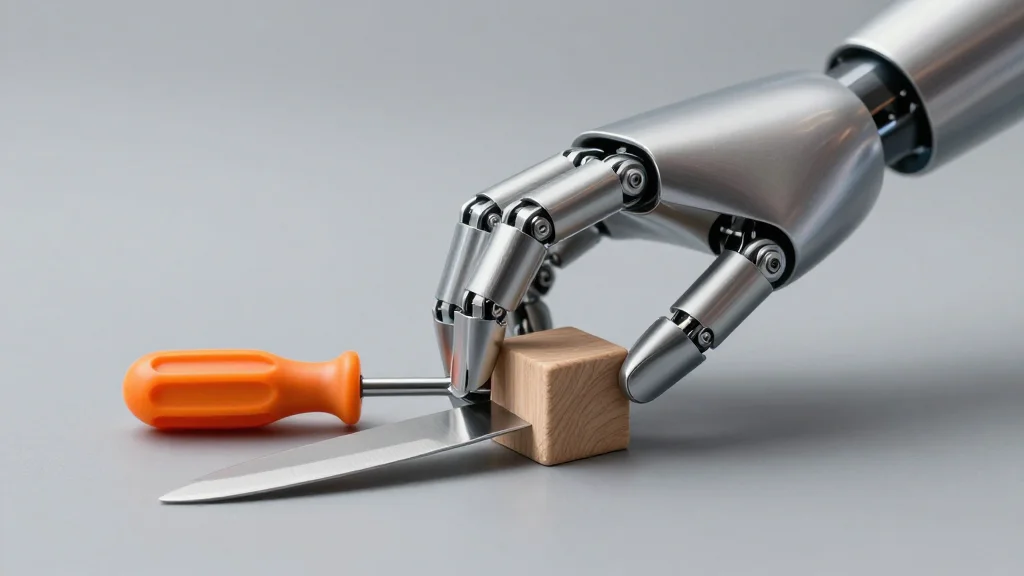
FingerEye Bridges Touch and Vision to Improve Robot Handling Before and After Contact
Companies Mentioned
Why It Matters
By providing seamless pre‑contact visual cues and post‑contact tactile feedback, FingerEye closes a critical perception gap, allowing robots to execute more reliable and adaptable manipulation in unstructured environments, a key hurdle for service and industrial automation.
Key Takeaways
- •FingerEye fuses binocular RGB vision with tactile ring for continuous perception
- •Open‑source design enables rapid replication and customization by researchers
- •Demonstrated dexterous tasks: chip picking, coin standing, syringe manipulation
- •Vision‑tactile imitation learning reduces real‑world data needed for training
Pulse Analysis
Dexterous manipulation has long been the Achilles’ heel of robotic automation, because most platforms rely on either vision or tactile sensing, but rarely both in a unified stream. Conventional tactile sensors such as GelSight only activate after contact, forcing planners to guess the optimal approach trajectory. FingerEye disrupts this paradigm by embedding two miniature RGB cameras that deliver implicit stereo depth alongside a soft ring whose deformation is captured through marker‑based pose estimation. The result is a continuous perception loop that mirrors human fingertip sensing, giving robots foresight and feedback in a single package.
The sensor’s hardware is deliberately compact and cost‑effective, making it suitable for integration on standard grippers without major redesign. Coupled with a vision‑tactile imitation‑learning policy, FingerEye can infer contact wrenches and adjust grip forces on the fly, dramatically reducing the amount of real‑world demonstration data required for training. The research team also released a digital twin and full codebase on GitHub, lowering the barrier for academic and industrial groups to experiment with multimodal perception. This open‑source ethos accelerates the diffusion of advanced tactile‑visual fusion across the robotics community.
With continuous perception, robots become viable for high‑precision service roles such as home assistance, surgical tool handling, and flexible assembly lines where object variability is the norm. By eliminating the need for separate pre‑contact vision rigs and post‑contact tactile pads, manufacturers can simplify hardware stacks and lower total cost of ownership. Competitors are now racing to embed similar multimodal sensors, but FingerEye’s open design gives early adopters a strategic edge. Future iterations that add haptic actuation or higher‑resolution cameras could push robotic dexterity toward human‑level performance, reshaping automation economics.
FingerEye bridges touch and vision to improve robot handling before and after contact
Comments
Want to join the conversation?
Loading comments...