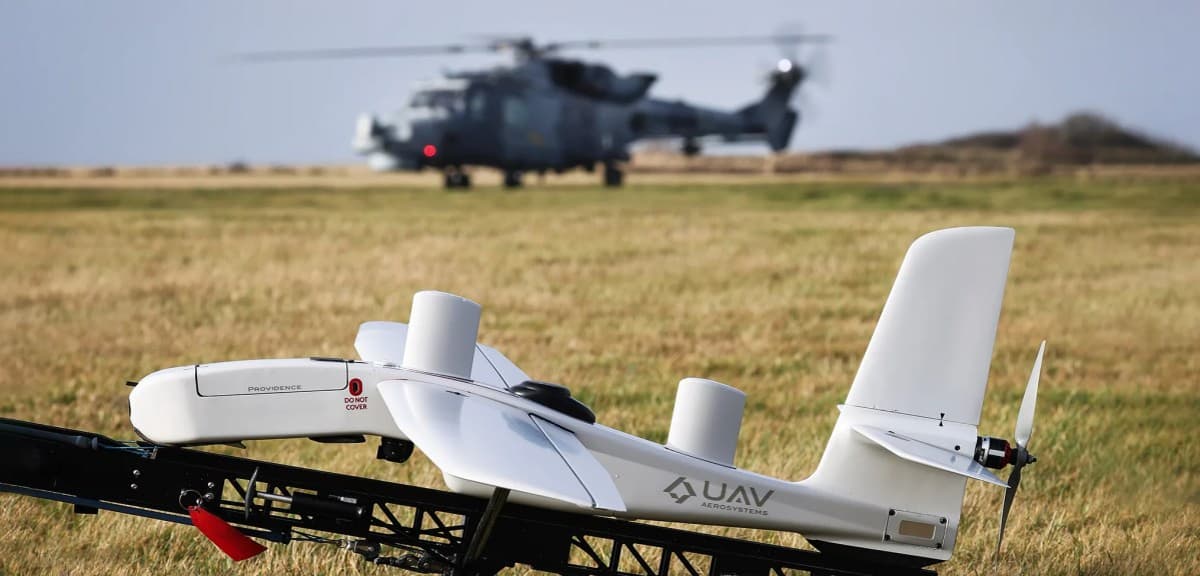
For the First Time Royal Navy Helicopters Have Used Live Data From Multiple Drones to Target a Moving Vehicle
•February 1, 2026
0

Companies Mentioned


Why It Matters
The capability gives the Royal Navy real‑time situational awareness and strike coordination across dispersed platforms, accelerating adoption of crew‑less‑crewed teaming in NATO operations.
Key Takeaways
- •Wildcat integrated live feeds from Puma and Providence drones.
- •Mesh network enabled beyond‑line‑of‑sight targeting.
- •Hybrid air wing concept links crewed and uncrewed assets.
- •Interoperability improves with universal translator for sensor interfaces.
- •Future exercises in Norway will test tactics against fast‑attack craft.
Pulse Analysis
The Royal Navy’s recent Eagles Eye trial marks a watershed moment in battlefield networking, as a Wildcat helicopter received live video and telemetry from a Puma and a Providence drone through a decentralized mesh architecture. Mesh networks, first fielded at scale in Ukraine, automatically reroute data around damaged nodes, ensuring continuous connectivity even under electronic attack. By fusing aerial, ground‑based and unmanned sensors into a single data stream, the system eliminates latency that traditionally hampers beyond‑line‑of‑sight targeting, delivering commanders a persistent, high‑resolution picture of the battlespace.
Beyond pure data sharing, the trial showcases the emerging ‘hybrid air wing’ concept, where manned platforms serve as mobile command hubs for swarms of drones. The Wildcat crew could not only view feeds but also task the Puma and Providence, coordinating Martlet missile strikes on a moving vehicle without direct line of sight. This level of integration reduces the sensor‑to‑shooter loop, enhances survivability by keeping high‑value assets out of the threat envelope, and creates a modular architecture that can be scaled to larger fleets or allied forces.
Looking ahead, the Royal Navy plans to embed these tactics in a Norway exercise, pairing Wildcats with Norwegian vessels to counter fast‑attack craft in fjord environments. The mesh‑enabled interoperability also aligns with NATO’s push for joint unmanned‑air systems, allowing British, American and European drones to exchange data seamlessly. As more services adopt the universal translator approach, procurement cycles shorten and legacy integration costs fall, positioning the UK as a leader in network‑centric warfare and setting a template for future coalition operations.
For the first time Royal Navy helicopters have used live data from multiple drones to target a moving vehicle
0
Comments
Want to join the conversation?
Loading comments...