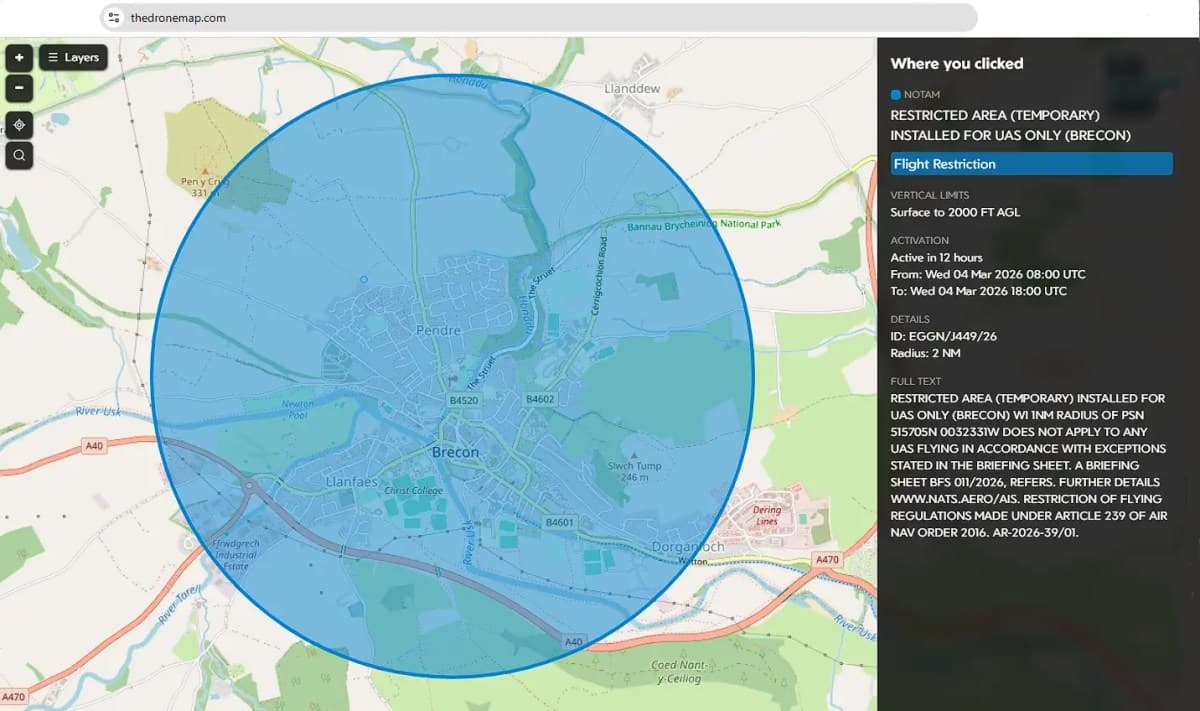
Formal Complaint – Late Publication/Notification of UAS-Only RA(T), Brecon, Powys (04 March 2026) – SkyWise SW2026/057 / BFS 011/2026
•March 3, 2026
0

Companies Mentioned
Why It Matters
Late‑notice airspace restrictions penalise compliant operators, raise safety risks, and weaken the credibility of the CAA’s notification system.
Key Takeaways
- •RA(T) issued <24h before activation.
- •Restriction limited to UAS, 1 NM radius, 2000 ft ceiling.
- •Late notice forces cancellations, adds costs for operators.
- •Pattern of short‑notice UAS restrictions identified.
- •Complaint calls for 7‑14 day minimum notice policy.
Pulse Analysis
Regulatory bodies such as the UK Civil Aviation Authority rely on platforms like SkyWise to disseminate temporary airspace restrictions, especially for unmanned aircraft systems (UAS). In theory, these notices give operators sufficient time to adjust flight plans, conduct risk assessments, and secure any required permissions. The Brecon, Powys restriction tied to a Royal visit illustrates a breakdown in that process: a notice issued on 3 March for a restriction effective the following day left operators with virtually no planning horizon, contravening best‑practice expectations for advance warning.
For commercial drone operators, the financial and logistical implications of a sub‑day notice are significant. Flights are often booked weeks in advance, involving crew deployment, equipment transport, client contracts, and insurance coverage. A sudden prohibition forces cancellations, re‑booking fees, and potential breach of service‑level agreements, while still obligating operators to monitor compliance. Moreover, the asymmetry created by last‑minute alerts may inadvertently encourage non‑compliant behaviour, as malicious actors are less likely to be deterred by a notice they cannot feasibly act upon before the restriction begins.
Industry stakeholders have repeatedly called for a standardized minimum notice period—commonly 7 to 14 days—for planned UAS‑only temporary restrictions, with a two‑stage alert system that provides an early warning followed by final details. Implementing such a framework would improve operational certainty, reduce unnecessary costs, and reinforce the safety culture that underpins airspace management. Clear KPIs for notification timeliness and a transparent complaints pathway would further enhance trust between regulators and the burgeoning UAS sector, ensuring that safety measures do not become a source of disruption.
Formal complaint – Late publication/notification of UAS-only RA(T), Brecon, Powys (04 March 2026) – SkyWise SW2026/057 / BFS 011/2026
0
Comments
Want to join the conversation?
Loading comments...