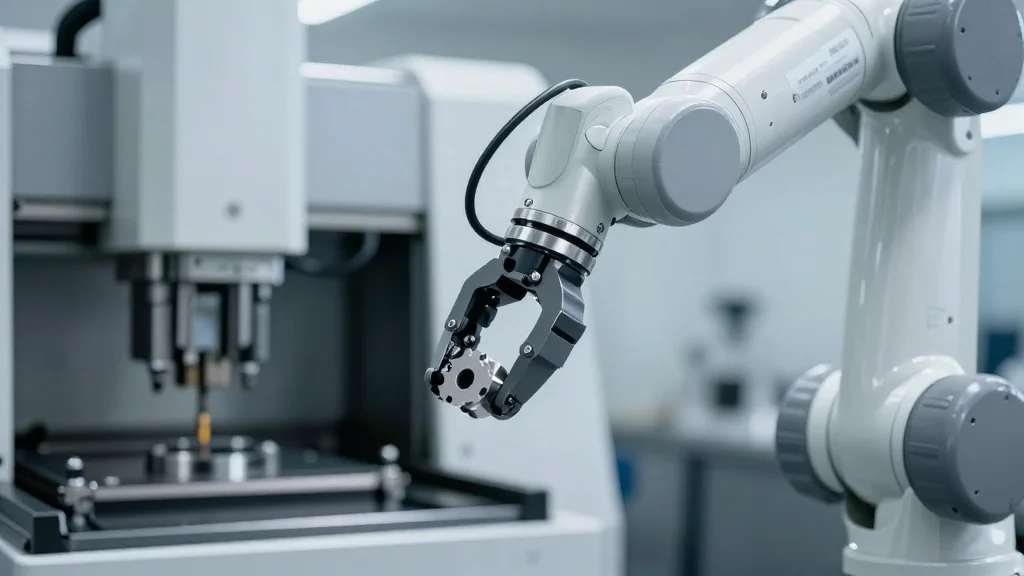
Fortuna Metals Rolls Out Precision‑Manufacturing Service Line for Global Robotics

Why It Matters
The robotics industry is moving from bespoke, low‑volume builds to mass‑produced, AI‑driven machines that require components with micron‑level precision. Fortuna Metals’ end‑to‑end service reduces the number of suppliers a robotics firm must manage, lowering logistical complexity and risk of supply‑chain disruptions. By offering tighter tolerances and faster turnaround, the service can accelerate product launches, giving manufacturers a competitive edge in markets where speed and performance are critical. Moreover, the company’s global footprint and ISO certifications provide a trusted platform for multinational robotics firms seeking consistent quality across regions. As demand for lightweight, high‑strength components grows—particularly in collaborative and service robots—Fortuna Metals’ material expertise and in‑mold riveting capability could become a decisive factor in cost‑effective scaling.
Key Takeaways
- •Fortuna Metals launches a closed‑loop precision‑manufacturing service for robotics hardware
- •Facility operates 85 high‑speed stamping presses and 42 multi‑axis CNC machines
- •Machining tolerances of ±0.01 mm and concentricity within 0.005 mm on critical parts
- •Proprietary in‑mold riveting runs at 100 cycles per minute, cutting assembly steps
- •ISO 9001, IATF 16949 and ROHS certifications ensure traceable, high‑quality output
Pulse Analysis
Fortuna Metals’ move signals a broader shift in the robotics supply chain from fragmented, component‑by‑component sourcing to integrated manufacturing platforms. Historically, robotics OEMs have relied on a patchwork of specialty shops, each adding lead time and cost variance. By consolidating DFM, prototyping, stamping and CNC machining under one roof, Fortuna Metals reduces hand‑off friction and creates a more predictable cost structure. This mirrors trends seen in the automotive sector, where tier‑one suppliers have built similar end‑to‑end capabilities to meet the demands of electric‑vehicle production.
The company’s emphasis on ultra‑tight tolerances addresses a pain point for AI‑driven robots that depend on precise sensor alignment and repeatable joint motion. As robot vision and force‑feedback systems become more sophisticated, even sub‑micron deviations can degrade performance. Fortuna Metals’ ±0.01 mm tolerance and 0.005 mm concentricity are competitive benchmarks that could attract high‑value contracts from firms developing collaborative robots for manufacturing and logistics.
Looking forward, the integration of additive manufacturing could further differentiate Fortuna Metals. Hybrid workflows that combine stamping for bulk structures with 3D‑printed lattice inserts would enable weight‑optimized designs that are currently difficult to achieve with conventional machining alone. If the company can successfully blend these technologies while maintaining its rapid response promise, it could set a new standard for supply‑chain resilience in a sector where component shortages have repeatedly stalled product rollouts.
Fortuna Metals Rolls Out Precision‑Manufacturing Service Line for Global Robotics
Comments
Want to join the conversation?
Loading comments...