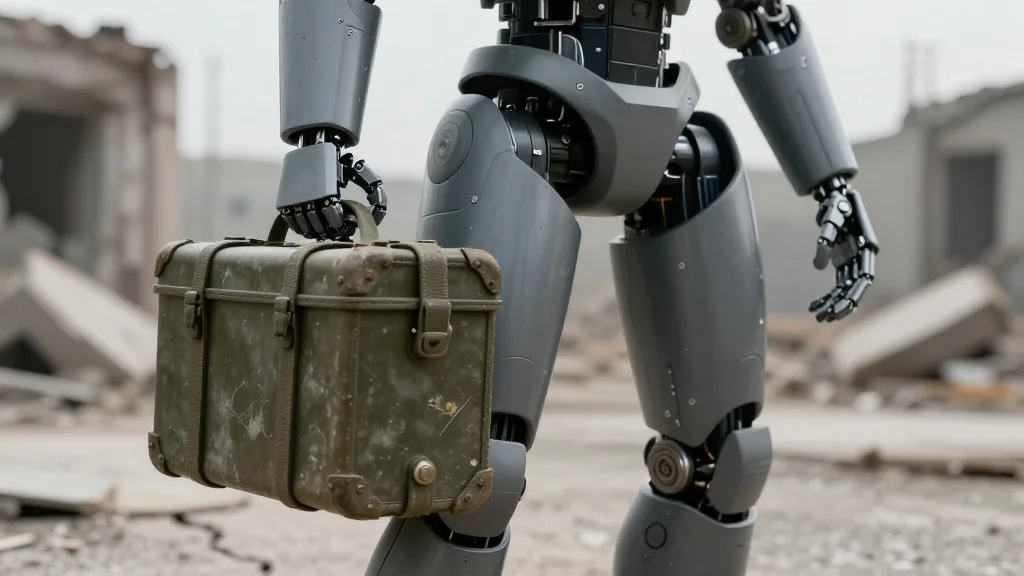
Foundation Tests Humanoid Combat Robots in Ukraine, Secures $24M Pentagon Deal

Companies Mentioned
Why It Matters
If Foundation’s humanoid robots can reliably perform logistics tasks under fire, militaries could reduce soldier exposure to high‑risk missions, potentially saving lives and lowering operational costs. The technology also forces policymakers to confront the ethical line between autonomous support and lethal autonomy, shaping future rules of engagement. Successful deployment would accelerate a broader shift toward humanoid platforms that can navigate complex, human‑scaled environments—something wheeled or tracked robots struggle with—thereby expanding the scope of robotic warfare beyond drones and unmanned ground vehicles.
Key Takeaways
- •Foundation sent two Phantom humanoid robots to Ukraine for a supply‑pickup pilot in February.
- •The company secured a $24 million contract with the U.S. Pentagon for further development.
- •CEO Sankaet Pathak highlighted the need for a reliable, lightweight, and affordable dexterous hand.
- •Eric Trump was named chief strategy advisor in March, adding political clout to the effort.
- •Foundation projects fully autonomous combat missions could be viable within five to ten years.
Pulse Analysis
Foundation’s Ukraine test marks a rare instance of a civilian‑origin startup gaining direct access to an active combat zone. Historically, humanoid robotics have been confined to research labs; this field trial suggests a maturing technology stack capable of navigating stairs, uneven terrain, and cluttered interiors—tasks that traditional unmanned ground vehicles cannot perform. The Pentagon’s $24 million commitment reflects a strategic hedge: rather than waiting for legacy defense contractors to catch up, the U.S. is betting on agile innovators to fill capability gaps in logistics and, eventually, combat support.
From a market perspective, the move could catalyze a new segment of defense spending focused on bipedal platforms. Companies that master reliable manipulation and power density will likely secure follow‑on contracts, while those that lag may be relegated to niche civilian applications. The ethical dimension cannot be ignored; as Pathak acknowledges, human oversight will remain a prerequisite for lethal actions, but the line between “support” and “combat” can blur quickly. Regulatory frameworks will need to evolve in step with the technology to prevent an arms race in humanoid soldiers.
Looking ahead, the key determinants of success will be battery technology breakthroughs, cost‑effective manufacturing of dexterous hands, and demonstrable reliability under battlefield stressors. If Foundation can deliver a field‑tested, survivable platform within the next two years, it could set the standard for a generation of humanoid systems, reshaping how armies think about force protection and mission execution.
Foundation Tests Humanoid Combat Robots in Ukraine, Secures $24M Pentagon Deal
Comments
Want to join the conversation?
Loading comments...