From Backflips to Folding Laundry: How X Square Robot Is Building the Missing ‘Brain’ for Embodied AI
Companies Mentioned
Why It Matters
The stack tackles the intelligence and data bottlenecks that have limited robot deployment, accelerating the shift toward practical, adaptable automation in homes and factories.
Key Takeaways
- •X Square open‑sourced Wall‑OSS‑0.5 VLA model for zero‑shot robot tasks
- •WALL‑WM aligns perception, language, and actions around physical events
- •XRZero‑G0 reduces data costs by mixing robot‑free and real demos
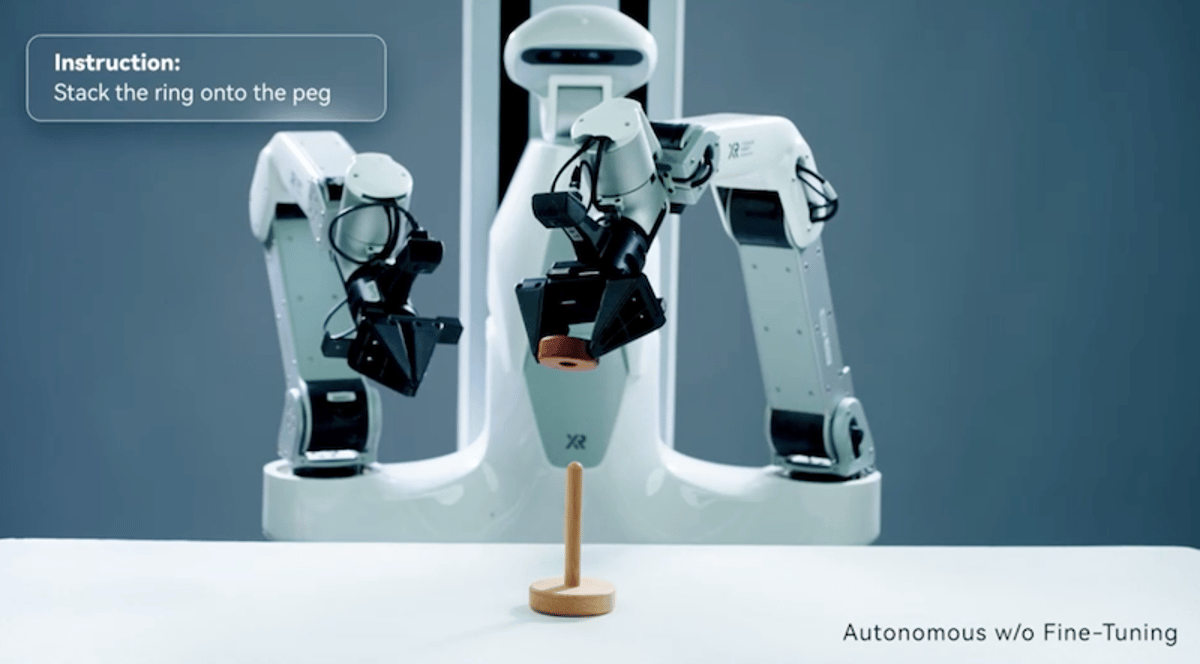
- •Pretrained VLA model succeeded on 17 real‑world manipulation tasks
- •Company released 2,000+ hours of multimodal data covering 3,000 tasks
Pulse Analysis
Embodied artificial intelligence has long been hampered by a mismatch between advanced hardware and limited cognitive capabilities. While companies showcase humanoid acrobatics, the real commercial value lies in robots that can navigate cluttered homes, warehouses, and factories. X Square Robot’s recent announcements signal a strategic pivot: providing the software “brain” that can interpret, plan, and act in unpredictable environments. By open‑sourcing its core models, the firm invites the broader research community to iterate on a shared foundation, potentially accelerating breakthroughs that hardware alone cannot achieve.
The three open‑source components form a cohesive pipeline. Wall‑OSS‑0.5 introduces a vision‑language‑action architecture that learns action tokens alongside visual and linguistic cues, enabling zero‑shot task execution across 17 diverse manipulation scenarios. WALL‑WM builds on this by reframing robot behavior around discrete physical events—reaching, grasping, lifting—allowing the system to predict outcomes and adapt when plans fail. XRZero‑G0 tackles the data scarcity problem by combining wearable, multi‑view capture with automated quality checks, showing that ten robot‑free demonstrations plus one real demo can match fully robot‑generated datasets. Together, they address perception, reasoning, and data efficiency in a single stack.
For industry stakeholders, the implications are immediate. Lower data acquisition costs and reusable foundation models reduce time‑to‑market for service robots, making deployments in logistics, elder‑care, and domestic assistance more economically viable. The release of over 2,000 hours of multimodal data also creates a valuable benchmark for academia and startups, fostering competition that could compress the timeline for truly autonomous, adaptable robots. As enterprises seek to replace manual labor with intelligent automation, X Square’s brain‑first approach may become a cornerstone of the next wave of commercial robotics.
From backflips to folding laundry: How X Square Robot is building the missing ‘brain’ for embodied AI
Comments
Want to join the conversation?
Loading comments...