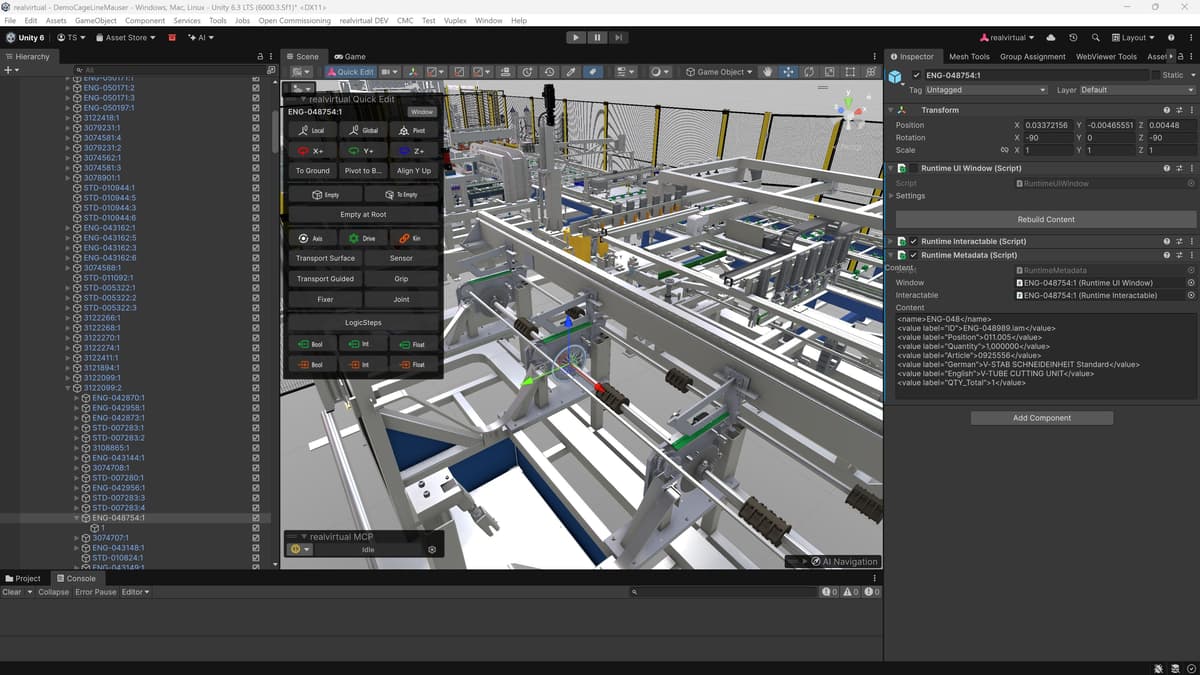
From Digital Twins to Industrial AI: Building the Machine Information System
Companies Mentioned
Why It Matters
By turning digital twins into operational hubs, manufacturers can cut support costs, mitigate workforce shortages, and unlock reliable industrial AI, giving OEMs and integrators a competitive edge in a rapidly digitizing market.
Key Takeaways
- •Digital twins shift from 3D visualization to operational data hubs
- •Structured documentation enables faster fault diagnosis and AI grounding
- •MCP standardizes AI access to live machine state and enterprise data
- •Unity and browser runtimes simplify building machine information systems
- •Grounded AI reduces integration effort and supports remote expert assistance
Pulse Analysis
The evolution of digital twins reflects a broader industry push to tame growing system complexity. While early twins served mainly as visual replicas, today’s manufacturers demand a unified view that fuses real‑time sensor streams, production schedules, and legacy documentation. European Machinery Regulation 2023/1230 accelerates this transition by mandating transparent, maintainable machine data, but the underlying driver is global: tighter margins, skill gaps, and the need for predictive maintenance. By treating the twin as a data‑rich integration layer, firms can streamline troubleshooting and reduce downtime without waiting for fully autonomous factories.
Machine Information Systems (MIS) embody this new paradigm through a four‑layer architecture: live machine signals, MES/production context, structured documentation, and spatial 3‑D context. Standards such as the Asset Administration Shell (AAS) provide a common vocabulary, while platforms like Unity and browser‑based runtimes deliver rapid authoring and cross‑device access. Structured metadata pipelines ensure that every component—from a valve to a robotic arm—carries versioned, searchable information, enabling operators to locate relevant manuals or maintenance histories instantly. This approach not only improves operator efficiency but also lowers integration overhead for system integrators, who can reuse the same data models across projects.
The real breakthrough arrives when this rich, contextual data feeds industrial AI. Large language models (LLMs) can only generate reliable insights if they are grounded in accurate, up‑to‑date machine state and documentation. The Model Context Protocol (MCP) offers a standardized interface that exposes live signals, MES data, and historical knowledge to AI agents, turning them from speculative tools into practical advisors. Grounded AI can suggest corrective actions, prioritize remote support tickets, and even automate routine maintenance tasks, all while preserving human oversight. As the cost of wiring signals and curating metadata falls, organizations that have already built this foundation will be poised to reap the productivity gains of truly intelligent factories.
From digital twins to industrial AI: Building the machine information system
Comments
Want to join the conversation?
Loading comments...