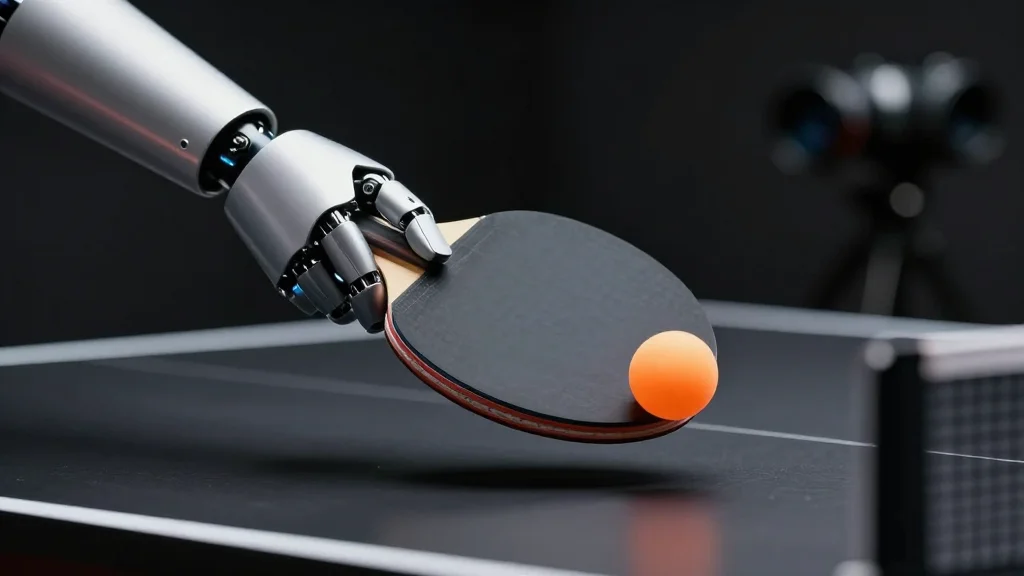
Game, Set, Bot: Sony AI’s ‘Ace’ Serves Up a Defeat to Table Tennis Pros
Why It Matters
Ace proves that simulation‑trained AI can rival human experts in fast, physical interactions, opening pathways for agile robots in industry and beyond.
Key Takeaways
- •Ace beat 3 of 5 elite table‑tennis players.
- •Uses nine APS cameras and event‑based sensors for spin.
- •Trained via deep reinforcement learning in large‑scale simulation.
- •Eight‑degree‑of‑freedom robot reaches 20‑30 m/s ball speed.
- •Tech could accelerate manufacturing and service robotics.
Pulse Analysis
Robotics has long chased the dream of machines that can match human reflexes in dynamic sports, and Sony AI’s “Ace” marks a tangible breakthrough. By leveraging a gaming‑centric AI philosophy—where virtual environments serve as high‑speed testbeds—the team translated lessons from the Gran Turismo racing agent into a physical table‑tennis challenger. The robot’s performance against elite athletes, including three match victories and a consistent 75% ball‑return rate, demonstrates that reinforcement‑learning agents can acquire nuanced motor skills without hand‑crafted code. This milestone underscores the growing convergence of entertainment‑grade AI and real‑world robotics.
The hardware behind Ace is a tour de force of perception and actuation. Nine active‑pixel‑sensor cameras triangulate the ball at 200 Hz, while three gaze‑control subsystems employ event‑based vision and tunable lenses to capture spin exceeding 160 rpm. An asymmetric actor‑critic network, trained in simulation, generates motion commands at 31.25 Hz, which a model‑predictive‑control planner translates into collision‑free trajectories for an eight‑joint arm capable of 20‑30 m/s swings. This tightly coupled sensor‑to‑actuator loop resolves the long‑standing challenge of real‑time spin measurement in table‑tennis.
Beyond the sport, Ace’s architecture points to a versatile template for physical AI across sectors. The same simulation‑first training pipeline could be adapted to assembly lines where robots must react to moving parts, or to service robots navigating crowded environments while handling delicate objects. By proving that high‑speed perception, reinforcement learning, and precise hardware can be harmonized, Sony AI offers a roadmap for next‑generation automation that balances speed, safety, and adaptability. Industry players eye such capabilities to cut costs, improve productivity, and unlock new human‑robot collaboration models.
Game, Set, Bot: Sony AI’s ‘Ace’ Serves Up a Defeat to Table Tennis Pros
Comments
Want to join the conversation?
Loading comments...